
What is tax really for? Most people assume that governments need to collect tax before they can spend. But for a government like that of the UK, which issues its own currency, that is not how the monetary system works.
The UK government creates new money when it spends. Tax then takes money back out of the economy. That means we need to think very differently about why taxation exists.
In this video, I explain six reasons why we need tax.
Tax gives the pound its value because people need pounds to settle their tax liabilities.
Tax helps control inflation by withdrawing spending power from the economy.
It can reduce inequality by redistributing income and wealth.
It can change prices to discourage harmful activities and encourage socially useful ones.
Fair taxation can strengthen democracy by reinforcing the obligations we share as members of society.
And tax is one of the government's most important tools for steering the economy.
Understanding this changes the way we think about government spending, deficits, inflation and economic policy.
Tax is not simply the government's piggy bank. It is one of the most powerful economic policy tools we have.
This video is part of my Understanding Economics series, explaining economics as it actually operates in the world around us.
This is the audio version:
This infographic supports this video:
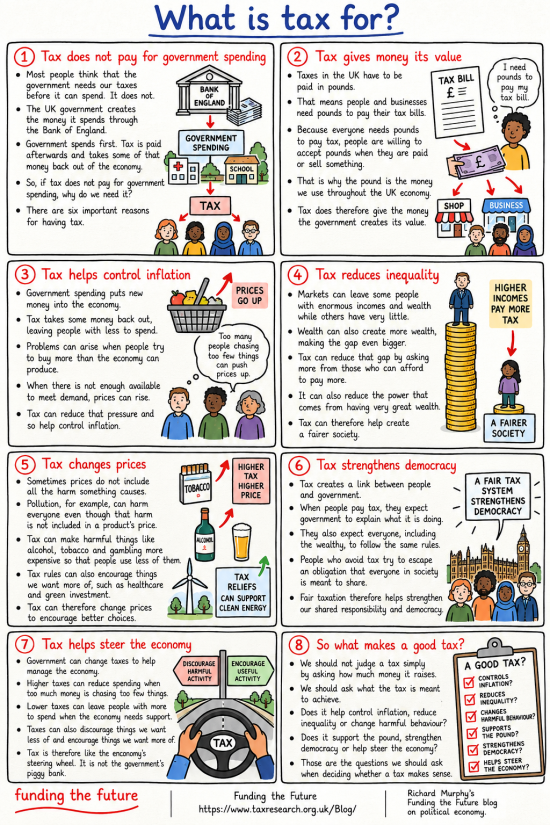
This is the transcript:
Hello, I'm Richard Murphy, and this is Understanding Economics, the series of videos that I'm making that explains how I think our economy works. And I stress that point. This is how I think our economy works because I do not agree with most mainstream economists on how the world around us creates an economy and how it functions.
I'm talking about the economy I can see, the economy I have worked in, the economy that I have studied, the economy that I have observed and written about in millions of words. And this matters because I want to talk about the economy as you will also experience it, and that is what Understanding Economics is all about.
And in this video, I want to talk about a topic which is especially dear to me in some ways, and that is tax. I was a tax specialist chartered accountant for many years. I co-founded the Tax Justice Network. I've written a great deal about tax. Tax really matters to me, but let me explain something which is absolutely fundamental about tax, which most people do not understand, and which is the basis for this video and all that follows in it.
And that is that tax does not pay for government spending. I know that 99% of people in the world think that tax does pay for government spending. And in fact, that is true with regard to subnational governments and any national government that does not have its own currency. But in a country like the UK, the government creates money when it spends by instructing the Bank of England to make a payment, and to mark up its overdraft, in effect, when it does so.
The government creates money when it spends, and tax is then used, necessarily afterwards, to reclaim some of that money back out of the economy with the purpose of controlling inflation, which would otherwise happen because there would be too much money in circulation.
So what are the real reasons for tax over and above that control of inflation, which I've just mentioned? There are six of them, and I want to explain them in detail.
The first, and one of the most important reasons why we must have a tax, is that tax gives money its value. Taxes in the UK have to be paid in pounds; the pounds that the government creates when it spends. That means people and businesses need pounds to pay their tax bills. And because everyone needs pounds to pay tax, people are willing to accept pounds when they are paid for their work or when they sell something. That is why the pound is the money we use throughout the UK economy, and tax therefore gives the money that we use, and which the government has created, its value. Tax creates value for the pound.
The second reason why we have tax is one I've already mentioned. Tax helps control inflation. As I've just noted, the government spends new money into the economy whenever it makes a payment. Tax takes some of that money back out of the economy, leaving people with less money to spend. A problem can arise when people have too much money in an economy and try to buy more than that economy can produce. The problem in question is, of course, called inflation.
When there is not enough available to meet demand, prices can rise. Tax can reduce that pressure by taking money out of circulation in the economy, and so tax is, above all else, our primary instrument for controlling inflation inside the economy.
And as a matter of fact, it works. Most of the time, except when we have external price shocks in the UK, we have remarkably stable inflation. Tax as an instrument to control inflation is amazing; so amazing, we don't notice that it works, and that's the problem of why we don't understand this role for money.
But tax has other purposes as well as giving the pound value and controlling inflation. Tax can reduce inequality. As a matter of fact, and we've all seen this, markets can make some people very much more wealthy than others and can give enormous incomes to some and leave others in poverty. Tax can reduce the gaps created by the market in this way by asking for more from those who have the ability to pay it and by asking for less from those who have very little. In this way, tax can reduce inequality of both income and wealth. Tax can also reduce the power that comes from having very great wealth. In this way, tax can also create a level playing field within our society, which would otherwise not exist. Tax can therefore help create a fairer society, and that is one of its purposes.
The fourth purpose of tax is to change prices. Now we're not talking about inflation here; we're talking about deliberately repricing some goods and services that are available in the marketplace because sometimes markets do not price products in a way that truly reflects the full cost of the product or service that is made available.
For example, we could buy fuel for our cars, and pollution would result. And if we did so and there was no price correction as a consequence of tax, we would be underpaying for the full cost of the petrol, diesel or whatever else it might be that we're buying to fuel our car. Tax can then correct for that price failure, and we know that it can be used for this purpose. It's also used for alcohol, tobacco, and gambling. These are made more expensive by tax so that people use less of them.
And at the same time, tax can also be used to encourage things we want to consume more of, such as healthcare, education, and green investment. Tax can therefore change prices to encourage better choices that markets by themselves cannot deliver. That is a major role of tax.
And tax can strengthen our democracy. Tax creates a link between people and government. When people pay tax, they expect the government to explain what it is doing. They also expect everyone, including the wealthy and companies, to follow the same rules as they do. People who avoid tax try to escape an obligation that everyone in society is meant to share. Fair taxation, therefore, helps strengthen our shared responsibility, and so our democracy. We have a stronger society if people understand that tax is a mutual obligation that creates a public good, our fair and democratic world.
And let me explain the last reason for tax, and that is that tax helps steer our economy. As I've already noted, tax can be used by the government to help manage the economy. Higher taxes can reduce spending. When there's too much money in the economy chasing too few things, it can control inflation. Lower taxes can leave people with more to spend when the economy needs support, in other words, when there's a recession. But taxes can also discourage things we want less of, I've mentioned this too, and encourage things we want more of.
But at the same time, it can do something at a bigger level. These issues can happen at a microeconomic level in the market. They can happen at a macroeconomic level when the government changes overall rates of tax that it tries to take out of the economy. Tax is therefore like the economy's steering wheel. It's not the government's piggy bank. It's the way in which the government can steer us in the right direction when the economy will, by itself, go in the wrong one.
This was the great discovery of John Maynard Keynes in the 1930s, when the UK government was trying to withdraw from the economy during the Great Depression of that decade. He said, get back in there. Use tax, use spending as the mechanism to ensure that the government can put the economy back on track. Tax is an essential part of that process.
So what makes a good tax? We should not just judge a tax simply by asking how much money it raises. Raising money is not in itself the purpose of any tax, although it is of course a common characteristic of all taxes. We should ask instead what the tax is meant to achieve.
Does it help control inflation?
Does it reduce inequality?
Does it provide value to the pound?
Does it change harmful behaviour?
Does it strengthen democracy?
And does it help the government steer the economy?
Those are the six questions we should ask when deciding whether a tax makes sense.
Tax does not pay for government spending.
It gives money value.
It helps control inflation.
It reduces inequality.
It changes prices.
It strengthens democracy.
And it helps the government steer the economy.
Those are the six reasons why we tax. We do not tax to fund government spending. That is a myth. These are the realities. Understand that, and you will understand economics better.
That is the goal of the videos in this series, and you will find a playlist down below of all the videos in this series, and I'd suggest you go and have a look at them. They are useful. Start at the beginning. They are recorded in a particular order to be useful, and I hope they help.
Poll
Thanks for reading this post.
You can share this post on social media of your choice by clicking these icons:
There are links to this blog's glossary in the above post that explain technical terms used in it. Follow them for more explanations.
You can subscribe to this blog's daily email here.
And if you would like to support this blog you can, here:

 Buy me a coffee!
