
The naysayers about my Taxing Wealth Report have always said that some of my suggestions, such as equalising the tax rates on income and capital gains, would not deliver the level of income that I suggested. I have never believed them. I always thought I had underestimated yields. That has always been my style.
New data from HM Revenue and Customs suggests that I am right, and that those who are proposing a wealth tax instead of taxing income and gains from wealth more, which was the basis of my approach in that report, are wrong.
This is the chart for revenues raised from capital gains tax for all tax years ending this century, including that to 5 April 2025, for which data has just been published, somewhat late in the day.
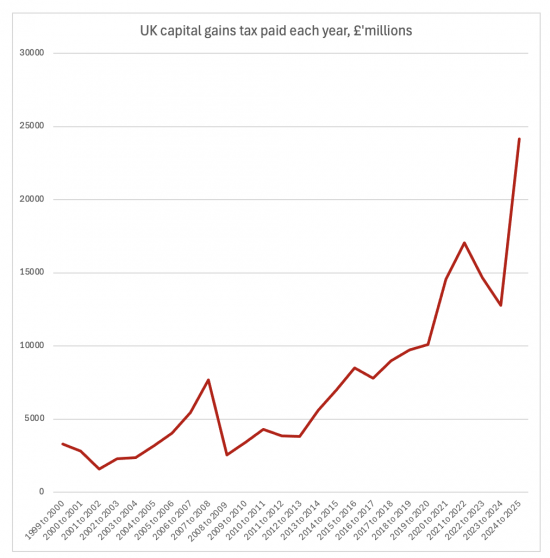
Rachel Reeves increased capital gains taxes between 2023/24 and 2024/25. The tax rate for basic rate taxpayers increased from 10% to 18% and for higher rate taxpayers from 20% to a baffling 24%, neither of which changes made any sense at all, most especially when most capital gains are generated by higher rate taxpayers.
Tax allowances were also halved from £6,000 per annum to £3,000 per annum.
The impact upon revenue was dramatic. Tax revenue in 2023/24 was £12.7 billion, and in 2024/25 was £24.2 billion.
The first thing to note was that the revenue increase was almost exactly what I predicted for equalising income tax and capital gains tax rates, so the level of increase is, in fact, quite surprising, being more than I would have expected.
The second thing to notice is that this yield is, by itself, more than many people estimate an annual wealth tax might supply.
In that case, the pragmatic question has to be why are we looking at the complications of a wealth tax when changes to the existing tax system of the sort that I have proposed in the Taxing Wealth Report, which I suggested were capable of delivering additional revenue of up to £90 billion a year, of which this capital gains tax adjustment was just one, might be so much more effective?
I am not saying that we do not need a wealth tax. What I have always said is that if we want to raise more revenue from those with wealth, a wealth tax is the best option available after all the others that I have proposed have been used.
I think that my case is now made.
There is a final point to note. All those on the right wing who claimed that there would be a dramatic Laffer curve effect as a consequence of this change might need to eat some humble pie. There was not. At the tax rates being used here, and at those that would be used if income tax rates were to be applied, there would be no such impact, which is an argument that I have presented many times, including in person in debate with Arthur Laffer.
Again, let's assume that the case is proven.
In that case, when will Labour deliver the other changes I proposed?
Thanks for reading this post.
You can share this post on social media of your choice by clicking these icons:
There are links to this blog's glossary in the above post that explain technical terms used in it. Follow them for more explanations.
You can subscribe to this blog's daily email here.
And if you would like to support this blog you can, here:

 Buy me a coffee!

Capital gains are realised when people choose to make a disposal rather than continuing to hold an asset, so we need to wait another year or two to see the long run effect of these rate change. I’d be very surprised if the receipts in 2025-26 are anything like this number.
The new Labour government increased the CGT for disposals on or after 30 October 2024. There was a lot of activity with people realising gains in the run up to and shortly after the election and then before the first Labour budget, with a concern that capital gains tax rates would increase, as they indeed have. That is happening again this year with Burnham’s first budget. Selling houses or shares, settling assets into trust, transferring assets to a company, etc. Those gains were realised and taxed in 2024-25 before the rate change and won’t be taxed again. There was also a fair amount of activity in the run up to the abolition of non dom status from 6 April 2025. People selling and going away. So I expect the gains in 2025-26 might well be much lower, closer to or below the long run trend of £10 billion to £15 billion.
The impact of the halving and halving again of the capital gains tax annual exemption from over £12,000 to £6,000 and then £3,000 is relatively modest – a few billions. That was a policy of the Conservative government, announced by Jeremy Hunt in November 2022 as he attempted to deal with the Truss/Kwarteng fallout and implemented in April 2023 and April 2024, before the general election. CGT receipts were up in 2022-23 and then down in 2023-24. I wonder why.
Noted.
But I think you are presuming tax dominates people’s decision-making on these issues. I do not think it does.
A dramatic rise indeed and equalisation of rates with income is now essential. I’d like to make a point about the Laffer ” curve”. For trivial mathematical reasons it does start at zero goes up, comes down and returns to zero at 100% (productive activity may still be undertaken though with forced labour). However, no-one can say with any degree of certainty what shape it is though. It’s generally presented as a symmetrical bell curve and right wingers insist we are on the RHS (based on little evidence). My own instinct is that the curve is not symmetrical and skewed to the right with the sweet spot around 50-70% based on post WW2 experience. Therefore, tax rises generally (and CGT for definite) WILL increase the tax take.
I pretty much agree with you. The inflexion is, I think, at around 70%.
Makes much more sense to tax capital. Where it can’t be paid in cash it can be paid in shares. What about 100% tax on inheritance over a certain sum?
I will never agree to 100% taxes.
They just do not make sense.
Tax cannot be confiscation.
Anyone seen Dan Neidle recently?
As a Chartered Accountant it is refreshing to see someone else with a similar professional background applying reason, evidence and practical ideas. Please keep going.
Currently we have tax on wealth. It’s practical and fair in that you only pay when you have cash in held and easier to manage as there are gatekeepers like solicitors, legal processes and a paper trail official documentation and transfers.
In practice that rise in CGT has generated little political kickback and collection will have been smooth.
A tax on wealth would be a fixed tax on overall wealth (which can be very hard to determine) and would likely require of selling assets or property to pay and would payable even if you have lost money in a year. Politically this would be a nightmare to introduce and problematic to collect.
The difference between these two approaches my behaviour quite change v noisy change.
I believe the intention of most of those calling of a ‘wealth tax’ is to see wealth redistributed and to tackle egregious inequality. Few will know how best that could be done technically as it’s beyond their lived experience.
The Taxing Wealth Report has always felt like a slow burner….
We do not have a tax on wealth.
We have an inadequate range of taxes related to wealth, income, and gains from it
I always wonder whether the noise generated about a tax on wealth is an attempt to get it introduced in the knowledge that it won’t work, for reasons that have been explained here many times, so the wealthy keep their wealth while the politicians claim they have tried to tax them properly. That way sensible taxation proposals that will actually have an effect can be ignored.
I am totally confused as a result of this post. I thought that according to MMT taxes do not raise revenue. I thought that the money collected in taxes was in effect cancelled and that the purpose of taxes was to control inflation, reduce inequality and discourage undesirable behaviour such as smoking, drinking and burning fossil fuels.
Of course taxes raise revenue. What else do we call the money they bring in to cancel?
It’s semantics. We don’t need the tax to spend as we all know on here, sovereign governments with their own fiat currency, have unlimited spending power and can no more run out of money than a Strictly judge can run out of points but it’s easier all round to call tax collected revenue.
Agreed
A backward looking analysis of tax take in any given year without explaining the circumstances that motivates individuals to realise gains for CGT purposes is useful but incomplete. The analysis above does not take into account that many who took gains in the 24/25 tax year were simply anticipating that CGT rates would rise again in 25/26 and, logically, again if a more left of centre PM took charge so brought their gains forward. Frothy stock markets helped and I have a strong feeling, based on personal experience and those of close friends and family, that this is exactly what has happened. Looking backwards at trigger points announcing intentions and then actual CGT rises really proves nothing about the future tax take especially given the number of wealthy people who have left the UK with their assets and gains intact. I think you are suffering from wishful thinking.
So, if they expected them to keep rising (and why not?), they would keep realising gains, and the revenue would keep rising. Thank you for making my case. And stop wasting my time with futile logic.
Not an accountant so don’t know the rules but if CGT was known to be increasing is it possible/legal for asset holders to cash in assets and then immediately re-buy them (thinking shares here) thus resetting their CGT limit. Probably not enough to explain all the rise but could it be some of it?
There are rules that make this pointless. They are complicated, but if the taxpayer makes settlement it might be a weird voluntary payment. I think that cannot explain this.
The Tories ( I had almost forgotten them ) continue to ignore what doesn’t suit them. Unfortunately the Telegraph reaches a lot of people. But , on Facebook there is a site Modern Money Scotland by Malcolm Reavell, explaining MMT for Scotland. The message is spreading. https://www.telegraph.co.uk/business/2026/08/28/treasurys-own-analysis-shows-wealth-tax-would-lose-money/
The Telegraph is reporting the Tories saying further rises in CGT would lower revenue. Give the sources I assume this is pro-wealth propaganda.
“Internal government modelling indicates that the top rate of Capital Gains Tax (CGT) is already so high that further increases will lead to lower tax receipts. Figures presented to the Government before Labour’s first Budget in 2024 show that the Treasury assumed it would raise less and less money from investors, business owners and landlords through CGT as it rose. After a certain point, increases would lose the Exchequer money as the high rate puts people off selling assets such as shares, businesses and second homes. Tory analysis of the Treasury’s assumptions suggests this tipping point is when CGT is levied at 22pc.”
The story also of course reckons the rise in CGT receipts was due to people selling up before Labour’s rises.
https://www.telegraph.co.uk/business/2026/08/28/treasurys-own-analysis-shows-wealth-tax-would-lose-money
“Figures presented to the Government before Labour’s first Budget in 2024 show that the Treasury assumed it would raise less and less money from investors, business owners and landlords through CGT as it rose.”
I have highlighted the keyword.
Neoliberals do assume that. The evidence need not support the claim.
And the idea that people sold up to avoid the tax – but then paid it, is a little absurd.
One of the approaches you see promoted to the wealthy is to retain assets, never triggering an event that would result in Capital Gains, and instead to borrow against the asset value (with a low interest rate due to being a secured loan).
Those outlines often ignore borrowing interest costs, but there is an interplay between triggering Capital Gains tax, not having Capital Gains applied to an estate on death, low interest rates available to low-risk secured borrowing and accumulating value of the asset that has been retained rather than sold, which may make borrowing a cheaper option overall.
Raising capital gains tax would not realise anything from those who are using this kind of approach. What would be a sensible approach to ensure this does not become a more common approach to minimise tax?
I think this situation is much less common than you think, except in equity release.
What is wrong with the people commenting here obsessed by the government getting more taxes. The root of our countries problems are the governments run away spending. Taxes need to be reduced not increased. All the pointless nonsense the government wastes our money on is shameful. We need a much smaller government only spending money on essentials and letting people keep more of their own money.
I think you illustrate precisely the problem I am trying to address.
What exactly is this “runaway spending”? Is it the NHS? Schools? Social care? Pensions? Defence? Policing? Courts? Local government? Housing? Infrastructure? Flood defences? Tackling climate change?
Simply saying government should spend only on “essentials” avoids the question of what those essentials are and how much providing them actually costs.
More importantly, government spending is not the equivalent of a household spending its savings. Government spending creates new money in the economy. Tax then cancels some of that money. The appropriate level of both depends upon the resources available, inflation, inequality and what we democratically decide government should provide.
Of course government spending should be effective. I have never argued otherwise. Waste should be eliminated wherever possible.
But “smaller government” is not an economic policy. It is a political preference. If you want fewer nurses, teachers, carers, police officers and other public services, say so. If you do not, then explain which substantial government spending you actually want to eliminate.
That is where the argument becomes considerably harder than saying government spends too much.
But please do something else, too. The private sector is not using all available resources now. It is leaving many unemployed. If the government shrank then the economy would be massively smaller. Is that what you want? Why? Why do you want to be very much worse off?
An obvious troll. Three grammatical mistakes in one sentence (sentence 2) is good going indeed. If people that oppose then we are winning.
James, with your virws on taxation, can I suggest that on Monday morning you give HMRC’s helpline a ring and chat to them about government waste.
When you’ve finished there, have a bite of lunch, if your budget allows, then ring the DWP and chat to THEM about waste too. That should keep you busy for all of Monday.
I have always stated that ALL income should be taxed at the same rate as wages!!!!!!
Also, I have always agreed that a wealth tax was uncollectable as not all assets (a Van Gogh painting, a tiara with royal history, the Codex Leicester…etc…ect) generate income. Many assets do not and cannot generate income unless they are sold.
I think that Roger Haworth (@10.43am) makes a reasonable point about the use of the word “revenue” in the context of taxes. However, it is important to note that the literal meaning of “revenue” is “to come back”, which is precisely the required meaning with respect to the money brought in from taxes being cancelled, after the money has been issued first. Unfortunately, the word “revenue” has acquired a very different meaning to most people, an incorrect meaning in this context, viz, the income from which public expenses are met. HMRC continues to mislead the public on this issue, stating on its website that “we collect the money that pays for the UK’s public services”.
Thank you. From Google (edited):
The word revenue comes from the Latin word revenire, which means “to come back” or “to return”.
It combines re- (meaning “back” or “again”) and venire (meaning “to come”).
The root goes back even further to Proto-Indo-European gwa- (to go or come).
From Latin, it passed into Old/Middle French as revenue, used as a noun meaning “a return” or incoming yield.
It entered the English language in the early 15th century (around 1430s) to describe the income or returns a person received from property, land, or investments.
This morning, I used the Terrorgraph’s report on the Treasury’s view on the ‘Laffer’ effect on tax revenues to discuss the function of tax with my brother-in-law, a retired chartered accountant. I should point out that he refuses to even consider that tax is principally a mechanism for inflation control and as a means to ameliorate the grotesque inequalities we permit to endure in our economy. The Treasury’s view is that the wealthy would simply postpone disposals of assets with built in gains, presumably awaiting for Badenoch’s cavalry to ride over the horizon after the next election to save these poor souls from state predation. It struck me that since the government doesn’t need tax revenue to finance expenditure, putting a brake on the liquidation of capital assets will achieve at least one of these objectives of taxation, namely potentially causing a reduction in money supply and thus dampening demand. Unless of course the capital is used as collateral for loans. But of course, as the press is so fond of telling us households and governments should never borrow to fund current expenditure. That said I’m sure the neoliberals would come up with an explanation why what’s sauce for the government goose isn’t sauce for the wealthy grandees.