
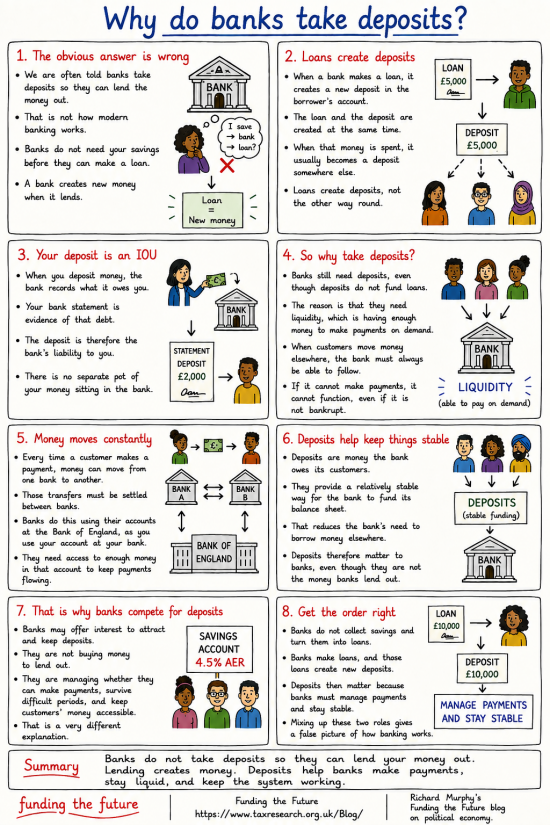
To answer a question I am often asked, and which was asked in response to relevant infographics on banks, I offer this:
How to expand this image
If you press CTRL or Command and Plus (+) on your keyboard, your browser should increase the size of your page every time you do this. Press CTRL or Command and the 0 (zero) key together to restore the screen to normal.
How to download this image.
If you right-click the image, you should be given the option to download it to your computer. So long as you do so without the intent to make a profit, you may do so without further permission. Commercial use requires consent. But if you just want to share it, do so with whoever and wherever you want. That is the purpose of these infographics.
The image library
We have a library of these images. It is available here. All downloads are free, but donations help our work.
You can download this infographic here.
AI use
I wrote this infographic based on many years of experience commenting on this issue. I used AI to create the image. I had no other budget to do so.
Thanks for reading this post.
You can share this post on social media of your choice by clicking these icons:
There are links to this blog's glossary in the above post that explain technical terms used in it. Follow them for more explanations.
You can subscribe to this blog's daily email here.
And if you would like to support this blog you can, here:

 Buy me a coffee!

Another good explanation for why banks seek deposits. Thank you.
The usual question is why do they bother if they just create the money for the deposit in the first place.
Prof Richard Werner also summed it up neatly, saying banks seek deposits from customers because it’s the cheapest form of borrowing for a bank, ie they will pay out no interest on a current account. This is cheaper than the other alternatives, i.e borrowing from another bank ( on the interbank markets)or raising new shares that require dividend payments, or worst case scenario, borrowing from the central bank, which comes with penalty charges.
Most banks now have enough reserves on hand(thanks to all that QE) to cover any daily shortfall, so the problem encountered during the 2008 financial crash is largely redundant.
If all banks lend at more or less the same rate, everything tends to work fine. Problems arise when one or two banks get too aggressive on lending,step out of line and lose too many reserves as money gets paid out to other banks.Then not finding enough reserves to replace them. The case of Northern Rock being a good example.
The answer is – as you imply, – depositors are a cheap form of capital – in fact, cheaper than anyone else – and deposits are capital to a bank – money they can lose if they go bust.
I know some resist that claim, so I did not put it in the infographic, but deposits are credits on the balance sheet, and so is capital. They have different regulatory roles, but look at the big picture, and they are now much the same; except deposits are cheaper.
I know you will push back on this… but I will say it again anyway. I accept that money raised through debt (including deposits) or equity is all “capital” but in a business like banking where debt IS the product, distinguishing between debt and equity capital is important. Why? If for no other reason (and there are other reasons) – because regulators say it is important.
Are customer deposits cheap? Well, yes and know. The infrastructure to gather and administer small deposits is expensive even if the rates paid are quite low. The real reason customer deposits are so valuable is their favourable treatment in Liquidity rules. Although technically “at call” regulators realise that they are sticky (unlike interbank deposits) because they are government guaranteed (and some other reasons, too like retail acts slowly etc.). So, the true value to a bank is closer to where their unsecured long term debt trades that will be substantially (1% ish) above swaps (a term proxy for base rate). One could, perhaps, using this data put an explicit (rough) estimate of the value of the government guarantee on deposits.
Clive
I know what the regulation says.
But as an accountant, I am interested in economic substance. Viewed in that way, if the purpose of deposits is to supply liquidity, they are just another source of capital.
I guess we will never agree on this.
Your suggestion, noted
Richard
I was wondering if/when you might tackle this…. it is a complicated/difficult concept.
An infographic can never capture the complexity of “liquidity” but I think you have avoided “the long grass” well – ie. simplification without saying anything that is untrue.
Thank you.
Thank you
Another that went through umpteen versions.
‘Just shows you where the power actually lies – in ‘our’ money paid into banks every month or week.
No wonder the banking sector lies so much. It is actually more like a public service at the end of the day.
Alright, I’ve decided now to send a weekly “Newsletter” to every major german party about your Infographics (would feel weird to send it to english parties as a german but there are surely people that could do that 🙂 ).
Even to the right-wingers.
Well, honestly said, most likely a waste of time (especially concerning the right-wingers), but at least I’ll have tried something and your graphics really need to be seen / known by much more people.
Thanks
A tiny nit-pick. Image 2 could perhaps give the impression that the person in green borrows £5,000 from the bank, and is then magically able to give £5,000 each to the other three people? Just my reading of it I suppose. Perhaps him depositing money with a garage in return for buying a car might be better? I think borrowing money to buy something is more common than just sharing it out with other people as the pic currently infers?
The implication is they end up with the deposits – as they do
Like most people my bank account sees regular flows in with my wages but all too regular flows out due to the usual costs of living and the essential payments I need to make. I am sure the majority of the people in the UK and beyond have the same experience, usually with little net difference in their balance from week to week/month to month. My first job back in the late 80s was working for a high street retail bank and I could see then, in particular when being the lead cashier when doing the end of day balancing up, that daily cash flows in and out were very similar. The point is, the bank physically needs those deposits to service all the other people taking their money out and of course most of that money comes from the people who making deposits. As a cashier you can literally take in notes one minute and hand the same ones back out the next to another customer. All of this is pretty obvious but I think the word “withdrawals” is needed here, (perhaps in point 4?) especially as numerically there are many more withdrawals going on than deposits.
I know you vave already stated that that a deposit is an IOU etc in point 3 but I would also add that it might be worth consideration to add the fact that deposits are loans to the bank and use the word loan because that is what is it is.
But most people now would have no idea what you mean. “What is a withdrawal?” they would ask. I can’t remember the last time I got cash. I never carry any.
To get into the double entry accountimg nitty-gritty in a bit more detail… When a bank customer deposits funds, that is a liability on the bank’s balance sheet; but the bank also receives a balancing asset in the form of either physical cash or central bank reseves (and the former can always be swapped with the central bank for the latter). Central bank reserves can either be lent out to other banks or swapped for treasury bonds, both of which will earn the bank a higher rate of interest than it pays the customer on the deposits. In this way, attracting more customer deposits enables the bank to build up more financial equity on its balance sheet. Have I understood correctly?
Thanks for this explanation. It’s still not clear to me what the banks need deposit for. Can you give concrete example of that? I guess the running costs are covered by their margin on transactions and interest rates and not the deposits. Then what do they use them for?
They need cash balances to meet cash demands. It is that simple.