
Andy Burnham wants to give local authorities in England much greater financial power, but he is ignoring a crisis that makes this dangerous: the audit system meant to hold councils accountable has almost entirely collapsed. Since the Tories privatised local authority auditing in 2014 and abolished the Audit Commission in 2015, the market has failed to deliver, leaving nearly 1,000 audit opinions outstanding by 2023 and only around 1% of English council accounts filed on time in 2022/23.
This video explains how that collapse allowed financial disasters to build unchecked, including Woking's accumulation of roughly £2 billion in risky debt from property speculation and crises in Birmingham, Thurrock and Croydon. It argues that devolving more money and power to councils without first rebuilding independent audit, potentially by expanding the National Audit Office's remit, is a recipe for disaster, not decentralisation.
This is the audio version:
There is no Debate Ammunition for this video, but you might like to send this infographic to your MP or councillor (the link is to a PDF for this purpose):
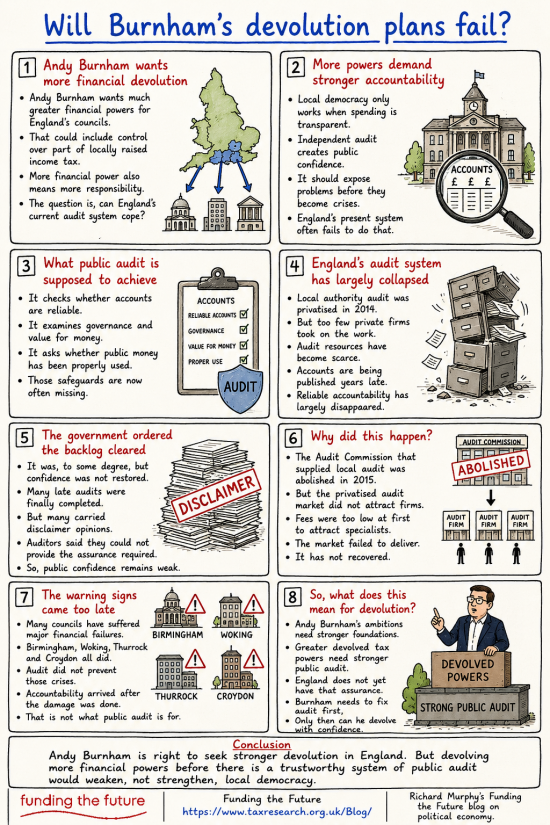
This is the transcript:
Can we trust a devolution of powers from central government to local authorities in England without proper audit being in place? I ask the question because Andy Burnham, as Prime Minister, wants to give greater financial powers to local authorities in England, and I stress in England because he has no control over this issue in either Wales, Scotland or Northern Ireland, and the focus on it must be very irritating to people in those countries.
But the point is, he's actually talking about devolving control of part of locally raised income tax to local authorities, but that will require much stronger public accountability for the use of funds by our local authorities, and at present, their accounting systems and England's audit system for local authorities cannot provide any of that assurance at all.
That should concern every taxpayer, because if we have local government running out of control with large sums of money, well, we're all in trouble really, because that is not good for local democracy. It's not good for accountability. It's not good for politics, and it's not good for us who are paying into local authorities because we do pay into local authorities and they do spend our money because that's the way in which local authorities work, unlike central government, which is funded by money creation.
Devolution needs democratic accountability. That is my point. Local democracy only works when spending is transparent, in that case. And independent audit is central to public trust in any large financial organisation.
That's true if you're talking about a public company.
That's true if you're talking about a local authority.
That's true if you're talking about a devolved government.
That's also true of government as a whole.
Audit should reveal problems and highlight weaknesses in systems and poor decision-making before they become crises. That is the role of local-authority auditing in particular; there being a focus upon good management in this case, which is in fact absent from private-sector audit, but which is fundamental to ensuring that we get good quality public services. And at present, England's system of local government audit fails to deliver any of that.
More power for local government should not come until we get stronger oversight of the money that they are being entrusted with. Public audit should provide timely and independent assurance to the central government authorities who are providing funds, and to us, and it should check whether accounts are fair and reliable.
Local councillors depend on this, after all. Many of them are not financial experts. They need an auditor to reassure them that their officers are doing what is required as well, and that is vital. And it's also critical to ensure that public money is being properly used.
This all means that audit is fundamental to ensuring that councils deliver value for money. At present, the local authority audit system is failing to provide any of these safeguards at all.
The reason for that is very obvious. Local-authority auditing was privatised by the Tories in 2014, and more than a decade later, the system of local authority audit has almost entirely collapsed as a consequence.
Only a few firms are now willing or qualified to take on this complex work, and as a result, many audits are happening years too late because there aren't enough auditors to do the work, and they're happening well after the time limits for submission of accounts under statutory rules. Nearly 1,000 audit opinions were outstanding by 2023 for English local authorities, and many of those stretched back over several years. Only about 1% of all accounts of English local authorities in 2022/23 were delivered on time. That is an extraordinary failure. As a result, we all, including councillors, lack reliable financial information, and accountability has effectively broken down.
When the government tried to tackle this issue by demanding that the reports be filed irrespective of the state of play in the local authorities in question, they were filed, but many of the audit reports that were submitted as a consequence had disclaimers of opinion attached to them. In other words, the auditor said they could not form a view on whether the accounts which they were asked to appraise did provide a true and fair view, or whether all the requirements that they were asked to undertake as part of their work, including checking that the local authority was using money to good effect, were met. As a consequence, the published accounts of these authorities did not provide the assurance that was required of them, and confidence in local authority accounts was badly damaged as a result.
As such, it's also true to say that the Whole of Government Accounts produced by the UK government are also unreliable because those local authority accounts are consolidated, which means added into those Whole of Government Accounts, and if they either aren't there or are unaudited, and they are so significant to overall levels of government spending then those Whole of Government Accounts are now unreliable as well, which is what the auditors of those Whole of Government Accounts now say. We are not getting the information we need to appraise the finances of our government as a consequence. This is serious.
So we have to ask, why did the system of local authority accounting and local government auditing collapse? And that is because, as I've already noted, the Audit Commission, which had existed to do this work and which had done it successfully, was abolished by the Tories with effect from 2015. Local audit was then required to be undertaken by private-sector firms.
The problem was, too few specialist auditors entered this market. There were simply not enough available to go around, and the prices that were offered initially weren't enough to encourage new entrants. And as a consequence, delays just built up and up and up until the whole issue became overwhelming. And at the same time, the financial reporting of local authorities has become more complex, as has most accounting of late, because of the absurd rules which are put in place by our accounting institutes, which pretend that local authorities are like private companies when they're not. And the overall consequence was that the market solution to local government accounting totally failed.
Abolishing the Audit Commission was meant to save money. Instead, audit fees have now increased dramatically, and we are still not getting the audits we require on time and in many cases, with appropriate clean audit reports because auditors have not been able to undertake all the work that is required. More money is then being paid for less; a sure sign of a failed privatisation, another legacy of George Osborne's folly when it came to privatisation.
But we do need audit. Good audit provides early warning signs of things that are going wrong in every organisation, including in local government. And there are clear signs that this system has failed at significant cost. Birmingham is now a failed local authority. It is in effective bankruptcy as a consequence of audit reports. But there are now questions over the quality of that audit, and whether the audit was itself appropriate, and whether the issues were addressed in a hurry because of government pressure. Birmingham has suffered as a result.
Other cases are just as shocking. Woking in Surrey accumulated around £2 billion of risky debt on property speculation, which its council undertook, and that led to bankruptcy.
Thurrock did much the same: they're in Essex. They too are under special measures because of investment decisions that they made, not for the benefit of residents but to supposedly increase the income streams of the council. It all went wrong.
And Croydon has suffered repeated financial failures.
Audit did not stop these crises developing, and in many cases, that was simply because audit was too far behind the event to allow the right messages to be sent that things were going wrong.
We've paid an enormous price for the failure of local authority audit, and the reality is that the current system of audit is not working because reporting is too late and accountability long after the date when it is required is hardly worth having. We've always known there's a trade-off in accounting between timeliness and accuracy. It's a delicate balance to find, but at this moment in local government, it's clearly failing.
But this has major current policy implications. Andy Burnham is talking about giving more financial control to local authorities, and that therefore requires there to be a strong audit environment in place, and the private sector has failed to deliver that. That then means there must be a state audit function recreated to deliver this essential public service.
Now we have an authority that can do that. It's the National Audit Office. That was not the same as the Audit Commission, which the Tories abolished in 2014/15. It is a separate authority that still exists, which still audits central government, and it could take on this role, but it does need more funding. It does need more staff. It does need more expertise because that would be essential to take on the range of additional work that it would undertake. But overall its reputation is good. It could undertake this work. And it's a precondition of Burnham's devolution ambitions that he gets this foundation right.
Greater devolved tax powers require stronger public audit. We deserve to know what local taxes are going to be spent on, and that confidence simply does not exist in England right now. Accountability must come before additional financial powers are granted to local authorities. Andy Burnham has to fix audit first, and then he can devolve with confidence. But if he fails to fix audit, his devolution plans will be a disaster. There's no way around that. That's where we're heading.
That's what I think. What do you think? Let us have your opinions. There is a poll down below. Please like and share this video. It's on an important topic which will affect your community and probably already does if you live in England. And please subscribe to our channel. Do hit the bell button because that means you are told when we've published a new video. And if you'd like to buy us a coffee, that will be great.
Poll
Thanks for reading this post.
You can share this post on social media of your choice by clicking these icons:
There are links to this blog's glossary in the above post that explain technical terms used in it. Follow them for more explanations.
You can subscribe to this blog's daily email here.
And if you would like to support this blog you can, here:

 Buy me a coffee!

“Local-authority auditing was privatised by the Tories in 2014″…….with the aim of allowing the Tories (& LINO) to point @ LAs & say – look they are corrupt.
https://chriscollins756.substack.com/p/how-corruption-became-legal-in-britain
Scroll down to heading “HS2 was not an outlier” and you get chapter & verse on LA corruption – because of ineffective auditing. Corruption is now so bad in the UK that it make banana-republics look good. & this is by design & LINO/Burnt-ham have no intention of changing things, too many corporate snouts in too many gov-filled troughs (the only competition being which snout gets closest to the spigot). Prediction: NAO – LINO will “outsource” the LA audit to assorted corporate scum – instead of pulling it in-house. UK, failing state in every way (oh dear, I hope I’m not compromising national security?).
Thanks, Mike.
I agree LA audit should not be carried out by private organisations, however I don’t think binging it ‘in-house’ is the answer if you mean that each LA will have its own employed auditor/audit department. The audit should be arms length, preferably by re-introducing the national audit office or something similar. I base this on years of negotiating and fighting with local authorities where those who should have exercised control were the ones lifting the carpet while someone else brushed the problem underneath it.
Timing!!
From today’s Bristol Post – an example of audit weakness.
https://www.bristolpost.co.uk/news/bristol-news/transparency-row-council-ordered-publish-11092124
“If in doubt, cover it up?” seems to be the mantra.
What is your view on the readines of the accountancy profession to meet the challenge (in terms of both staffing and professional standards)? How long would audit reform take?
Audit reform would take at least three years if adequately resourced, maybe less. It could be done. The question is, does anybody want it done?
I live in Sheffield. There is a disclaimed audit opinion for 2022/3, and the council claims the work for 2022/3 is complete and it is thinking of starting on 2023/4. Sheffield City Council has showed itself, over the trees issue, to ignore public opinion in an aggressive way. Last time I looked, even the PFI contract with Amey was suffering because financials were not presented on time or in detail as agreed in the contract. The idea of more devolved power going to this council and its administrators horrifies me. How many more of those who comment here have a similar council?
Ah-ha – Sheffield & its trees. I believe the UN was called in? Nobody asked the question: “wot’s happening under all these wobbly pavements” – turned out poor repairs & nowt to do with trees. Was it £15m they pissed away on failing to ask the right question & NOT doing £200 worth of investigation………….
Agreed proper auditing may have picked up local authorities dubious investments decisions, but very much after the event.
Cameron and Osborne when they started austerity in 2010 slashed funding for local authorities.
But decided local authorities to replace the lost funding should be commercial and should raise income from commercial ventures such as commercial property, solar panel farms etc.
Osborne then supplied the funding to the local authorities through the public works board at very low interest rates.
If you scan through the reports about what went wrong in the various local authorities the common themes are senior politicians and officers:
did not follow reasonable due diligence requirements. Who needs a proper valuation?
Would audits prevent this now? The atmosphere in local authorities is ultra caution.
The crisis was created by Cameron and Osborne’s austerity.
Burnham does not appear to be advocating proper devolution with revenue-raising powers, but is continuing the current Central Government approach of we will throw you scraps of finance, and you spend it how we dictate.
As well as auditing what about Proportional Representation for Local Government Elections?
Especially if there is more money at stake?
Don’t forget my home town of Nottingham who diverted money from their housing revenue account – ring fenced under the 1989 Local Government & Housing Act – into their failed ‘local’ energy company (‘Robin Hood Energy’ – you couldn’t make it up could you!) and got pulled up for that in 2022.
The auditing arrangements are really bad – agreed – but the harsh austerity of the Cameron government, the rather stupid ‘Localism Act 2011 etc., has only created conditions where the unthinkable is put into action.
And to think – we are now entering the era of the ‘combined authority’ – bigger councils with even less oversight – Councils that exist in my view to help propel what is left of the common wheal into the private sector, I kid you not.
Much to agree with
I had a vague recollection of complications in the Scottish Government’s Annual Budget due to the substantial lack of up-to-date results in English Local Authorities, so I asked Google about this. Its answer was ” Yes, Scotland’s local authority audits are better regulated and significantly more effective than those in England”.
It continued: “While England’s local audit system fell into a severe structural crisis following the abolition of its centralized watchdog (the Audit Commission) in 2015, Scotland maintained a centralized, publicly managed model overseen by the Accounts Commission and Audit Scotland. This difference has resulted in vastly better performance in Scotland regarding audit completion, cost stability, and institutional independence”.
Even more disturbing were its comparators: Audit Completion for 2022/23 as at mid 2024: Eng 32%, Sco 88%
Long-term Backlogs 2021/22: ENG 59% with some councils going 5 or more years without audit, SCO 0% of audits with 12 months or more delay
Cost Stability (2022/23 to 2023/24): ENG Scale Fees increase 238% & Hourly Rate fees for extra work by 151%, SCO Scale Fees decrease(!) 2% & Hourly Rate fees increase capped at 4.4%
Audit Scope: ENG – Basic financial accounts, SCO – financial accounts, ‘Best Value’ performance, long-term sustainability.
Conclusion: SNP Gov ensured sensible management, England’s Tory Gov not interested in financial control and more interested in “bungs” for their auditor pals. Once again we couldn’t make a bigger mess of running our own country!
Thank you.
There is a better system……
I’d note that the plans for new Local Audit Offices has the potential to tackle some of the issues you raise: “The English Devolution and Community Empowerment Bill gives the Local Audit Office power to carry out audits of local bodies itself through an in house provider, but decisions on whether public provision will be based on in house provision, or a separate, publicly owned provider will be made after the organisation is set up.”
https://www.gov.uk/government/publications/local-audit-reform
Depends on proper resourcing though. Indeed, a lot of these issues have been caused by austerity – under-funded local authorities have turned to risky financial ventures alongside losing council officer expertise. I understand there are still concerns over scrutiny of the Mayoral Strategic Authorities – and under Burnham’s plans they will have a lot more money…
Pathetic is my response to that