
John Healey's appointment as Chancellor surprised many people, me included. The biggest reason for surprise was that he has no record as an economic thinker.
As I noted on Monday evening, he might have spent time in the Treasury under Tony Blair and Gordon Brown, but since then he has shown little interest in the issue until he quit as defence secretary over funding.
That absence of thought matters. I described him in that same article as "a man to perpetuate the status quo." That's what people who have not thought do: they note the rules, and work within them.
Now we know that this is what Healey, backed by Burnham, who reiterated his commitment to fiscal rules yesterday, will do. That is because he made a speech at the Treasury yesterday in which, according to the FT:
He declared that “fiscal control is the first duty of any Chancellor”.
He then added:
“It is the fiscal credibility that gets us economic stability, growth and national security.”
The statement attracted remarkably little comment. It appeared well down in the FT article. It was noted as if it were simply a statement of fact. It is, however, nothing of the sort. In those few words, Healy revealed his assumptions about how economies work, and every one of those assumptions is open to challenge, not least because they both define much of modern British economic policy, and explain why it has failed.
The opening claim was that fiscal control is the first duty of a Chancellor. The obvious question to ask is, why? That is not a rhetorical question. Instead, it is because I think that a Chancellor's first responsibility is to create a prosperous, resilient and fair economy.
After all, why should controlling the government's finances be considered more important than maintaining full employment? Or ensuring the delivery of decent public services? Or tackling climate change? Or investing in the country's future?
Managing the public finances is one of the tools available to achieve those objectives, but it cannot be the objective itself. Confusing an instrument of delivery with the purpose of activity has become one of the defining characteristics of Treasury thinking. And that confusion has consequences, because once fiscal control becomes the goal rather than the means, every other ambition the government might have is subordinated to it. To open your description of the job you plan to do with a category error is quite something, but Healey managed it.
Healey then went on to claim that fiscal credibility creates economic stability. Again, the question is why? There is good reason for asking. Economic instability has many causes. Of late, the UK has endured banking crises, energy shocks, Brexit, supply chain disruption and pandemics. None of these arose because government borrowing was too high. None arose because a fiscal rule designed to deliver fiscal credibility had failed. That is because economic stability does not depend on such rules. It does, instead, depend upon secure energy supplies, functioning financial markets focused on delivering working capital for the economy and not speculative finance, productive investment, resilient infrastructure, effective public institutions and social cohesion. Fiscal policy contributes to that stability, but it most definitely does not determine it. Once more, in that case, Healey's claim was wrong.
Then Healey went on to argue that fiscal credibility produces growth. Behind that simple statement lies an entire economic philosophy.
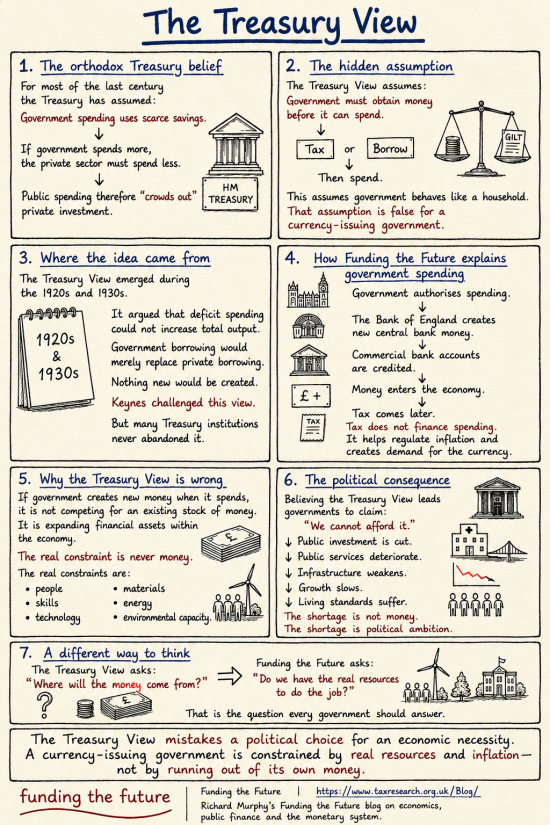
The assumption is that if government demonstrates fiscal restraint, financial markets become more confident. Interest rates then remain lower, and private businesses invest more as a result. The claim is that growth then follows. This is simply another version of what is called the Treasury View. It rests upon the belief that government borrowing crowds out private investment.
The evidence to support this claim is not encouraging.
That is partly because this View is based on the belief that there is a finite pool of money in the economy and the government competes for use of that limited resource with the private sector. That might have had some basis in truth a century ago when the country used the Gold Standard to limit the money supply, but it does nothing remotely like that now. Instead, as we know, banks do not lend because someone else has first deposited savings with them. They create money whenever they make loans. The stock of loanable funds is not fixed. Businesses do not invest because the government has borrowed a little less. They invest because they expect customers to buy what they produce. Reducing public borrowing does not conjure those customers into existence.
The whole intellectual foundation for this View is based on an outdated falsehood, in turn based on the mistaken belief once held by the UK Treasury that government activity must be constrained by limiting the money supply, in turn based on the mistaken belief that individuals always know best how to spend and invest because there are no communal goals or public goods
The reality is the opposite of the beliefs implicit in the Treasury View. Public investment frequently does create the customers that the private sector seeks. Investment in transport, education, housing, research, healthcare and energy systems expands productive capacity while increasing demand. It creates profitable opportunities that encourage private firms to invest alongside the public sector. Far from crowding private investment out, government investment often crowds it in.
This is not just theory. Britain has already tested the Treasury View, which is the foundation of austerity. Following the financial crisis, governments pursued fiscal restraint for much of the period after 2010. If the orthodox theory were correct, business investment should have surged as government stepped back. Instead, productivity stagnated. Business investment remained weak. Infrastructure deteriorated. Economic growth disappointed year after year. The promised private-sector renaissance never appeared.
So, let me come to Healey's final claim, which is, in many ways, the most curious. He said fiscal credibility delivers national security.
The implication seems to be that stronger growth enables higher defence spending. But even if that is true, it does not explain why defence spending is so often treated as though it should simply be a fixed percentage of GDP.
If GDP rises because house prices increase, creating more transaction income, or because the City of London enjoys another profitable year, does Britain suddenly require more warships? And if GDP falls during a recession, are we somehow less safe than we were the week before?
National security should begin with strategy. What threats does Britain face? What capabilities are required to meet those threats? What investment is needed in defence, intelligence, cyber security, energy resilience, food security, scientific research, infrastructure and public health? Only after answering those questions should government decide what resources are required. Strategy should determine expenditure. A ratio derived from GDP is merely a convenient accounting convention, and they are rarely of any use to anyone but managers with limited imagination and little strategic ability.
The relationship between growth and security also runs in the opposite direction to that implied by Healey. Investment in resilient infrastructure strengthens the economy. Investment in education raises productivity. Investment in research creates new industries. Investment in secure energy systems reduces vulnerability while supporting economic activity. Security often creates growth. Growth does not automatically create security.
The real significance of Healey's statement is therefore not just what it says about one politician, important as that is right now. It reveals how deeply embedded Treasury thinking has become within British politics. Ideas that are, in reality, contestable economic theories are now presented as unquestionable common sense.
Fiscal control comes first. Fiscal credibility creates growth. Growth creates security. Defence should be measured as a share of GDP. Each proposition reflects a political choice about how we should organise our economy, but none of them does in any way represents an economic law, let alone a fact.
That matters, most especially because Britain desperately needs a different conversation, and Healey's suggestion represents a brazen attempt to close that opportunity down.
The question we should be asking is not whether governments are sufficiently fiscally disciplined, but whether they are creating the conditions in which people can flourish.
Success should not be measured by compliance with arbitrary financial rules. It should be judged by whether governments deliver decent housing, secure energy, productive investment, high-quality public services, environmental sustainability and genuine economic resilience.
Those are the outcomes that matter. Fiscal policy should serve them. A Chancellor who begins by treating fiscal control as an end in itself has, before a single decision is made, already confused the map for the territory, and that always leads to economic and political failure, a situation with which we have become all too familiar.
I had some hopes for Andy Burnham. John Healey has shattered them. More of the same is the same hard gruel he is going to supply.
Thanks for reading this post.
You can share this post on social media of your choice by clicking these icons:
There are links to this blog's glossary in the above post that explain technical terms used in it. Follow them for more explanations.
You can subscribe to this blog's daily email here.
And if you would like to support this blog you can, here:

 Buy me a coffee!

[…] curse of monetarism has blighted the UK for more than 45 years now, and in the light of John Healey's comments yesterday, it still is. That makes this new infographic especially […]
The so-called “fiscal rules” are political choices, not laws of nature.
If you carry on doing the same old things in the same old way, you should not expect a new and different result this time around.
Quite so.
“every one of those assumptions is open to challenge” indeed.
In public, or to a large audience, these assumptions are NEVER challenged. Managed information flows, keep the serfs ill informed. That is the way it has always been.
Healey came across as weak/ill informed 16 years ago – nothing has changed. Another Sooty or Sweep.
[…] is, yet again, the Treasury view in action. Instead of asking whether the policy will make the economy function better, ministers have […]
So here we are again then – the private sector is in direct competition with the State for the money supply. That ‘competition’ is done by denying State sovereignty over money. Deny the State its own money, and you can kiss goodbye to fiscal policy and let markets and their animal spirits call the tune (and democracy essentially no longer exists). Calling the tune means redirecting the money supply to the private sector via rents and other privileges through the tax system.
And this achieved by co-opting elected officials like Healey into the market view. All people like him do is reinforce the view that the State is incompetent at managing the economy and cannot be trusted – that is what the OBR and the fiscal rules imply.
And the fact that the last crash was caused by private sector banking is totally forgotten. Thus, the perfect soviet style rewriting of history is achieved in the ‘democratic’ West.
You show brilliantly (again) the fatal weaknesses of Healey’s strategy and the failure of this Chancellor to break with monetarism, with the fiscal rules, with wrong headed ideas about growth, with the household analogy, and you offer an alternative, one urgently needed now, not later.
What puzzles me, is WHY Burnham should continue with an economic strategy that has failed for 46 years,and has been particularly harmful for the last 18 years.
Burnham appears to have chosen failure. What IS his goal? What WILL he call success?
Is he hoping to con us all into thinking things are improving , with cosmetic changes at the margins, merely so he can win in 2029? What will he do then?
Is the real goal to keep his real masters happy in their UK & overseas castles, as long as the poor at their gates can be conned or repressed into putting away their pitchforks?
The public KNOW they have been conned. They KNOW who benefits from austerity. They have had 2 years of Starmer’s “change”. They have had 2 days of Burnham’s “change” and already they can see more of “the same”.
So, my question again, like a biblical lament, is, ”
Why, O, Mr Burnham, WHY?”.
Good morning Richard
Can I just observe that the Chancellor cannot on his own create a prosperous, resilient and fair economy. That surely has to be part of the whole government’s objectives In that sense, stating that fiscal control is his first responsibility is not necessarily wrong. I would like to think he is pointing to the need to adjust taxation in order to balance planned government spending.
Having said all that, my comment is I fear largely about semantics. I do tend to agree that more of the same hard gruel is what we’re actually in for.
It is wrong.
He is putting accounting before action. His job is to facilitate action. The bookkeeping is a sideshow
If business is the only “investor” in the UK economy why is business continually screaming for subsidies?
Rolls Royce is reported today as demanding UK government ” financial support to re-develop its re-entry into the market for narrowbody passenger aircraft engines or it will go elsewhere”.
JP Morgan who will only build a new London HQ if it does not pay business rates for a huge number of years and if the UK government increases bank profit taxes we are leaving!
Oh yes neoliberalism only benefits those companies who depend on state contracts or subsidies to exist. A small state please, but not too small so that we are state subsidised because that’s how the market works.
I’d like to take a slightly more optimistic position. I fully accept the insanity of the fiscal rules and expecting different results if you do the same old thing. But I’m hoping that Healey won’t do the the same old thing.
The same old thing is not simply obeying ludicrous fiscal rules but also continuing with tax policies which favour the already wealthy and lead to increasing inequality. An article in today’s Guardian (www.theguardian.com/politics/2026/jul/21/fiscal-hawk-or-big-spender-what-kind-of-chancellor-will-john-healey-be) suggests Healey is a big spender rather than a fiscal hawk. And, as I’ve argued previously, spending is what is needed rather than immediately busting the fiscal rules.
There can be more spending, without breaking fiscal rules, if there is greater taxation. Now, that would not help if that taxation were merely crowding out private spending. But if taxation is focused on the wealthy, who hoard their money rather than spend it, this will not be the case.
There have been many ways that taxation can be increased, discussed here, that lead to a fairer more progressive tax system. And a fairer more progressive tax system, reducing inequality, is entirely possible even within the government’s quite absurd fiscal rules. Indeed, even with an understanding of MMT, this is probably what the Chancellor should do at the moment. Whilst long term it is necessary to run a perma-deficit at any one time the deficit needed depends on the state of the economy. I think that we much more desperately need to reduce inequality, with will itself yield increased government revenue, than to create more money.
This can happen, even with Healey as Chancellor. Will it happen? I don’t know. But let us not despair.
I admire your optimisom. I wish I could share it.
Without wishing to argue with any of the points already made, if Healey really believes in the fiscal falsehood, surely the first thing he should have announced is a strong HMRC task force to go out and recover as much possible of the missing tax billions that the treasury seems to have forgotten about.
A good point.
I asked AI if the Treasury still holds the Treasury View.
AI Responded: HM Treasury does not believe that government spending is always fully crowded out by private activity.
It’s current frameworks — the Green Book, Managing Public Money, and the Office for Budget Responsibility — explicitly allow for fiscal multipliers, counter cyclical policy, and demand side effects.
However, the Treasury retains a strong institutional bias toward caution, which can resemble a soft version of the Treasury View.
A question: How can you test whether a policy will work? It can’t be easy. If so, won’t policy makers inherently be risk averse?
Mainstream economists use DGSE economic models that resolve to equilibrium (equilibrium rarely exits) and dont model the banking system (treated as barter arrangement between lender and borrower).
A better model is a dynamic systems model such as Steve Keens Minsky/Ravel based on macro economic definitions.
See Steve Keen discussion on DGSE and alternatives
https://www.youtube.com/watch?v=l1VS6u1V_Jo
Agreed
Perfectly summed up, Richard.
Thanks!
Healey’s resignation from the Starmer Government over defence spending was a ridiculous ‘toys out of the pram’ moment. It seems he is going to do no better as Chancellor.
We’re back to having the Greens as our main prospect for sanity. I hope they get their economic thinking sorted soon!
I strongly suspect Healey was just uttering tropes written for him by some lowly Treasury official (possibly with the help of TreasuryViewAI), and that he had not even read the words until he spoke them. That is certainly not to excuse or exonerate Healey, and every criticism you make is valid. At the very least, it doesn’t bode well. I fear he is so much out of his depth, he will simply sit back and take the salary while the Treasury carries on as it always has.
I wonder if Ed Miliband would have made the same speech?
To the last, maybe not….which is why he is not there.
“Strategy should determine expenditure”. Put this in capitals on hoardings; make it a bumper sticker, let’s have a T-shirt. Not only is this true for defence. it applies to any management.
Agreed
Some things have changed since the long hot summer of 1976. One of the abiding legacies of Britain’s shift to the right in the 1970s was the idea that there was no difference between the government and a household when it comes to spending, with the implication that either can go bust if it lives beyond its means. That notion lives on today, with even the most modest of ministerial spending pledges met with the challenge: how are you going to pay for it? If Burnham is serious about rolling back neoliberalism, he needs to start by challenging this entirely wrong-headed idea.
Larry Elliott is a Guardian columnist.
This is as far as MSM are prepared to go in the only slightly left of centre paper. Nowhere can people see an alternate vision spelled out.
How do you know?
Why?
And other media do say this. I write for The National.
Since the public and most people, including politicians, economists and the media, believe that taxation funds government spending, Healey should decide how much he wants to spend on the things that matter (which you have listed many times, Richard) and then simply say that his spending will be ‘paid for’ by recovering the unpaid tax over the last several decades and the closing the many tax loopholes that have supported this. It’s bound to possible to show that it will indeed be sufficient to ‘fund’ his spending and it will give those tax dodging institutions something to keep them awake at night trying to find a flaw in the process. In the meantime the money will be spent, boosting economic activity, creating further tax ‘income’ whilst following the ‘fiscal rules’
As an aside and following on from the comic idea, it struck me this morning that, although you are making them available as downloads, come November, selecting the best/favourite would make a great Funding the Future Annual – a hardback available in Waterstones/Amazon for £19.99 for Christmas? I’ll buy the first signed edition!
We will have to see…