
As Katie Martin has noted in the FT this morning, there is something exceptionally strange going on in the world's financial markets at the moment, and we should be taking note.
Since 30th March this year, the S&P 500 index in the USA has gone up by approximately 17%:
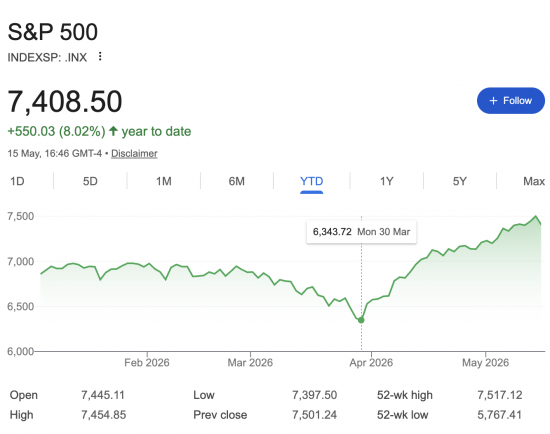
This, as Katie Martin points out, using not wholly dissimilar language, feels like pre-crash mania. There is a good reason for her concern, which I have also expressed for some time, and that is that this is precisely what we are seeing in this chart.
The long-term chart makes it clear just how absurd the current situation is:

Those engaged in these trades might fear missing out, but what they are actually doing is exposing themselves to enormous risk.
The reality is that, as the realisation dawned that the Strait of Hormuz was closed and unlikely to reopen for some time, with massive economic consequences for the world, stock markets have celebrated as if there is no tomorrow. That might, of course, be one possible reaction to the situation that Donald Trump has created. This particular reaction, however, adds to the economic meltdown I expect this summer and autumn, the risk of a stock market crash. That, I think, is now entirely unavoidable, and to a greater extent than I ever believed before.
Then add to this something important, which is the chart that Katie Martin produced showing what has happened to government bond rates around the world since that stock market euphoria erupted on 30 March. This data is from the FT:
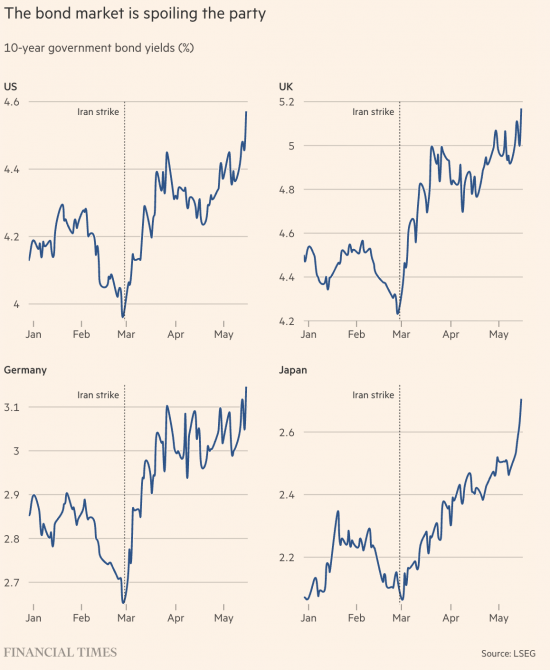
Everywhere, and without exception, traders are, utterly bizarrely, at a time of crisis when they should be heading for safety, selling bonds and buying shares. After all, the money to fund this mania has to come from somewhere, and this chart makes clear its source. When government bonds are sold, the effective interest rate increases. That is because, in practice, the amount of interest paid on bonds is fixed, meaning that if the price falls, as happens in a net selling market, that fixed interest payment appears to be more valuable in terms of the interest rate earned.
I stress, the trend is universal. The UK might have experienced a slightly larger increase in rates than other countries, but it is no exception to the general rule. To therefore pretend that there is a peculiar crisis in the UK, and that this has something to do with whatever Labour might be up to, is total nonsense.
To even pretend that any of this has something to do with a change in the risk profile of gilts, or inflation expectations, or just about anything else, is also utterly absurd.
All that is happening is that market traders are following the herd in pursuit of what they think might be gains, and are ditching government bonds as a result to put all their money into shares, with the risk that they will suffer very large losses as a consequence, at cost to those in whose interests they are meant to act, many of whom will be people saving for their pensions.
This behaviour defies all rationality. Anyone with any sense can perceive that we are facing fuel and food shortages, and the risk of massive supply chain disruptions as a consequence of Trump's war against Iran, with a resulting risk of economic meltdown, substantial falls in corporate profits, the risk of corporate failure, and a banking crisis, both in the mainstream and shadow sectors.
The likelihood that this might be as bad as 1929, with consequences at least as severe if governments do not take action to bail out many of those who will be impacted, is very high indeed. In that case, if you look at what is happening in financial markets, the only reasonable conclusion to reach is that those trading in them are giving themselves a massive dopamine hit at cost to the rest of the world before the crisis arrives.
I am angry because governments are going to have to bail out banks and even major corporations as a result of what is going to happen. We will be doing QE again, but this time we have to get it right.
I am angry because millions, if not billions, of people will suffer the financial consequences of this coming crash, just as they will also suffer the direct economic consequences to their employment prospects and the real physical consequences of supply shortages.
I am angry for all the people whose futures will be destroyed as a consequence of this utter folly.
I am angered by most in the media, who are completely distorting this story to say that markets have lost confidence in governments, when in fact the true story is that we should have lost confidence in markets.
I am angry with the media that says nothing about the idiots trading this way, whilst demanding that governments must serve them.
I am angry that we have ministers who apparently cannot see what is going to happen, or who are doing absolutely nothing about it, meaning they are, as a consequence, contributing to the disaster heading our way.
I am angry at the pretence that life is carrying on as normal when it is doing anything but that.
I am angry that we do not have financial transaction taxes that could kick in to prevent speculative trading of this sort.
I am angry that we still have a bias within our tax system towards wealth and against ordinary people, which means folly of this sort is supported by the state.
I am angry that we have banking regulations and financial market regulations that do nothing to prevent all of this.
I am angry that neoliberal politicians still think, despite all the evidence to the contrary, that markets are rational when they are anything but, as this situation shows.
And one day, I know I will come back to this post. I am going to say, “I told you so”, and I will be sorry to say that, but I know it is going to happen. In the face of this type of madness, nothing else is possible. In the history of stock market investment, no other resolution to madness of this sort has ever been found.
My advice is then, to batten down the hatches, expect the worst, and, if you have any control over your own financial affairs, and I am well aware that not everybody has, look for safety. Do not worry about missing out now. Take the long-term view. Markest may be abandoning caution. There is no reason for you to do the same.
Thanks for reading this post.
You can share this post on social media of your choice by clicking these icons:
There are links to this blog's glossary in the above post that explain technical terms used in it. Follow them for more explanations.
You can subscribe to this blog's daily email here.
And if you would like to support this blog you can, here:

 Buy me a coffee!

The billionaires and multimillionaires are safe in their bunkers and gated housing, so don’t give a damn. Funding the extreme right and living under the illusion that AI is going to produce even more profit and abundance. Blind to the fact that massive unemployment will follow, let alone the ecological consequences. What to do? That is the question. Certainly no clues from our present rulers.
It’s quite obvious to anyone with basic knowledge of markets and economics, that if inflation is your concern, buying bonds isn’t your path to safety.
its quite obvious from the graphs posted, that although the direction of bond yields is similar across markets, yields in the UK have increased much more – that’s because the fear of inflation is much great in the UK, directly as a result of Labour policy (and fear of a shift leftward in Labour policy).
And in the face of a global economic meltdown, shares obviously are.
Stupidity has to appear here sometimes. You just provided it.
And we should remain angry at declines in living standards, healthcare, mental health, healthy lifespan, all while we continue to produce more and more per capita.
That’s all the fault of the neo liberal ‘experiment’, too
And meanwhile we have an ineffective prime minister in office but not in power and a Labour Party imploding inwards. I hear your frustration, like a biblical prophet who can see clearly the inevitable, but knowing no one wants to hear. I really hope when the inevitable happens a war time spirit is initiated and people help each other, rather than the Tory bungs and those in deprivation being the hardest hit.
Given the choice I might study form…………
(Gee Gees)
Excellent post and analysis as always Richard. However, I struggle to agree that inflation expectations are not a factor for all bond rates, and potential changes in leadership and economic policy in the UK are not factors. I do agree with the core of your argument that the driver of the crazy stock levels, and this pulling money out of the bond market, can only be explained by FOMO (and AI powered stock software), I just can’t totally dismiss inflation, and individual economic policies also being contributory factors.
What is the risk? And why? And why do you think it will not ne mitigated, which would be easy?