
James Meadway, the carpet-bagging economist who served as chief economic adviser to John McDonnell during the Corbyn era in the Labour Party, and who is now a Green, has written this on Facebook:
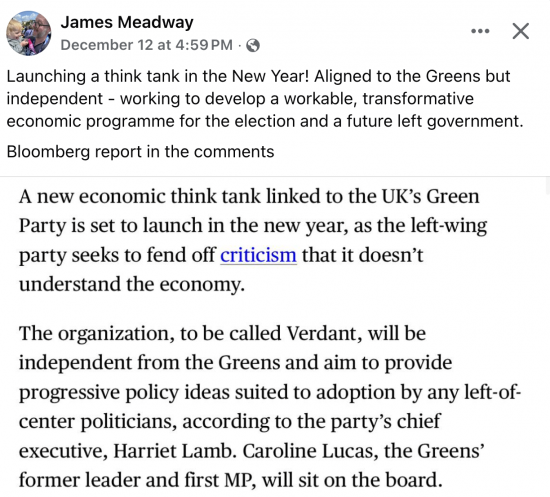
Let's be blunt: Meadway failed Labour, McDonnell and Corbyn. I said so at the time, more than once, not least when it came to Labour's adoption of profoundly neoliberal fiscal rules whilst Meadway was there. Candidly, either he delivered full-blown neoliberal thinking for them, or he stood by and took his salary whilst someone else did.
Why was that? At least in part, it was because he did not understand how the macroeconomy works. Again, and once more, in so small part, that is because of his passionate, visceral, and irrational hatred of modern monetary theory, which provides all the answers he lacks. He holds this position because, he claims, there is no theory of class inherent in MMT, meaning, he says, that as a Marxist, he cannot therefore embrace it. When it is simply a description of what money is and how it works within macroeconomic policy, that is about as meaningful as hating electricity when explaining household power supplies, because it also has no inherent theory of class.
And now he wants to impose his Marxist form of neoliberal thinking on the Greens. So, let me suggest some questions for his new "think tank" - a term so elitist by implication that it is amusing to note him using it. Let's start with:
- Where does the national money supply come from, and how does it enter the economy?
- How, and why, do banks create money, and how is it destroyed?
- How did the central bank reserve accounts come into existence?
- How are they eliminated?
- What is tax for?
- What are bonds for?
- How would you control inflation?
- Do you believe in NAIRU? If not, what are you going to do about it?
- How are you going to fund a green transition?
- Do you think savings equal investment in the current economy?
- If not, what are you going to do about it?
- Do you want a wealth tax? Why, when there are so many more readily deliverable ways of taxing the wealthy very much more?
I have, of course, already answered all these questions.
I look forward to the debate.
And I should add one more thing, which was a thought offered by Jacqueline this morning, who asked:
What do you get when you mix red and green in the way James Meadway does?
The answer is, of course, you get a dull brown. Dull brown content (for which she had another word) is what I am expecting from this "think tank" that would appear, from the outset, to be driven by prejudice and loathing for the economic truth.
Thanks for reading this post.
You can share this post on social media of your choice by clicking these icons:
There are links to this blog's glossary in the above post that explain technical terms used in it. Follow them for more explanations.
You can subscribe to this blog's daily email here.
And if you would like to support this blog you can, here:

 Buy me a coffee!

Sounds more like a septic tank than a think tank.
Indeed Meadway pretends to think like a Marxist but actually thinks like a Tory. Even Marx’s M>C>M needs a unit of account measuring device to ascertain profitability. Meadway never/can’t explain why there’s only one agency that can create this necessary stable device for a market capitalist system to exist. Even a pure state captalist economy needs such a measuring device to figure out if resources are being used efficiently!
‘Meadway’……………….is that old English for ‘being mediocre’ by any chance?
… but the Greens DO need a group (and yes, “think tank” is a dreadful word) that can develop policy ideas away from the hurly-burly of internal and external Party Politics.
They DO need to answer the questions you pose…. and answer for themselves with, of course, reference to your blog.
But they DO need the right people…….
not someone with Meadway heading it up – thats the wrong path and ruinous . It will be the same old regurgitated shi*te
We already have a well established Economy policy working group in the Green Party with a policy chapter we are refining but has an MMT lens. This was decided upon via a 4 year process of debate and consultation. The lone voice of James Meadway should not be allowed to dismiss the thousands of hours of that work. Hopefully it won’t. Ultimately conference will decide.
Absolutely spot on with your list of questions for Meadway who from past evidence doesn’t appear to have the thinking ability to answer them. On the first of your questions he doesn’t understand that the UK’s money is now chartalist and for good reason. Some national agency has to set up a unit of account measuring device that enables businesses to assess profitability (which obviously links to productivity). Not only that this measuring device enables market capitalism to exist in relatively stable form.
The question which then has to be considered is what agency has the power to establish this unit of account (which we call money). The answer is government which has the enforcing power to do so (usually backed by law). It does this as the chartalists (MMT’ers) explain by creating reserves (High Powered Money) from nothing which it then spends into the economy but withdraws it back through taxes. In making the non-government sector pay taxes lies the magic in creating a national unit of account which then serves the market!
Here’s Randall Wray’s 2000 paper once again which although long and technical beautifully explains all the nuances behind modern day societies using a chartalist unit of account:-
https://tools.bard.edu/wwwmedia/resources/files/924/WP%2012%20-%20Money%20and%20Inflation%20-%20Wray.pdf
Let’s hope Zack Polanski reads your blog on a regular basis and understands Meadway is attempting to undermine the Green Party with failed Neo-Classical economics!
Thanks
I challenged JM, some years ago, via Twitter, that he didn’t understand MMT , he replied (much to my surprise) that it wasn’t that he ‘didn’t understand’, but that he ‘didn’t agree’.
A shame really.
Great stuff Richard.
Thanks
He wants to decide political outcomes for us. It is that simple. So of course he doesn’t agree with MMT reasoning. He denounces us as the lunatics and gets the praise for doing so. Thus he gets the elevated status equal to that of the high priest of capital. Which is what he wants
I think the Green Party would do well to be wary of former Labour Party officials cosying up to them.
I could not agree more.
Mustn’t forget Grace Blakely is also in the Greens. As with Meadway, a dangerous inappropriately influential motormouth that Polanski must counter if he’s to advance the monetary truth to his members and beyond.
What a shame Harriet Lamb and Caroline Lucas are giving credence to “Verdant” a Tory “wolf in sheep’s clothing” organisation. “Left-wing” my arse to put it impolitely!
And there was me thinking I might have someone to vote for.
It’ll be half-arsed fiscal conservatism that pleases no one, and Zack Polanski saying “My mum knew how to budget”
Meadway refuses to acknowledge the historical reasons why the unit of account (money) is first and foremost a “creature of the state”. Here’s why he’s wrong not to agree:-
https://tools.bard.edu/wwwmedia/resources/files/1267/WP%2055%20-%20The%20Origin%20of%20Money%20-%20Semenova.pdf
Reading beween the lines of that announcement with my world-weary, cynical specs on, it seems to me that the words “independent” and “ANY left-of-center politicians”, and the fact that the Green Party have put some minders on board, suggests to me that perhaps they are being very cautious about keeping his “think-tank” at arms length from party policy formation processes. Just in case he tries to embroil them in a class war, rather than what we need, a national postwar recovery programme after 45yrs of Neoliberal Blitzkreig.
@ RobertJ I don’t think what you say is true. I think Harriet Lamb and Caroline Lucas (of all people) have betrayed Zack Polanski in regard to the Green Party’s relationship to the “Verdant” think tank. Indeed Lamb announced this relationship without her having any democratic mandate to do so!
You may be right – I’m just guessing.
Time will tell.
Smears against Polanski will get more media coverage than economic ideas.
Back in 2018 Bill Mitchell did his best to explain why James Meadway’s beliefs are a load of nonsense in his report of his meeting with John McDonnell and James Meadway:-
https://billmitchell.org/blog/?p=40562
In regard to what the Americans call the FIRE sector (Finance, Insurance, Real Estate, in the UK Finance, Insurance, Property) Meadway was saying the UK is heavily dependent on this sector therefore as Bill Mitchell quotes:-
“The inference was that the fiscal rule was necessary to placate any hostility that might arise in this ‘large’ sector.”
In other words unless a UK government had a Fully-Funded Rule to balance current spending the FIRE sector would undermine or rather blackmail the government. If Meadway properly understood MMT he’d know this was nonsense. Here’s some of what he fails to understand in relationship to what he said in that 2018 meeting:-
It makes no difference whether a government bond is owned by a domestic investor or a foreign investor. In either case, the asset is held in a reserve account at the currency issuer’s central bank. In either case, the bond is serviced in precisely the same way (the central bank writes up the relevant reserve account).
Any nation that issues its own currency, allows the currency to float in foreign exchange markets, and enforces tax obligations in its currency can employ any unused resources that are for sale in the currency. This is the case regardless of whether the nation’s currency is the world’s “reserve currency” or among the world’s most demanded currencies or a currency that is not in high demand in foreign exchange markets. Full employment is achievable for any monetarily sovereign nation.
Nations that are net importers of essential commodities (energy and food) and that don’t produce output that the rest of the world wants to buy might have to depend on foreign aid to provision their populations. But even those nations can achieve full employment.
As I have said before, Bill and I have to find common ground sometimes.
If a bond is held by a domestic investors the interest payments stay in he domestic economy. The Scottish Government has announced a plan for a Bond Programme, issuing in the bond market. The Scottish Currency Group is advocating that the bondsshould be offered as retail Green Bonds to the Scottish public with the Post Office acting as the intermediary
I prefer Jacqueline’s word for ‘dull brown content’ – it means so much more.
Agreeing with Susan Mensforth. So, as ’tis the season for renaming of misleading or ambiguous terms, are we all going to be referring to this new think tank as E****ment?
It’s only dull brown when you are mixing paints. If you are overlapping lights in red and green then the result is yellow, so that’s symbolic of the SNP.
Artists refer to this mix of colours (usually including a bit of blue, too, as seems to be emerging from Verdant) as “Palette Mud”. A totally useless material; the only way forward is to scrape it into the bin and start afresh.
Hopefully Polanski and co (Molly Scott Cato – economy spokesperson ?) will be sufficiently open minded to continue talking to Richard Murphy, and people like Mazzucato, Pettifor Gabor, Blanchflower, Sikka , Mellor, Varoufakis, Raworth, Kelton, Keen etc
Its pretty encouraging that Polanski seems to have rejected the ‘economy as household’ model.
Ann Pettifor is another utterly irrational hater of MMT and me and Stephanie Kelton in particular.
I see Pettifor did write a book about money – which seems to have some overlap with MMT concerns but focuses on banks creating money – yet advocating more democratic control of the financial system .
There ought to be scope for lively discussion – rather than visceral hatred.
I promise you gave tried, very hard. No success at all. Just total bloody mindedness and utterly false claims in her part. Apparently MMT is all about helicopter money.
“Helicopter money” ha! It’s depressing when people confuse the theory of how money works with the emerging political uses that theory has resulted in. It’s like hating electricity because it has occasionally been used to implement the death penalty by electrocution.
Agreed
Basically there is a split in the Green Party between the Thatcherites (government has no money of its own and needs to kow-tow to the interests of the rich) and those who believe the opposite. The Green Party members now need to vote whether to expel the undemocratic Harriet Lamb!
This is Google’s AI explanation of why Harriet Lamb CEO of the Green Party and Caroline Lucas former MP for the Green Party have joined the board of the new think tank Verdant without consulting Zack Polanski.
Harriet Lamb and Caroline Lucas have joined the board of the new economic think tank.
Verdant as part of an effort to provide progressive, but also “mainstream,” policy ideas for left-of-center politicians.
The suggestion that they went “behind Zack Polanski’s back” stems from internal disagreements within the Green Party over economic policy, particularly a perceived conflict with Polanski’s favored Modern Monetary Theory (MMT).
Policy Differences: Verdant aims to develop ideas that are compatible with the UK’s financial system and can garner mainstream appeal, which some see as a rejection of more radical economic approaches like MMT, which are popular with some members close to Polanski.
Lack of Mandate: Some critics within the party have argued that Harriet Lamb, as the Green Party CEO, announced Verdant’s launch and the associated board appointments without a proper democratic mandate from the membership, leading to accusations of a “betrayal” of Polanski and a lack of accountability.
Independence: Verdant is intended to be an independent organisation from the Green Party itself, which some worry is a way to distance the party from more socialist policies and potentially accept funding from sources (like big business) that might influence its direction in a less radical way.
The situation highlights a split within the Green Party between those who want to appeal to a wider, more moderate electorate and those who favour a more radical, socialist agenda.
Thanks
I love Jacqueline’s question. 🙂
Basically there is now a split in the Green Party between the Thatcherites ( who don’t understand the UK government has money creation powers of its own and the implications of this especially that the country doesn’t need to kow-tow to the interests of the rich) and those who believe the opposite. The Green Party members now need to vote whether to expel Harriet Lamb for behaving undemocratically and attempting to undermine Zack Polanski who was voted party leader by a massive majority!
This is Google’s AI explanation of why Harriet Lamb CEO of the Green Party and Caroline Lucas former MP for the Green Party have joined the board of the new think tank Verdant without consulting Zack Polanski.
Harriet Lamb and Caroline Lucas have joined the board of the new economic think tank.
Verdant as part of an effort to provide progressive, but also “mainstream,” policy ideas for left-of-center politicians.
The suggestion that they went “behind Zack Polanski’s back” stems from internal disagreements within the Green Party over economic policy, particularly a perceived conflict with Polanski’s favored Modern Monetary Theory (MMT).
Policy Differences: Verdant aims to develop ideas that are compatible with the UK’s financial system and can garner mainstream appeal, which some see as a rejection of more radical economic approaches like MMT, which are popular with some members close to Polanski.
Lack of Mandate: Some critics within the party have argued that Harriet Lamb, as the Green Party CEO, announced Verdant’s launch and the associated board appointments without a proper democratic mandate from the membership, leading to accusations of a “betrayal” of Polanski and a lack of accountability.
Independence: Verdant is intended to be an independent organisation from the Green Party itself, which some worry is a way to distance the party from more socialist policies and potentially accept funding from sources (like big business) that might influence its direction in a less radical way.
The situation highlights a split within the Green Party between those who want to appeal to a wider, more moderate electorate and those who favour a more radical, socialist agenda.
I wonder where the money has come from to set up this Verdant organisation.
I’m sure there will be an office and staff to be paid for.
The fact that it has started at all is an indication that the Establishment is suddenly concerned about the rise in popularity of Zack Polanski.
I hope he doesn’t get reined in.
It was only a matter of time before The Establishment decided to take Zack Polanski out of the game! God forbid its scared to death that seriously tackling climate change in this country will mean higher taxes for them to help control inflationary pressure as government spends more!
Green Party members need to be aware that James Meadway never answers awkward questions that challenge his views:-
http://www.taxresearch.org.uk/Blog/2018/08/06/labours-chief-economic-adviser-confirms-it-is-committed-to-the-thinking-that-will-deliver-yet-more-austerity/
And here you have it from Jo Michell:-
“At what point does over-use of a term as an insult render it meaningless? Richard Murphy tested the boundary yesterday when he accused John McDonnell’s economic advisor James Meadway of delivering “deeply neoliberal, and profoundly conventional thinking”. This was prompted by a negative comment James made about Modern Monetary Theory (MMT).
In response, Richard posted a list of MMT-inspired leading questions which, wisely in my opinion, James declined to answer.”
and
“The two dangers that must be balanced when setting fiscal policy are insufficient demand and private sector unwillingness to finance public deficits.”
Clearly neither understand MMT but arrogantly attack it!
https://criticalfinance.org/2018/08/07/labours-economic-policy-is-not-neoliberal/
Jo Michell has long been another block to any form of understanding of progressives macroeconomics. I am not the least surprised he sides with Meadway, and cannot answer the questions .
And nit the whole framing: it is all about ceding power to finance. It is quitevextraordinary,
“The two dangers that must be balanced when setting fiscal policy are insufficient demand and private sector unwillingness to finance public deficits.”
A couple of thoughts from the omnibus…
1. There is no lack of demand round here (for GP appointments, mould-free affordable housing, social care, and tarmac to fill the potholes, and someone to remove a lot of torn tatty wet limp flags from our lamp-posts). Sorting that would not be inflationary and inflationary pressure could, if required, be countered by an appropriate level of redistributive taxation.
2. As to “private sector unwillingness to finance public sector deficits” – if they don’t WANT to buy government bonds and collect all that interest, then why do they keep buying them?
I make the 2nd comment as someone who is still at the FTF kindergarten level when it comes to bonds, so please correct me if I’m mistaken).
I mentioned the flags. “Raise the flag” has cost a life here in S Bristol (plus at least one serious assault of an objector).
https://www.bristolpost.co.uk/news/bristol-news/well-known-bristol-football-fan-10699651
Your bond question is just fine
In an additive colour model, red plus green gives you yellow. Could this tell us anything about Meadway’s willingness to confront the establishment?
Such as?
I think Andy is suggesting Meadway is “yellow” I.e. a coward
I realised afterwards. Slow this morning…
James Meadway is actually a Monetarist not a Marxist as the following article explains:-
https://tribunemag.co.uk/2019/06/for-mmt
Monetarism created a lot of unemployment last century and it’s still being implemented by the Starmer government with the Fully-Funded Rule.
Google AI explains why Monetarism failed:-
Unstable Velocity of Money:-
Monetarism assumes that the velocity of money (the rate at which money changes hands) is stable and predictable. However, in the 1980s and 1990s, financial deregulation and innovation (such as interest-earning checking accounts and money market funds) caused the velocity to become highly unstable and unpredictable, making it impossible to forecast nominal GDP and inflation based solely on money supply growth.
Difficulty in Measuring the Money Supply:-
Due to ongoing financial innovation, accurately defining and measuring the “money supply” (e.g., M1, M2, M3) became increasingly difficult. Different measures often gave conflicting signals, further complicating the implementation of a money growth rule.
Loss of Central Bank Control over Money Supply:-
Contrary to monetarist assumptions, central banks found they did not have direct, precise control over the broad money supply. In a modern financial system, private banks create money by issuing loans, and the central bank primarily influences the price of reserves (interest rates) rather than the quantity of money itself. The money supply is largely demand-driven, responding to the demand for credit from firms and individuals, not an exogenous variable controlled by the central bank.
Real-World Policy Outcomes:-
The practical implementation of strict monetarist policies in the late 1970s and early 1980s (in the U.S. under Paul Volcker and in the UK under Margaret Thatcher) did bring down high inflation, but at the significant cost of severe recessions and high unemployment. This contradicted the monetarist claim that controlling the money supply would have only minimal effects on output and employment.
Theoretical Shortcomings:-
The core monetarist argument relies on a stable relationship described by the Quantity Theory of Money (M x V = P x Y) and the assumption that economies quickly return to full employment. The reality of persistent unemployment and the non-constant velocity exposed the limitations of these assumptions.
Ultimately, the breakdown of the stable empirical link between money supply growth and inflation led most central banks to abandon money growth targets in favour of more flexible, direct inflation targeting using short-term interest rates as their primary policy tool.
Thanks
Even the so-called Marxist government of China has adopted Monetarism:-
https://www.chinadaily.com.cn/a/202512/11/WS693a2aeca310d6866eb2e139.html
This is ironic as Michael Pettis explains in the following article:-
“Reversing inequality and other distortions in income distribution in both the surplus and the deficit countries is therefore the only durable way to end the trade war.”
https://carnegieendowment.org/posts/2019/10/why-trade-wars-are-inevitable?lang=en
This is very telling; “he claims, there is no theory of class inherent in MMT, meaning, he says, that as a Marxist, he cannot therefore embrace it.”
It means that whatever you may say, no matter how true, he can’t believe it due to ideology. If true, he has no right to advise anyone. Reality must be distorted to fit his internal notions. This is, in my mind, no different from someone like Steve Bannon, who can advise the cruelest of policies, such as separating children from their parents at the border, because he believes in a grander (nonsensical) narrative that is at play. If MMT doesn’t accept class, then perhaps class isn’t important?
James Meadway is hard of thinking. Class division is now a very strong feature of so-called Marxist China as much as Neoliberal Germany. In both countries policies have been implemented which effectively lower citizens’ purchasing power with the object of allowing business elites to achieve better price point in global markets with their exports. Michael Pettis is telling him this loud and clear in the following article as well as his jointly authored book “Trade Wars are Class Wars.”
https://carnegieendowment.org/posts/2019/10/why-trade-wars-are-inevitable?lang=en
I would add that some MMTer’s fail to recognise this telling us cheap imports are a blessing whilst failing to examine the under-lying factors determining the cheapness.
Noted
@Schofield The article link didn’t work, but are you saying that countries deliberately engineer conditions that emiserate workers so they are more competitive on a global market? That would explain a lot of what the Americans are trying to do, in rolling back all safety nets and regulations, and also why the Right is so divided. Some on the Right really are all about rejuvenating the working class, something Project 2025 isn’t interested in. It would also explain Farage’s resistance to minimum wage, despite being “for the People.”
The thing about people who try to socially engineer populations is that they are clever enough to come up with the idea, but too dumb to realise that people won’t let them do it to them.
Seems to me that teaching the “ruled/exploited/lower income/non-capital-owning” people of the UK, the truth about where money comes from, is scaring the living daylights out of those at the opposite end of the wealth spectrum.
It’s giving a lot of us the confidence to challenge monetarist ideology and tell the Treasury where they can put their fiscal rules and the economic status quo.
Seems to be quite a lot of class wrapped up in that.
Spot on
@ Tom B
The link just worked for me from Richards’s blog. The article by Michael Pettis is called “Why Trade Wars Are Inevitable” so you can Google it. I chose it because it’s a sort of precis of his jointly authored book “Trade Wars are Classwars.” Yes you are right in your summation. Emiserating workers is common to fascists (like Farage), neoliberals (like Starmer), and communists/Marxists (Chinese). Does it work long term? Not really because human beings, like other life forms, are constantly seeking to find a balance between Communitarianism and Libertarianism.
[…] Zack Polanski published a new edition of his podcast last night, in which he is in conversation with James Meadway, about whom I have written here of late. […]