
It is very hard to explain just how bad yesterday's Budget was, in terms of having nothing to say, in terms of its presentation, and in terms of the abandonment of responsibility to the people of this country that it represented on the part of a Prime Minister and a Chancellor of the Exchequer, both of whom were desperate for power, and both of whom have proved that they have no idea what to do with it.
I have now offered two videos on the Budget, but the point to note is that for most people it literally did nothing to change their financial situations, with all the supposed benefits being made available on energy costs likely to be less than the increase in household payments due from January 2027.
Elsewhere, banks had a better day than expected, but Burnham and Healey otherwise deferred every major decision that should have been made until later. That strongly reinforces my belief that a general election is coming, whatever Burnham says.
That being said, the underlying macroeconomic assumptions are also quite bizarre.
For example, it was assumed there will be continuous growth of between 1.5% and 2% in the coming years, when the prospect of that is so remote that the suggestion is utterly ridiculous. We are going to have a crisis because of either war, an AI bubble burst, or the consequences of climate change, and quite possibly all three. Growth is very unlikely.
And then there are the sectoral balances. This is the chart included by the Office for Budget Responsibility in its forecast.
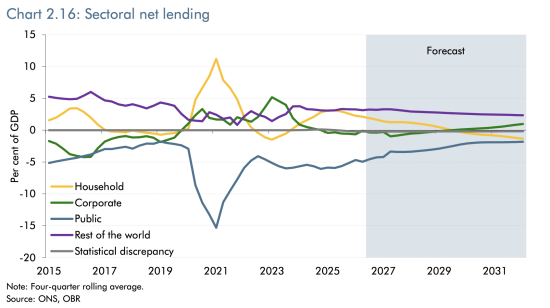
By definition, these lines must equal zero. The logic is quite simple. If somebody is saving, somebody must be borrowing, and that is what double-entry requires of all transactions in sterling, which is what this chart represents.
The chart includes the typical projection that the government will reduce the level of its borrowing. All the forecasts I have ever seen from the Office for Budget Responsibility have done that, and that outcome has never been delivered, or even come close to doing so, as the chart shows. John Healey's claim that he will meet his fiscal rules is based on this projection, and it is a work of fantasy.
What, however, is most fantastic about this is the belief that household debt is going to increase significantly over the next few years, which is the necessary consequence of the government reducing its support for the economy, which must be the case if it is to meet the fiscal rules. In other words, if the government balances its books, households must go seriously out of balance when many households are already seriously vulnerable to the burdens of debt. If you want a definition of government irresponsibility, that is it.
At the same time, it is forecast that businesses will go into a net-savings situation, meaning they will invest less in the economy than they already do, which, by international standards, is negligible. Forecast growth is, in that case, just a pipe dream
Add it all up, and the projections in this one chart prove this Budget has no credibility or relevance at all except to support John Healey's claim that he will meet his fiscal rule, which he will not.
Never has so much effort been wasted for no net gain to anyone, which might well be the summary for this whole Labour government under both its prime ministers.
Thanks for reading this post.
You can share this post on social media of your choice by clicking these icons:
There are links to this blog's glossary in the above post that explain technical terms used in it. Follow them for more explanations.
You can subscribe to this blog's daily email here.
And if you would like to support this blog you can, here:

 Buy me a coffee!


There is yet another whammy on its way as a result of what is happening between the US & Iran
Sulphur
Article here
https://payneinstitute.mines.edu/how-institutional-failure-turned-sulfur-into-a-global-crisis/
It is also used in Vulcanising – treating natural and synthetic rubber to make it useable.
No sulphur means amongst other things no tyres which isnt mentioned in the article.
Thank you
Agreed.
The shifting of the burden on real unsustainable debt has shifted onto households which is exactly one of the things you pointed out during Cameron and Osborne’s infamous government from 2010.
What is that saying?: “Plus ça change, plus c’est la même chose.”
“More it changes, more it’s the same thing.”
I think that the modern term for this method is ‘gas lighting’? We are being lied to about the power of the government to help us. And what political economy is this a part of?
Why Neo-liberalism of course – a form of retention or preservation of the capital order in the face of the overwhelming need for change.
Agreed, and thank you
The budget felt consistent with Burnham’s time in office so far – tinkering with small things to garner positive headlines, kicking the expensive and difficult stuff into the long grass, and desperately trying to avoid upsetting the markets.
Healey is asking people to look at a mirage and believe it is really there. As you say, no help at all to travellers across a barren desert. If this nonsense is really part of some early election strategy, I’m afraid reality will intervene and it will be opposition parties, not Labour, who will benefit.
The OBR forecasts are works of fiction, based on guesswork as to which way the world will be affected by unknowable events. As I said last week, the blind leading the blind into the pit.
There will be a video tomorrow on the OBR forecasts
Meet the Burnham government’s scapegoats: “the young”.
https://www.theguardian.com/uk-news/2026/oct/29/healey-cut-welfare-bill-tough-approach-young-people-accept-jobs
“Healey added: “We will expect, as we’ve done before, that (young people) take up the offers … and that’s the way that we can bring welfare bills down in the long term.” ”
Oh dear…
Agreed. Oh dear…
The workhouse mentality is alive and well and living in Downing Street.
It appears that sectoral balances are, perhaps, not understood in the Corridors of Power, including the Chancellor.
Situation is untenable.
It is basic knowledge about economics. It doesn’t have a label on it; it’s not neoliberal, nor MMT; it’s simple accounting which is fundamental to taking decisions that will affect millions of lives.
Surely someone cares?
I think your assumption that they care might be misplaced.
That is why politics has to change.
During the budget address more than one mention was made ‘providing some breathing space ‘. I think the Chancellor of the Exchange should have said he was providing some breathing space… for the Government! Burnham has signalled some important changes of direction and a less confrontational style of government. But clearly not yet ready with a plan. Then there is the unusually high level of uncertainty. You list of what could seriously impact the UK economy has grown longer over passing months.
The background does not lend itself to an early election – which polling my indicating would be unpopular
On government budget press release was particularly telling for me. Half a dozens quotes gathered around some housekeeping measures.
https://www.gov.uk/government/news/everyday-fixes-to-make-life-easier-for-millions-of-britons
What odds now for the return of the big spring budget?
It will be called a spending review.
Only tangentially related to the budget – and Healey’s ineffectual action on energy prices , but also material to your definition of neoliberalism, and the sometimes perverse role of the state within Britain’s very particular and peculiar ‘neoliberal’ energy system<p>
this is a very relevant piece by Arthur Downing on ‘Sweating Assets’ https://www.lrb.co.uk/the-paper/v48/n17/arthur-downing/asset-sweating<p>
‘Britain (energy system) has private ownership while making the state responsible for planning via subsidies. The result is a zombie system, a muddled and dysfunctional hybrid of state and market, with the benefits of neither and the costs of both. The regulatory architecture behind this is the most complex in the world.<p>
‘ China is using a combination of public ownership and markets; Britain is de-marketizing its energy system with subsidies and central planning to preserve ubiquitous private ownership.'<p>
Despite some saying neoliberalism unlike neoclassical economics – doesn’t see a role for the state – in practice neoliberalism seems to need the state to play an essential – if perverse – role at the heart of it – to invent fiscal rules, subsidize and regulate/deregulate monopolies to keep them in place?
The small amount of support for energy bills dressed up as helping the poorest in society seems to me to be another ‘help to buy’ scheme where government support is being passed straight to the already wealthy private market energy suppliers who collectively have failed to build in sufficient resilience into the global energy supply systems (which we are all now paying for). The government must know that any money they give the poorest has to be passed on. If the government really cared it would be helping people to be less reliant on finite energy resources which would be better for them and the planet.
As recommended on this site I have recently purchased ‘Debt’ by David Graeber (which I am enjoying) but at the same time I also purchased ‘Can’t We Just Print More Money’ by the Bank of England (Rupal Patel and Jack Meaning). In the second book the authors present one of a banks roles as matching borrowers up with lenders – is this correct as I thought that when i took out a loan it is an agreement between me and the bank, not me and a depositor that i do not know from Adam? Do banks like bookies spread their bets/liabilities?
The Bank of England book is entirely false. It is scandalous that they published this when they have themselves said that books suggesting this are wrong.
I was astononished to see a post on facebook this morning celebrating the fact that 78% of Cambridge residents would receive the £100 payment against energy costs!!
There is certainly poverty and hardship in parts of Cambridge but you only have to walk around to know that it is nowhere near approaching 78%…..and this asisde from the fact that £100, though welcome to many, contributes very little to general living costs.
I am one of those who live in council tax band D by virtue of having bought my house 35 years ago and happen to have a lower than average income but those who’ve moved to this area in recent years, who have expensive cars, large extensions and send their children to private school, are hardly in need of extra pocket money. This must be replicated country wide – I’m not against universal benefits when appropriately taxed but what a footling waste this is when so many are in great need.
You are right, this is a budget of very little consequence….I noticed Aditya Chakrabortty described it as a Martin Lewis budget.
Much to agree with
I meant to say that the post was from Daniel Zeichner – my MP !!
Might the following assessment of the budget be reasonably accurate?
”While the budget was politically framed around protecting working people, the long-term mathematical reality is that the frozen threshold architecture quietly transforms active labourers into the primary funders of the state’s fiscal recovery.” (From AI Mode)
See my video in the morning.
I just watched Owen Jones discussing the Budget with James Meadway on Owen’s YouTube video. I posted the following paragraph in the comments. I hope you approve.
‘ I trust Richard Murphy’s assessment more than James Meadway as i believe James’ critique of MMT (which is championed by Richard) is nonsense. I thought you accepted MMT Owen (disappointed if you don’t) If you want to replace neoliberal economics with a progressive economic model, it has to embrace MMT as an accurate description of how money creation actually works. Increasing public spending and investment will largely pay for itself through the multiplier effect and will only tend to increase inflation if there is a general shortage of real resources due to full employment (which hasn’t been the case for decades) and could in any case be controlled by increasing the tax take from the wealthiest 10 per cent, as Richard set out in his Wealth Tax Report. Any chancellor who doesn’t accept MMT is doomed to stay stuck in the neoliberal trap – having to appease the City and the bond markets, worry about government ‘debt’, the deficit and balancing the books (treating the government budget like a household budget as promoted by Thatcher 45 years ago and accepted by mainstream economists and successive governments ever since). Please invite Richard onto your YouTube channel soon.’
Thank you.
Well said.
Appreciated, and correct.
Meadway’s small-minded, profoundly neoliberal obsession with the existence of a subservient state and the supremacy of markets is a menace to the left.
A lost weekend here in Supermanchester.
I am bitterly disappointed by John Healey’s budget.
3% extra tax on bank profits. 2% extra on landlords! If I were a billionaire, or a banker, or both I would most likely also be a landlord as well.
2% extra tax on rental income. HA! I’ll just put all my rents up in line with mortgage interest rates increase, legal and justifiable and my profits have just gone up by a minimum of 2%
Extra 3% on bank profits? According to ChatGPT the Govt will pay out between £144 and £155 Billion in interest on Bank reserves and gilts in the next 12 months. A Billion Pounds is £1,000,000,000. The maximum corporation tax rate is 25% so an extra 3% on unearned profits of £1,550,000,000? I’ll grab that with both hands and complain bitterly about it if I can manage to complain with a straight face.
Burnham had the gall to say he’ll find savings in welfare payments to cover the “giveaways”
Bryant is withholding the minuscule “giveaway” to blackmail NI into settling a grossly unfair budget.
Burnham, Healey and Chris Bryant have all said “there is no more money available to me” For everyone who understands MMT this means they also understand MMT and they are deliberately pulling the wool over our eyes.
They are, as you say, clueless.