
Is Britain facing another financial crisis? I believe it is. But the real danger is not government debt, despite what Chancellor John Healey is likely to tell us in tomorrow's Budget. The much greater risk lies in the scale of the debts owed by Britain's private sector.
In this video, I explain why the government's obsession with fiscal credibility, borrowing and debt-to-GDP ratios is distracting us from the financial risks that could threaten millions of households, businesses and banks.
Using data from the Office for National Statistics, the Office for Budget Responsibility and the Bank for International Settlements, I examine how debt in the UK has changed since 1970.
The figures reveal something extraordinary. UK government debt is just under 100% of GDP, but total private sector debt is approximately 279% of GDP. That means private debt is around three times larger than government debt.
And the trends are revealing. Since the 2008 financial crisis, private sector debt has fallen relative to GDP while government debt has increased.
I argue this reflects an important shift in how money and savings are distributed across the economy with more people now saving with the government, which is why its so-called debt has increased.
The crucial difference is that the UK government issues its own currency, so it can always repay whoever it owes. Households, businesses and banks cannot create money in the same way and can therefore face genuine problems repaying their debts.
That is where the danger lies.
With the possibility of an AI investment crash, escalating war in the Middle East, rising food prices and disruption to global trade, Britain's private sector could face serious financial pressure.
Households already struggling with mortgages, credit cards and other borrowing could find their debts increasingly difficult to manage. Businesses could fail, putting banks and other financial institutions under pressure.
I am particularly concerned about risks in private equity, hedge funds and the wider shadow banking system, where financial exposures may be difficult to identify.
Yet tomorrow's Budget is likely to focus on fiscal rules, government borrowing and financial market confidence rather than the much greater risks associated with private debt.
I argue that John Healey must recognise where the real threats to Britain's financial stability lie and prepare the economy for the possibility of another major crisis.
The Budget matters enormously, not only for the future of Andy Burnham's government but also for the financial security of everyone living in Britain.
The question is not whether the government can repay its debts. It is whether households, businesses and financial institutions can repay theirs.
That is the risk we should be talking about.
This is the audio version:
This infographic is on a theme related to this video:
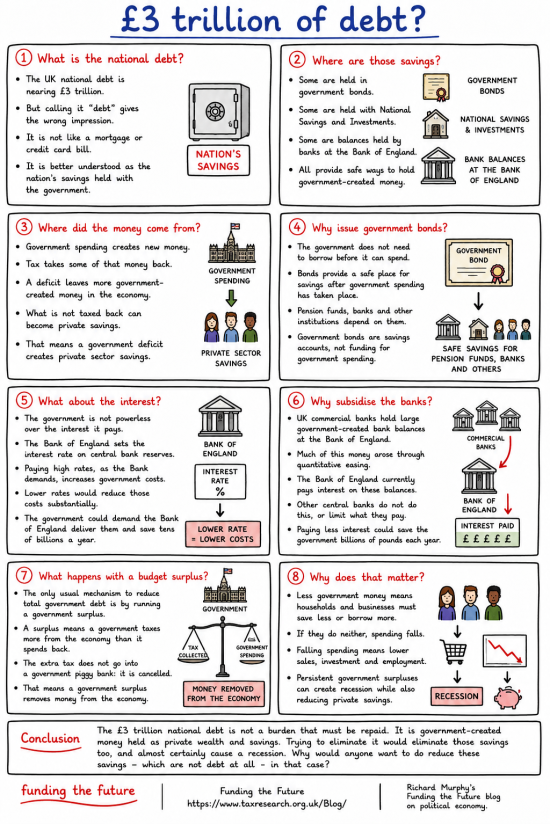
This is the transcript:
John Healey's budget is tomorrow. This is the first of Andy Burnham's government, and who knows, it may be the last because there is now discussion about him going to the country sometime fairly soon for a general election. But the point is, this budget matters because it will position where the Burnham government is with regard to the population of this country as a whole and how it intends to manage risk.
And risk is the overriding question that hangs over everything that John Healey will say tomorrow. I believe that we are facing a financial crisis in this country. Why? Because of the risk of escalating war in the Middle East. Because of the risk of an AI bubble burst. And because of a risk of food price increases as a result of climate change, and a shortage of fertilisers, again, as a consequence of war in the Middle East.
We are therefore in a very precarious financial position at present, much more precarious than John Healey is likely to talk about. And so in advance of that budget, I just want to frame where the risk is because that is what a prudent financial manager does, and I have been a financial manager for longer than I care to remember.
I was a chartered accountant for 42 years. I've run many companies. I have been a senior partner in a firm of accountants, and so I do have a fair understanding of these issues. And for the last 30 years or so, I've looked at the government's finances in some detail.
So let's have a look at a chart which tells us the story that I want to relate. And that chart is now on your screen, and it has four lines on it.
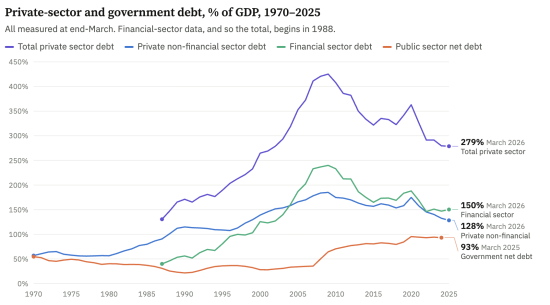
The story that John Healey will talk about tomorrow relates to that bottom red line. That is the ratio of government debt to GDP, which is supposed to be our gross national income in the UK per annum.
Now, let's look at that chart. It fell from around 50% in 1970 to rise to about 93% or a bit more now, at this particular moment in time. We are approaching the point where UK national debt, as it is defined to be, which I call UK national savings, is equivalent to our total national income. The figure for 93% is actually the data for 2025 because, since then, all the data is a little uncertain because it is restated quite regularly for many months after it is first published.
The other lines on the chart refer to private debt. The blue line that also starts in 1970 and goes to date, and which has reached 128% now, is private sector, non-financial debt. That is, in other words, the debt owed by households and ordinary companies who are not in the financial services sector, including banks, of course. They are not in that figure.
This is genuine debt owned by trading companies and private households. And you'll notice that the pattern of that debt is quite different to that for the government.
And the same is true of the green line. The green line is the pattern of debt for banks. This data comes from the Bank for International Settlements, whereas the data for the other information on this chart comes from the Office for National Statistics and the Office for Budget Responsibility. And the data for financial sector debt shows a pattern which is broadly similar to that for households.
In other words, it rose steadily from the 1990s onwards. It reached a peak at around the time of the global financial crisis in 2008. And since then, both financial sector debt and non-financial sector private debt have fallen.
There's a little bit of a bump around 2020, of course, but that was because GDP fell so heavily during the COVID crisis and not because the amount of debt went up. And this figure is a ratio of debt to GDP, which is a figure that therefore takes the time value of money out of consideration, and that is why it provides an objective indicator.
Now the point is this: when we look at the government chart, government debt has gone up since 2008. Private debt has gone down, and in fact, if we add the two figures for private sector debt together, we get the top line, that is, the purple line on the chart, which shows, at this moment, according to this chart, by chance, total private sector debt is now 279% of GDP, and government debt is around 93%.
Now, these figures are, of course, estimates, and there will be some to and fro, but the point is total private sector debt in this country is now three times as much as government debt, and government debt has increased from well below 50% in 2008, around 30% to 40% regularly at that point of time, to around 95% plus now and heading for a hundred per cent, whereas the scale of private sector debt has fallen.
In fact, financial sector debt went from 40% when the index or the chart shown on the line started to 240% of GDP in 2008 and is now running at around 150%. And for private non-financial sector debt, the figures have risen from 57% in 1970 to 185% in 2008, to 128% now.
Now the fact is quite simple: The scale of private debt has fallen after the global financial crisis. But if we are in a situation where private sector and bank debt is falling, and we are talking about the closed sterling-valued economy here, and this is all sterling-based debt, we are not talking about foreign debts here; we're talking about sterling. Then, if those sectors reduce their debt, somebody has to increase it. That is the nature of double-entry. As a matter of fact, somebody's debt has to rise if those sectors reduce the scale of their debt. And whose debt did rise? Well, more than anybody else's, it was the government.
Now, the overseas sector did have a role to play. I'm going to ignore that for the moment, but it's the overseas sector denominated in sterling we're talking about. They have saved more in the UK economy to compensate for the fact that there has been a change in private sector debt elsewhere. But the government and the private sector, as the chart shows, have relatively swapped positions. The government debt has gone up. Private sector debt has come down.
Now you could say that's good news. Why? Let's look at this rationally.
The government can always repay its debt. That is why the private sector, in the form of banks, life insurance companies, pension companies, plus foreign banks and large companies who wish to save, do so with the government. They buy government bonds because they know, unlike our politicians, that the government will always repay its debt and has no problem doing so. They implicitly understand modern monetary theory. As a result, they know the government is good for its promise.
Is the private sector good for its promises? No. Could the private sector fail? Could it fail because it has debts which are much bigger, three times bigger in total than the government? Yes: at a point of stress, that is where the pinch point in the UK economy is.
Households are stressed. They're not as stressed as they were in 2008, but they are still stressed.
Our banks are stressed. Again, they're not as stressed as they were in 2008. But when we look beyond our primary banking sector, the banks that we all know about and looked at, the secondary banking sector, which is made up of private equity, hedge funds and secondary banks, there may be hidden debt that we don't know about here as well.
Now, my point is quite simple. If we are in a situation where the private sector has total debt three times bigger than the UK government, why is the government obsessing about its need to control its debt, which it can always repay, when the real risk within our economy at the moment is that the private sector will not be able to repay its debts?
And if anyone, households or genuine trading businesses, cannot repay banks, their situation becomes very much worse because the moment we have a pattern of non-repayment, which is what happens in the global financial crisis, or indeed in a localised financial crisis, we get to the point where banks are stressed. And when banks are stressed, they could fail.
We saw that happen in 2008. Now I don't think that's going to happen because of factors inside the UK economy this time.
AI crises are not going to happen here. They're going to be made in America.
War is going to be made by the USA plus Israel. That's not a domestic event.
And although we are going to suffer food price problems in the UK, that will not be because of a failure of UK production. It will be because of a failure of international production and our dependence upon food imports, which is a major problem for the UK economy.
We are therefore going to face a debt crisis if the economy goes as I expect.
But tomorrow John Healey will spend all his time talking about how he is going to be fiscally prudent and try to manage our debt so that his fiscal credibility, a term that he likes, will be maintained, and he will discuss other nonsense things like fiscal headroom and so on, but he will be ignoring that 279% of total private sector debt.
That is where the risk is. If he does ignore that, we will know that he is not preparing for the crisis to come. That is why you need to watch this budget with care.
Any budget is more important for what it does not say than what it does say. The fact that we have in the UK got more government debt is simply because people have increasingly trusted the government with their savings and therefore government debt has risen, but private borrowing has reduced, and that's because people are saving. Where are they saving? With the government.
These ratios do make sense, but that chart by itself shows where the risk is. There is no risk with government debt, even though the government is obsessing about it because they've been told to do so by the City, by commentators and by economists who don't know what they're talking about. The risk is in the private sector, and to understand that risk, we just have to lift up our eyes and look out from the UK economy to the rest of the world, and it is a major threat to our well-being at present.
Please do listen to the budget in this light. We are facing crises, and the problem is with debt, but not with government debt. That's how we have to understand our risks. That is where the threat to our well-being lies. Listen to what John Healey has to say.
And I will talk about the budget and discuss these consequences when he has sat down on BBC Radio 2 tomorrow. After that, on a video we will put out tomorrow afternoon, and probably in another video we will put out on Thursday morning, by when I will have had a chance to read some of the budget documents, and there are hundreds of pages of them.
But this budget is important. It is coming at a pivotal point for our economy. It is coming at a pivotal point for Andy Burnham's government. He may decide to go to the country after this, and it is coming at a pivotal point for your well-being because that is at risk because of what is happening in the global economy.
Can you afford to repay your debts? That's the question you need to ask. If you feel at risk as a consequence of rising interest rates, increasing debt levels, unmanageable burdens imposed upon you by credit cards, mortgages, or anything else, then you will understand why I am worried.
That's what I think. What do you think? There's a poll down below.
Poll
Thanks for reading this post.
You can share this post on social media of your choice by clicking these icons:
There are links to this blog's glossary in the above post that explain technical terms used in it. Follow them for more explanations.
You can subscribe to this blog's daily email here.
And if you would like to support this blog you can, here:

 Buy me a coffee!


Thanks to you and your team for another excellently analytical infographic and article.
Might it be that the likely forthcoming “Neoliberal Faithful” budget will be an acute consequence of the following biased systemic structures/systems?
1) The closed form of Treasury attitudes, thinking and behaviours
2) Financial sector dominance
3) The considerable inluences and power of the “Think Tank Network”
4) Main stream media, not least the B. B. C., promotion of Neoliberalism and single-transferable-party politics
5) A mass education set up which promotes citizen passivity and socio-economic ignorance
6 A serious deficiency of objective, analytical Parliamentary opposition