
This morning's video is about getting the message out there, and I seem to be getting the opportunity to do so at present.
In this context, I asked ChatGPT to analyse the comments on yesterday's Channel 4 video I featured in. There were around 800 when I asked it to do the analysis. There are more now.
This was its overall summary:
Overall assessment
Your appearance on Channel 4 has been very well received, and the positive reaction extends beyond people simply expressing support for you personally.
There is now enough material to identify three important developments.
First, the enthusiasm for your appearance is striking. People are not just agreeing with individual arguments. They are asking why they have not heard more from you on mainstream television, why politicians are not listening, and why the economic arguments you presented are not part of normal public debate.
Second, the comments reveal substantial agreement with your critique of neoliberalism, privatisation and the concentration of wealth. That agreement is much broader than agreement with modern monetary theory. Indeed, some commenters explicitly support your arguments about wealth taxation while rejecting your explanation of money creation.
Third, the critical response is notable. There are plenty of insults, but there are also serious questions about inflation, exchange rates, taxation, the movement of wealthy people and the credibility of predictions about economic crises.
My conclusion is that this has been an unusually successful appearance, but the comments also identify precisely where your argument needs further explanation if it is to reach people who are not already persuaded.
The balance of comments was:
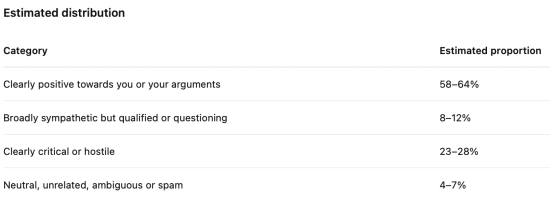
It added:
Was this a successful television appearance?
Yes. On the evidence available, I would call it a considerable success.
Not because everyone agreed with you. They plainly did not.
Not because the comments prove your economic arguments are correct. Public approval cannot establish that.
And not because 67,000 views on a channel with 4.27 million subscribers is, by itself, an extraordinary achievement.
The success lies in the combination of factors.
You have reached a substantial audience outside your own channel. The video is performing strongly within Channel 4's current output. The most popular comments overwhelmingly support your contribution. Viewers are explicitly asking to hear more from you. And the discussion has developed into a serious, if sometimes heated, debate about the economic system itself.
There is another point worth emphasising.
Some of the most interesting comments come from people who accept your diagnosis of neoliberalism but question your monetary analysis. They are not necessarily hostile to your objectives. They want to know whether your proposed alternative can work.
Those people are probably your most important potential new audience.
And this was the final comment (it did not know when to stop):
Final conclusion
I think the most significant feature of these comments is that you have succeeded in making a critique of neoliberalism sound relevant, understandable and urgent to a substantial mainstream audience.
That is not a small achievement.
The opposition is real, and some of it is intellectually serious. But much of the disagreement concerns whether your proposed solutions would work, rather than whether the problems you identify exist.
That suggests the debate is moving onto potentially more productive ground.
There is one final observation. The comments repeatedly contrast your willingness to challenge the foundations of the economic system with Vicky Pryce's apparent preference for reforming the system as it exists.
That contrast seems to have been central to the programme's impact.
The strongest message from the audience is not simply that they agree with Richard Murphy. It is that they want an economic debate in which the existing system is no longer treated as the only possible option.
That, I think, is the real significance of this appearance.
There's stuff to work on there, but all those hours making videos have paid off, I think.
And my thanks to all those who supported what I had to say.
Thanks for reading this post.
You can share this post on social media of your choice by clicking these icons:
There are links to this blog's glossary in the above post that explain technical terms used in it. Follow them for more explanations.
You can subscribe to this blog's daily email here.
And if you would like to support this blog you can, here:

 Buy me a coffee!


It seemed encouraging to me that Guru-Murthy seemed to have prepared in such a way as to show at least the beginnings of understanding of MMT.
I thought it interesting that Vicky Pryce clearly was invested in defending what she understood to be neoliberalism (it seemed to me that that’s where her biggest energy was). She didn’t say so in so many words but trying to define it as not really having been tried or not actually operative was an significant move on her part. I think that this may be where the force of argument needs next to alight to take down the ‘yes but’ defenses. “Yes, but the water companies aren’t really in a market” (implying that if they were it’d work?).
I think too that maybe there was some confusing of neoliberalism as an ideological political project and the idea that markets can be efficient at allocating resources and pricing them.
I think she was nodding at, eg, Starlink and Palantir etc when talking about companies with huge state tie-in (if that’s a fair characterisation). And that has me wondering whether she was trying to hint that we should be regulating more and downsizing these entities? But then, that is vulnerable to the argument that therefore unrestricted markets, a la Neoliberalisme, tend to produce monopolies over time, not to mention things like producing harmful products, underinforming consumers, too much caveat emptor… So the real question is what kind of state oversight is necessary, isn’t it? In fact isn’t that giving away the neolib family silver? It may be collapsing a defense of markets into neoliberalism.
That’s a bit unformed as yet but my first-ish thoughts on her apparent position.
Looking at the relationship between Starlink/Starshield Defence and consumer businesses is interesting, especially how the latter is funding the former. It might involve holding your nose a bit. But it is interesting.
That’s good news. Let’s hope your following in this forum and elsewhere will burgeon, so that those who were previously unaware of your stance and your well-informed arguments will begin to take notice.
Thank you
Interesting analysis of the comments Richard. In a way, it is a cross between content analysis (Krippendorff, 1980; Weber, 1990), and thematic analysis (Braun and Clarke, 2006).
Not my work, but interesting. The full version is five or more times longer. We do this on our own videos now.
What a great video. You truly are a shining light Richard, thanks
Thank you
Interested in analysis of comments to see questioning of money creation. Despite following this channel for years I still can’t get my head round the relationship between money creation and accounting for the money in GDP and in GDP growth/recession. Where does the increased GDP come from? I know what the equation says but where does the actual money come from? A glossary on growth?
Money is not in GDP.
It is used to measure it, but that is something entirely different.
And where does money come from? One of two places. Government spending or commercial bank loan creation. There is nothing else. That is it.
Richard – I know you are in for a busy couple of days, so here are some thoughts/reflections on your appearance on C4 for you to take up at your leisure – or not.
I felt that Vicki Pryce was not the worst Neo-lib you could come up against. In fact to be fair she conceded many of your points. I think that her answers tried to say that there were many other issues to be talked through/examined (this could have been sophistry, a form of gentle undermining or she may have a point – we know that what you advocate will have consequences in the economy we may be unaware of until we actually get the opportunity to try it – please!).
I felt that when she said that we all work for the government she was not correct to say that in her denial of Neo-liberalism, but there was a big unconscious I think kernel of truth in what she said. The issue for me is, if we are all working to put government money to work, why must some benefit more so dis-proportionally than others? And why does government allow the private sector to exploit the electorate by denying people of base money it could produce instead of austerity?
Pryce did not really engage with the concept of Neo-liberalism. I do not think she is a political economist at all Richard, because being Neo-liberal her self she is just being ‘rational’ and ‘scientific’. But she also did stray into the zone familiar to you about ‘choices’ – the ECB could do more than it did in 2008 – but will it? That’s the kicker. When the shit hits fan, what will happen this time?
Good luck.
Thank you.
I appreciate feedback back.
Brilliant.
Lots of curious people wanting to know if this will work, it took me a while to understand this is the best description of how money actually works in UK and is happening NOW. So not a theory.
Just wondering about spreading the message to those yet not convinced but curious, whether ‘scaffolding’ would work – find their existing schema and extend from there.
So whether foregrounding the fact that everyday banks also create money like BoE – if this would work as scaffolding.
As there is a widespread mistaken belief that these banks only lend as much as savings and deposits allow, and that loans are backed by deposits. It might be a useful starting point to explain these banks also create money through loans. (Thinking everyday banks are more relatable than the BoE and so starting here might offer something that is familiar and relatable.)
But this won’t work if I am wrong about monetary process, so please correct as needed.
Noted, and useful to help my framing.
It would be interesting to ask how the banks were able to fund the ‘Bounce Back Loans’ which appeared so readily during the Covid crisis.
I watched the episode yesterday when there was only 210 comments and read most of them. I can confirm that most of them were positive and the comment of “Why haven’t we seen this guy on mainstream TV” came up a lot, along with great praise for a proper challenge to the Neo-liberal narrative. There were several calls for Kristian to get you back and several more asking for more debate like this on this subject. There were a few troll bots with very similar emails and negative question phrasing, one or two sophisticated (seemingly AI powered) bot retorts, a couple of straight forward antagonists and one crypto phishing spam (which I had removed). If you remove the obvious detritus from the list I would say that almost all the comments were positive. A much deserved pat on the back.
Thank you, Stefan.
Really,the only thing to say is Fantastic! Well done you.
Thank you.
Having watched it again, we can hope that this type of thing happens more often on TV, but one word of advice I would give to you, Richard, would be to never use the word neoliberal. As soon as you do then you will exclude every normal person who does not follow these matters on a daily basis. And we don’t want to do that. Instead always find the normal phrases which describe its impacts.
Why should I dumb down?
There is no evidence it failed in this case.
I genuinely do not get this concern. I need explanation.
I have noticed that some people think I’m just having a go at the Liberal Democrats when I mention Neoliberalism! Clearly not everyone understands the term. That said, I am quite happy to have a go at the Lib Dems too!
What is the alternative term or phrase to use?
I tend to agree with Douglas. Even though I’ve been reading your blog for quite a while, I’d still struggle to explain what neoliberalism is; it just won’t lodge in my mind ready for use. I wouldn’t go as far as Douglas, telling you never to use the word, but do carry on what you’re so good at, explaining uncomfortable realities in ways that immediately turn our lights on.
So, what do I say is happening instead?
Thatcherism? Market fundamentalism? The extraction economy?
I will do some more on this.
Thank you
I’m with you on this Richard. Even Andy Burnham has labelled neoliberalism as the culprit behind the UKs decline.
Neoliberalism really does need naming and shaming because virtually all parties are now subscribers – either knowingly or unwittingly – to neoliberal ideology. It is this which they have in common above all else.
Without shining a spotlight on this shared ideology, how else could you explain why each government is economically just another version of the previous one? There is no other available word to use. Love of money has been said to be the root of all evil; neoliberalism is the root of our domestic troubles. It is the disease itself which needs treating, not this policy or that policy.
Thank you
Christopher Pipe & Douglas Clegg (hopefully not related).
So, you don’t know what Neo-liberalism is?
Answer: Read, Read & Read.
Try Richard’s recent infographic?
Or how about Phil Burton-Cartledges”The Party’s Over: The Rise and Fall of the Conservatives from Thatcher to Sunak (ed.2023).
This is not just a thorough examination of the Tory party but one of British politics since Thatcher. Indeed Burton-Cartledge says (p.9):
‘As such, the British political system or at least the part of it concerned with Westminster is best characterised as a one party system given how politics pivots around the Conservative pole’.
Read – READ!
Thank you and much to agree with
Need to decide on who the audience is and who you are trying to influence: economists or politicians.
Since some survey once said 85% of MPs didn’t know where money came from, then talking to them about neo liberalism will just go over their short attention span. We should talk to them in terms that they could repeat on the doorstep as an alternative to the household analogy.
I do not accept that choice. Why should I have to decide whether I am speaking to economists or politicians? I am trying to explain economics to the public, and both groups are part of that audience.
Nor do I accept that politicians are incapable of understanding neoliberalism. It is the ideology that has shaped economic policy for decades. If politicians do not understand it, that is an argument for explaining it, not avoiding it.
Of course we need simple explanations of how money works, including why the household analogy is wrong. I spend a great deal of time providing them.
But explaining how the economy works and explaining why politicians make the choices they do are equally important.
We need to challenge both economic ignorance and the ideology that sustains it.
Congratulations on the analysis. It seems very encouraging to me. Keep up the good work.
Thank you. I will try.
One big positive on this. I got the impression that krishnan guru-murthy has done his homework, read up on at least some of your ideas and appears to embrace them (whilst attempting to be impartial, which of course he should).
I hope you are right
Very well done Richard! Scrolling through the comments on YouTube I can only see positive feedback … very many saying ‘must get Prof. Murphy on again’
Regarding the earlier discussion about the word “neoliberal” and whether it’s understood by a general audience. I suspect it’s not. Perhaps you introduce the Neoliberal word via a one-liner e.g. ‘the neoliberal ideology introduced by Thatcher, when democratically elected government became subservient to market interests”. Or something better.
I will post on this. It is an issue to resolve.