
What does a crisis look like? This:
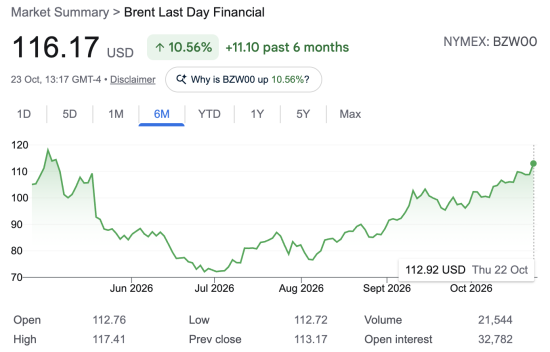
That's the chart of the benchmark Brent crude oil price over the last 6 months, and it is heading sharply upward again.
That is not surprising. Trump and Netanyahu are threatening to escalate their war with Iran. We are all going to pay the price.
The crises facing us are developing.
The question is, has John Healey noticed?
Thanks for reading this post.
You can share this post on social media of your choice by clicking these icons:
There are links to this blog's glossary in the above post that explain technical terms used in it. Follow them for more explanations.
You can subscribe to this blog's daily email here.
And if you would like to support this blog you can, here:

 Buy me a coffee!


Are there any figures for the amount of oil actually getting to market?
Yes.
It remains down and is expected to decline, which is the key issue.
I have just driven down to Exeter for the Garden Railway show and what is amazing is that despite high fuel prices and poor visibility as result of the heavy rain I kept on being passed by large cars and SUVs doing well over the speed limit.
Surely if oil supply is dropping this sort of behaviour is something that should be a major concern to the Government
Agreed
Enjoy the show.
The 1970s fuel shortage and 50 mph speed limit proved what little difference high speed makes to journey times. The majority of journeys average around 30 mph at best.
Thanks for another timely article.
If, as may be the case, “our” government continues to be “Neoliberal Faithful”, will he be allowed to notice “externalities”?
The “what is tax for?” page today has a “critical error” affecting display and function of the page.
I will take a look
Is it OK now?
I think I found a bug in the coding.
All ok now. 🙂
I can code, after all!
https://www.facebook.com/share/v/1GtAemxLWh/
This is a quite helpful, detailed analysis.
I think there is a note of irony in your comment
I found Wes Streeting’s announcement about having some food etc in stock patronising and useless.
And did not mention the one shortage which will quickly become critical.
Fuel for transport.
I think the Governemnt should indicate it understands the problems that are coming by one big announcment which will both be effective and really get peoples’ atention.
Reduce the maximum speed on road and motorwars to 50 mph.
Now.
Much to agree with
And encourage remote working again. It will upset the landlords, but they are the least of our worries.
Looking further ahead, a recent study has suggested the rest of the animal kingdom is suffering the same decline in fertility rates as our species, which points to an primarily environmental cause (such as microplastics) rather than socioeconomic factors:
https://www.nature.com/articles/s44454-026-00032-6
This would also mean a certain further decrease in Total Fertility Rates going forward, with a population peak probably before 2050, perhaps as soon as 2030. This will be of great benefit to the biosphere and will help with managing our 170% ecological overshoot but will require significant adjustments to how we all live. A shift of focus from exchange value to use value is paramount, consumerism and the market economy will not be viable.
Elsewhere, the climate change outlook keeps worsening with every data update and new study so it’s probably worth considering that the last time carbon dioxide levels were this high was 3 million years ago; at that time the sun’s output was about the same but sea levels were 50m higher and Artic summers were +14°C. It takes centuries for the warming caused by carbon dioxide to fully manifest so that is what is already baked into the system, even if we completely stopped producing carbon dioxide now. Unfortunately we have the tiger by the rail, having made our entire society completely dependent on the energy source that is destroying the biosphere on which we all depend.
Apologies for the lengthy and slightly off-topic post.
No problem, as young people say these days.
I think Trump, Netanyahu, and other so called strongmen want chaos and disruption. They know that historically, people flock to strongmen in a crisis. It is clearly in Netanyahu’s playbook to destroy Israel before they ever punish him for his crimes, and Trump isn’t done looting the ruins of the US yet.
Maybe not the right place but just seen the Channel 4 interview and you did an excellent job Richard.
One thing, have you seen this: https://www.nber.org/papers/w35854
Thank you. I was virtually at the Scottish Currency Group and have just seen this.
It feels as though they are concerned about frightening he horses.
They won’t say or do anything until the proverbial hits the fan and then say they are having to take emergency action to ‘help’ us and prevent things getting worse.
Easier than being courageous now and putting honest policy in place.
Is it them or are they getting instructions from elsewhere?
Only marginally relevant to this topic – so not intended for publication – but Chris Goodall writes a Carbon Commentary blog which I follow and greatly respect. You may find it interesting
carboncommentary@substack.com
His Item 4 today reads: Should utilities be privately or publicly owned?
Bloomberg carried an article about the comparative electricity prices of two towns in Massachusetts, separated by a narrow lake. On one side, customers of a *municipal* utility pay 16 cents per kWh while on the other side, households pay 34 cents, a price that rivals the costliest countries in Europe. Their supplier is *privately-owned* National Grid, a subsidiary of the UK’s main transmission operator. Massachusetts prices are generally high by US standards and have increased above inflation in recent years. Moreover the gap between the two sides of the lake has increased in recent years. Can we generalise from this example to say that municipally owned utilities are more capable of delivering lower priced electricity? Not necessarily, but new work from an *Oxford-based* group has suggested that the large difference in the costs of capital between publicly owned electricity generators and private competitors may mean a real difference in prices charged. Their analysis suggests that the cost of capital of a fully public system in today’s financial condition may be 3 to 5 % percent less than a private owner. As a result, they conclude the state could buy out all UK generating assets at a fair market price of £72bn to generate an annual saving in electricity bills of almost £15bn.
Much to agree with
Thank you