
The FT includes this headline this morning:
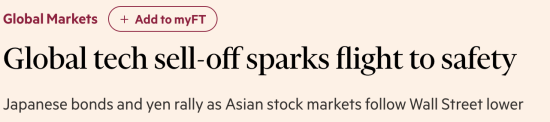
There are a number of things to note.
Firstly, there is growing evidence that the retreat from AI stocks has begun. Many stock markets fell overnight. The FT also has an article today saying that CalPERS, which is the Californian public employees' pension fund, and one of the largest in the world, has begun its retreat from AI stocks. That bubble is going to burst sometime soon.
Secondly, the direction of travel of the funds that have left the market is very interesting. The sell-off in the Japanese stock market has resulted in purchases of Japanese government bonds, reducing interest rates there as a consequence.
I was told recently that there was no crossover between these markets. I had suggested that interest rates on government bonds around the world have risen because of sales of those bonds to release funds to buy AI shares. It was said that this does not happen.
The evidence from this activity is very clear: it does, it has, and the implication is obvious. The increase in the cost of government borrowing has had nothing to do with increased risk perception, inflation fears or liquidity concerns. It has, instead, had everything to do with the irrationality of financial markets seeking to make a quick buck from AI share speculation.
Among the many threats AI has created so far, we can add the threat to stable government financing, and the consequent risk of economic austerity by governments that do not understand what is happening in the marketplace.
Let me be clear, then, about the third conclusion to draw, which is that as the value of AI shares tumbles, which it will, the value of government bonds will increase significantly.
The result will be that interest rates on these bonds will fall, because there is an inverse relationship between the value of government bonds and the effective interest rate that the government has to pay on them, and the consequence is that many of the imagined pressures that John Healey will say exist in his budget next week will disappear.
If he has not got the imagination to understand this possibility, then yet again, he will prove himself to be unfit to hold the post that he has. If he constrains the role of government in this country, at cost to millions of people within it, and lets the Bank of England continue to raise interest rates wholly inappropriately, punishing householders and renters alike, and all as an indirect consequence of AI share speculation, he will not have understood that it is the job of government to protect people against the consequences of market failure, which is what this AI speculation represents, and not compound its consequences.
I am expecting a massive reset in financial markets soon. The impact will be very significant, but as far as governments are concerned, the cost of their borrowing will fall significantly. If those who are forecasting in the Treasury and the Office for Budget Responsibility do not understand the likelihood of this, they, like too many in the market, are the victims of groupthink, and we will all pay a significant price for that, and that is my very real concern.
Thanks for reading this post.
You can share this post on social media of your choice by clicking these icons:
There are links to this blog's glossary in the above post that explain technical terms used in it. Follow them for more explanations.
You can subscribe to this blog's daily email here.
And if you would like to support this blog you can, here:

 Buy me a coffee!


I’d like to see evidence of that inverse relationship between the effective interest rate and the value of government bonds. Market participants are not daft and if there’s a causal link which wasn’t previously known, then they would pounce on it to make a bit more money, and then the relationship would disappear.
When I’m investing I always ask myself “Am I the stupid one here?”. It’s a question which has saved me a lot of time and money, typically 1-2 dabbles a year.
Start here. https://www.taxresearch.org.uk/Blog/2026/05/22/richard-murphys-view-on-government-bonds/#gsc.tab=0
A thin salami slice of AI this morning.
Just spent an hour with AI customer help bots, twas bots trying to manage AI bot distribution service, you ask for a human but there is no access to real human interface, someone who can join the dots. The system has a life of its own, which people can’t intervene even at the simplest level, like extending a collection time. Or resolving a failed QR and collection code. Humans are written out of the process, we are told tech will solve it all. Not!
I imagine companies were told this tech would save them time and money. Instead they have problems to unpick and recompense which any human could have averted if they were able to intervene.
Scale up this AI salami slice and it gives an idea what a big sausage of hubris AI is!
I sense your frustration
I suspect that you are quite right, Richard, in that there will be a so-called “flight to quality” away from speculative equities and ‘junk’ bonds into Sovereigns, which is a common reaction to market downturns. As you say, this would normally drive down yields.
A significant outcome of this probable change in conditions is twofold for those with DC pensions. Firstly, the notional valuation of their pension pots will decline, perhaps significantly. Secondly, and less obviously, this will lead to lower lifetime incomes from guaranteed annuities as gilts are still the main asset held by life offices to back their annuity “books”. Recently, annuity rates have been rising and the market is fiercely competitive between the six main firms in the market. Those who have not ‘jumped’ of late may come to regret that choice perhaps.
The other pricing anomaly in the ‘retirement market’ may become less attractive, too. This is using ‘fixed term income plans’ to remove investment risk for 5 years or so and taking no income. Very briefly (and this is NOT ADVICE), looking at a current case on my desk, a £1.5m DC fund will become a £2m DC fund in 5 years time (remember this is a nominal return) from such a contract. Fully covered by the FSCS with no upper limit, too. In the right circumstances, rather attractive. OK, few have a £1.5m pension fund, but this idea works whatever the fund size.
I jumped.
I am not expecting to regret it.
You really won’t, Richard!
I know 🙂
My pension now helps make this channel possible – the least profitable thing I have ever done in terms of financial return – and worth all the effort.
I’m no expert in pension schemes. I’m very fortunate to have a public sector, final salary, index linked pension. But I can’t help thinking that all you’ve outlined, Mark, indicates that DC pension schemes are a remarkably silly way to care for elderly people. Surely we can do better.
We could…with a state scheme
The Tories killed that
One aspect that I haven’t seen any discussion about, is the effect on many businesses if any I providers have to cease trading as a result of the bubble bursting. In 2008 a few financial empires closed. So, perhaps it could happen in the AI company world too.
Should it happen, the rest of the business world that have replaced humans with AI bots, will immediately loose their output. Surely this would potentially cause chaos? The real world output would tumble for those companies. Depending on how AI has been integrated into their business workflow, recovery may be difficult or even impossible to do quickly.
I realise that it would be almost impossible at this juncture to estimate the consequences, but the AI bubble bursting could surely cause tidal waves of trouble in industry. Why isn’t this mentioned?
Or perhaps I’m tilting at windmills?
You are not tilting at windmills. I think you have identified a significant risk that is receiving far too little attention.
There are two distinct issues here. The first is the financial consequences of an AI bubble bursting, which could be considerable given the scale of investment and the expectations built into company valuations.
The second, which is your point, is potentially more serious. Businesses are becoming dependent on AI systems that they neither own nor control. If major providers fail, withdraw services or dramatically increase their prices, those businesses could find themselves unable to operate effectively. We would undoubtedly be less efficient without it now.
The danger is particularly acute where businesses have dismissed staff and lost the knowledge and skills needed to perform tasks without AI.
A financial collapse would not necessarily mean that AI services stopped working. The underlying technology and infrastructure might survive a provider’s bankruptcy. But there is no guarantee of continuity, particularly if several interconnected providers encounter difficulties simultaneously.
This is another example of the dangers of concentrating economic power in a handful of companies.
We should be discussing resilience, contingency planning and the risks of excessive dependence on AI much more seriously than we are.
See yesterday’s news about 5,000 redundancies at Barclays Bank. What can possibly go wrong?
There is a sense that the decline of market and seaside towns across the country was precipitated by bank branch closures creating ‘banking deserts’ – a good example locally being Glastonbury – as the ‘high-street banks’ scrapped buildings, staff, and services and transferred this work entirely onto their customers and charge them for it. Many of our elderly clients are not equipped to deal with their finances in today’s world and the banks have (deliberately) created serious vulnerabilities – a poor show.
Much to agree with.
It’s happening here too.
Not complete yet, but many have gone.
For sure the biggest issue with IT systems has always been quality of end service. When Management Information Systems were introduced they initially didn’t regularly produce pertinent outputs and dependence on them was ruinous for corporates until they called in consultant engineers who knew their business well and could see where the garbage in or parameter mismatch problem was. Now the NHS wants to impose AI patient safety feedback designed without reference to any previous patient feedback research which has just been shut down. The results will be about as bad as having an eventually functioning system stop because its supplier has gone bust.
A technical question about the blog GUI…
There used to be a “subscribe to get notified about replies, without commenting” link, on blog posts, but I can’t see it anymore (android phone, firefox). Is that still an option?
It has, I am afraid, gone. The plugin we used to deliver that functionality got outdated and vulnerable, and we could not find a direct replacement for that functionality. Sorry!