
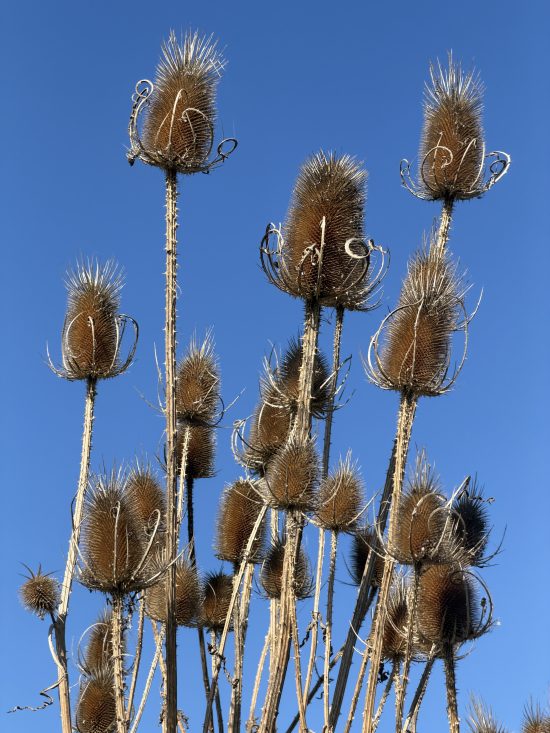
There is no reason to post this photo that I took at WWT Welney on Sunday, except to put up something that is not about doom and gloom.
Our economy is being immeasurably harmed by economic policy designed to reduce the well-being of most people.
But there are still moments of joy.
These teasels provided one.
So did the family of whooper swans I saw shortly afterwards, but failed to photograph successfully.
They brought four cygnets with them and were the first returnees from Iceland with young this autumn.
It is staggering that these birds can fly continuously for about 24 hours when just a few months old, covering about 1,200 miles in the process, but their arrival makes autumn feel a little more special.
If only everyone might see the hope in migration.
Thanks for reading this post.
You can share this post on social media of your choice by clicking these icons:
There are links to this blog's glossary in the above post that explain technical terms used in it. Follow them for more explanations.
You can subscribe to this blog's daily email here.
And if you would like to support this blog you can, here:

 Buy me a coffee!


Thanks for a moment of calm sanity. 🙂
I too get solace from nature. In my case watching birds along the mouth of the River Tay. On Sunday I saw a little egret for the first time in Scotland.
Lovely.
Very common here, as are cattle and great white becoming more so.
Lovely photo. I love a teasel, such a brilliant structure, and grow them in the gardens I work in.
I first became aware of them in the 70’s when I recieved one in a package of woollen cloth I’d commisioned from a couple who’d wove small quantities of very beautiful tweed – I liked to think they used them in the carding process – the tweed had a beautifully soft texture.
Thanks for sharing.
I learned this morning that there was once a belief that barnacle geese arrived fully formed as adults hatched from barnacles. This was before anyone understood avian migration. I think it’s a lovely myth! We live near to water areas where geese and ducks in particular gather. Ducks are in my view the most gossipy of all birds – I really enjoy watching and hearing them, even though they are fairly common.
That story is true, in that it was once told.
I like both ducks and geese and their sociability.
The problems are not going away any time soon. I think to be able to continue facing them and be in it for the long haul, it’s very important to find some balance.
“A poor life this if, full of care,
We have no time to stand and stare“
Agreed
From “Leisure” by W H Davies:
https://www.yourdailypoem.com/listpoem.jsp?poem_id=100
His best poem, by far. I have a collection of others, but none stands out like this.
Watching a pair of the Mendip Red Kites drift across our village on Sunday morning was quite the thing. That was the second time I’ve seen them come down the escarpment towards the levels – looking for lunch, no doubt.
I find them slightly more menacing than other birds of prey, and I suspect I see more birds than most people do.
But they are perfectly formed, and their flying in the wind is amazing.
Flying that far so young is impressive, and they’re very wise to get away from Iceland at this time of year!
We’re well into spring here in Tasmania and have a family of flightless Tasmanian Native Hens (aka Turbo-chooks because of how fast they can run) nesting across the driveway from our bedroom window who have just produced a brood of chicks of whom 3 are still chasing around after their parents.
The usual brood size is 6, though that tends to reduce quite quickly in the early days, presumably due a variety of predators. Something I have seen several times in past years but have never managed to catch on camera is one of the parents sitting on the grass….and then standing up to reveal 6 tiny, jet black chicks that run off in every direction. I assume the parent is warming them up for a while before they start eating again.
There is still plenty to smile at in the world and it is important not to loose sight of that.
Agreed.
It is why I go out, look and wonder.
To add to the wonder we have a platypus in our garden pond! The spring-fed ‘dam’ (Australian for pond/lake) is the head of a small stream, including a culvert under the road, which eventually finds it’s way to the river 2Km away. We have had a platypus find it’s way up here once before, but not for about 2 years. We’re hoping it will take up permanent residence this time.
How many people can nonchalantly sip their G&T and say “Oh, yes. We have a Duck Billed Platypus living in the pond outside our bedroom window”!!! My wife can’t stop grinning.
Thanks for your indulgence, back to the serious stuff.
🙂
The teasel in Richards lovely photograph looks like Dipsacus fullonum (common teasel), Judith B might be interested to know that the less common teasel Dipsacus sativa (which has hooked spikes on the seed head) is the one that was used in cloth production for fulling the woven cloth to produce a “nap” on the material. Carding is the process of preparing the raw wool before it is spun into yarn.
Thank you