
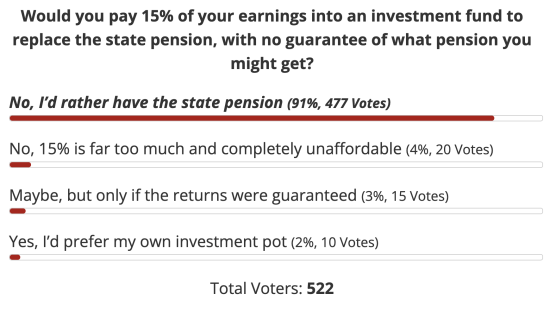
The poll I put up here yesterday on proposed changes to the UK state old-age pension suggested by a think tank linked to Reform was not too popular with readers here:
Interestingly, a broadly similar result was found amongst my Substack readers, although the proportion voting there was higher:
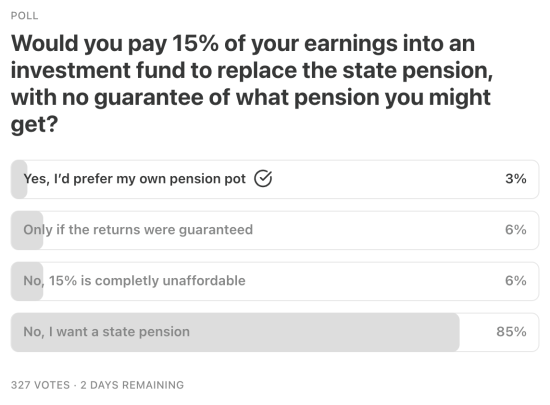
I inadvertently voted for the worst option on Substack. It's not my policy to ever vote in my own polls, but this was the first time I had done one on Substack, and I made a mistake.
What to conclude?
First, that I have sane readers.
Second, that there is very little trust in Reform.
Third, that there is as little trust in the financial services industry.
Fourth, that when a proposal feels as if it is about the promotion of the short-term interests of the City of London and financial advisers, very few people want to go near it with a barge pole.
Fifth, I think Reform will have considerable difficulties selling any idea like this to the electorate.
Sixth, the key communication issue with the electorate is, then, that what Reform is proposing is deeply detrimental to their best interests.
This last point is, ultimately, the key one. We know why people are attracted to Reform. The supposed reason is misplaced anger around migration. But if it becomes clear that electing Reform would be deeply detrimental to those who would remain in this country after they have expelled everyone they claim is undermining it, their case would become harder to make.
In that case, there is a job to do, and flooding social media with that message matters.
Thanks for reading this post.
You can share this post on social media of your choice by clicking these icons:
There are links to this blog's glossary in the above post that explain technical terms used in it. Follow them for more explanations.
You can subscribe to this blog's daily email here.
And if you would like to support this blog you can, here:

 Buy me a coffee!


Heartening.
Woebetide any political party foolish enough to tamper with the state pension. It’s almost as sacred as the NHS, despite the fact that it compares poorly with pensions in the EU in terms of how old you must be to receive it and the amount you get. I wasn’t surprised by the poll results even though the sample is small and biased toward a responsible welfare state.
Reform have a very serious problem; the people formulating policies are far removed from the support they rely on. They are also ‘sponsored’or led by individuals who no longer require any help from the state or no longer live in the UK. I believe they send a few people around pubs to listen to the wisdom of gobby blokes who have easy answers to what a gov should do. Needless to say, such blokes are often racist, comfortably off and believe anyone receiving welfare payments is a cheat. Most voters dislike such blowhards and their rantings, so if Reform are echoing this stuff, they are in trouble.
“Fifth, I think Reform will have considerable difficulties selling any idea like this to the electorate.”
They’ll use fear and panic in the event of a major financial crash and lots of people will fall for it because they are already pessimistic about the future and imagine that personalised accounts will give them more control.
The elderly might fall for it – by being told it will not affect them.
No one else will.
I would love to believe that but honestly there is a very large constituency of hyper individualistic men under the age of 50 out there who would say yes. A few women too.
Individualism runs very deep in England. It’s its biggest weakness IMO.
It’s tiresome to read that the political right are still peddling this stuff. It’s at least thirty years old. The pressure group which calls itself “The Adam Smith Institute” has historically proposed reform to the UK’s welfare and retirement systems through various iterations of privatised personal savings accounts, most notably proposing a single, portable Lifetime Investment Account or Fortune Account. It’s about transferring risk from the collective to the individual.
Agreed
When I was young there was great hype about endowment mortgages bringing a lump sum when you’d finished paying the mortgage off and AVCs (additional pension contributions) in the private sector rather than with my professional pension scheme and both turned out to be scams. I had to pay an additional £10,000 when I sold my house rather than getting money back and my AVC contributions will fund a pension of £150 a year. A state pension is the only thing that could be guaranteed. Harry Lesley Smith wrote a great book called “Harry’s Last Stand”. It should be mandatory reading in educational establishments because it a memoir of lived experience in a society without much in the way of social and health related support ie England in the twenties and thirties. This is why the ‘Politics of Care’ is such an important concept for us all to share.
Thank you.