
Is the UK facing a government debt interest crisis? More than £100 billion a year is now being spent on debt interest, and this is frequently presented as a threat to the government's finances. In this video, I argue that this misses the real issue.
The UK government cannot involuntarily run out of pounds with which to meet sterling-denominated payments. The important question is therefore not whether the interest can be paid, but who receives that money and what those payments do to the distribution of income and wealth.
Government interest payments become somebody else's income. They flow to the owners of government bonds and other savings, including pension funds, investment funds, banks and other financial institutions. But because financial wealth is distributed very unevenly in the UK, the benefits of those payments are also unevenly distributed.
I argue that this means higher government interest payments can contribute to wealth inequality. Those who already own substantial financial assets receive additional income, while households with little or no financial wealth receive very little direct benefit.
That raises an important question when politicians simultaneously argue that spending on pensions, health, education and other public services must be constrained. Why is austerity discussed for those services while the scale of interest payments to asset owners receives much less attention? Is this a case of austerity for the poor and interest for the rich?
The real interest crisis, in my view, is therefore not government solvency, or even the cost being paid. It is the distributional impact of transferring such large amounts of income to the owners of financial wealth while claiming that spending elsewhere must be restricted.
This is the audio version:
This is the transcript:
Has the UK got an interest crisis? More particularly, has the UK government got a debt interest crisis as a consequence of the interest that is being paid on the UK's so-called national debt? That interest is now costing more than £100 billion a year, and some people are claiming that this is totally unaffordable and will effectively bring our government's finances down.
Now, I don't believe that. It's completely untrue. The UK government can always settle its debts because it creates the money to make the payments. So there is no government debt crisis, but there are still questions to ask about such an extraordinary level of interest payments. And the real question to ask is who gets this money and what are the consequences?
Let's just put the figure in context. The latest estimate for debt interest payments was that, in the last financial year, the UK government paid £110 billion of interest, and the figure will, of course, be more this year, and it is expected to reach £137 billion in 2030. That is more than £30 billion greater than the cost in 2024. And the monetary scale of this transfer is then increasing.
And at the same time, interest is taking a bigger share of government spending. Debt interest was around 8% of total government spending in 2024-25, and that is expected to rise over the next few years, although not exceptionally, because, of course, the economy will grow as well. But that doesn't mean that this isn't an issue.
There is money being paid, but it's not lost as a consequence, as you would think is true when you hear some politicians talk about this. The fact is that this money isn't poured into a black hole. It becomes somebody else's income, and so it might become somebody else's wealth. And the important question is, who gets this money? And that matters because the total level of debt interest paid now exceeds 3% of the whole UK economy, and that figure might be rising to 4% by 2030.
So this is a question about distribution and not about government solvency. It's a question of who bears a public cost, and why should we continue to put up with that level of transfer of wealth from the public purse into the hands of private individuals.
And I stress yet again, this is not about government solvency. The UK government can afford to pay its debts. In fact, it doesn't have a problem with paying interest on this money because all this money represents is money saved with it by wealthy people, by banks, by pension funds, by foreign governments, and even by the Bank of England. And it cannot involuntarily run out of pounds with which to make the payments due with regard to the interest.
So, the question is very much about who benefits and not about whether this payment is affordable. And the reality is that whenever the UK government spends, the payment made becomes somebody else's income. It's vital to remember that. Most people don't. But every transaction has two sides. So when the government pays interest on a bond, or a gilt, as they're commonly called, the owner will receive it. When the government pays interest on an NS&I savings account, with that bank being run by the government, the person who has saved in that way gets the interest.
And let's not forget that the Bank of England also earns a significant amount from these interest payments because around one quarter of all government bonds are still owned by it. But the reality is that most of these payments go to pension funds, investment funds, and banks located in the UK, but some also abroad and some of the interest gets paid to foreign governments as well.
Don't worry about the foreign dimension of this. It really doesn't matter because we earn matching interest from abroad. That just represents the fact that savings are spread outside the country where they originate. That's normal, appropriate and balanced. So there is no foreign concern about this. All the payments are made in sterling. The UK government can afford to make them. They do not prejudice the well-being of our country.
But the point is, who owns the pension funds, the investment funds, and the banks, and even the companies that receive these interest payments? And what we can see from data is that wealth is very unevenly owned within the UK economy. This chart shows that. It is prepared on the basis of data produced by the UK Office for National Statistics, and the figures along the bottom of the UK population split into 10 equal groups by size.
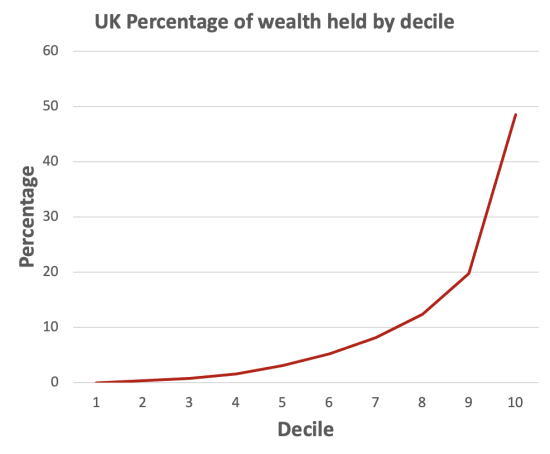
If you are in the poorest group, you are in decile one as shown on this chart. If you are in the richest 10% in the UK, you are in the group called Number 10, and you can see that that group owns almost half of all UK wealth between them. In fact, the top 1% of wealth owners in the UK own more than all the wealth owned by the bottom 50% of people in the UK as a whole, so unevenly shared is UK wealth.
And this is important because what those wealth owners actually own are the pension funds, the investment funds, the banks, or shares in them, and shares in large companies that also benefit from the interest payments. The poorest households in the UK have very little wealth capable of generating any financial returns. Those in the top 10% or so of the UK population generate a lot of returns either directly to themselves or indirectly through their pension funds and other assets. And they therefore benefit from these interest payments by the government because these funds in which they have a stake are the people who own the UK government's bonds. That matters.
What we are seeing is that the UK government is paying out substantial amounts of money for people who are already rich. And, as a consequence, their income goes up. But so too does their wealth because, of course, if you have enough money to be able to save already, any income that you earn on your investments will probably simply accumulate as greater wealth from then on.
The fact is, as a consequence, that the UK government is increasing wealth inequality in the UK, and things like the subsidies that the UK government provides to pension fund contributions only exacerbate this trend by providing an extra subsidy to those who are already being paid large amounts of interest by the UK government.
We are seeing the inequality that we know our economy suffers from increase as a result, and this does then matter. What we are seeing is interest rate policy creating a distributional problem in the UK, and to me that is an issue which requires attention.
And so what we need to do in that case is to raise the question about why is the benefit of this payment so unevenly distributed and should we as a result be asking questions about it?
And let's put this in proportion. The wealthiest 10% or so in the UK economy are picking up over £50 billion a year as a consequence of these payments. And that's equivalent to around one third of the total old age pensions paid in this country each year as well.
Now old age pensions are paid to prevent poverty and to support those who have no other way of keeping themselves going. But these payments of interest are going to those who are already wealthy, and yet nobody's talking about this.
We hear talk about cutting the pension triple lock, but we don't hear talk about how we can cut the amount of interest paid to those who are already wealthy and yet we could. We could cut the interest rate, for example. The fact is, though, we don't do that. So there is austerity for some and interest for others.
That's wrong. When people are being told the government has to be constrained with regard to its spending on education, on health, on pensions, on crime, on defence, on justice, then we should instead be asking why we are still spending to make the rich richer?
This is the contradiction which is at the heart of the UK political debate and which isn't being talked about. And this, in my opinion, is the real interest crisis we face in the UK.
The problem is not that the UK government might be unable to pay its debts. It can. It will. There is no question about that. The problem is what these enormous payments do to the distribution of income and wealth in the UK, and why they leave the most vulnerable even more vulnerable still, because the government claims it has to deliver austerity as a consequence of making the rich even richer in this country. The government is providing a substantial income to the owners of financial assets in the UK, but why isn't it instead making it a priority to increase the well-being of those who are most vulnerable?
Who gets money is a question that always matters. The government can create the pounds to pay its debts. The economic consequences of those payments should not be ignored.
Those interest payments are the problem. And the result is that we have an issue which we should be talking about in the UK economy. I believe we need to tackle the imbalance that these interest payments give rise to, but you might disagree.
There's a poll down below. You have the opportunity to leave your comments as well. Please do take part. Please do like and share this video. Please do subscribe to our channel. And please hit that bell button because that means you will then be told when we make another video, although, let's be honest, that tends to be every day. And if you like what we are doing and support the work that we're trying to undertake so that people better understand the way in which our economy works and the way in which politicians should be talking about it, please do make a donation. There's a button down below for that as well. It's called Ko-fi, or coffee, and that helps buy some more of this, and I promise coffee helps make these things.
Poll
Thanks for reading this post.
You can share this post on social media of your choice by clicking these icons:
There are links to this blog's glossary in the above post that explain technical terms used in it. Follow them for more explanations.
You can subscribe to this blog's daily email here.
And if you would like to support this blog you can, here:

 Buy me a coffee!


Thanks for an article which uses our essential “friend” “Double Entry Questioning” so well!
Might it be that if all students were taught to always ask the questions below about current practices, conventions etc. and every projected and actual change, our society would be more transparent, fairer, more sustainable in itself and for its environments and generally better?
1) How much of what is involved, including time, effort, emotion, attitude, skills, power, status and money etc.?
2) Who gains?
3) Who loses?
4) Who breaks about even?
5) Who is well informed and really understands the matter and why?
6) Who is not well informed ditto?
Thank you
‘Austerity for some, interest for others’.
Quite right, and quite wrong in practice from a moral point of view – the high handed view of finance is that debt is useful tool to curb spending even on things we need actually exists believe you me.
You present yourself as the economist who explains how things really work, but this video misleads your audience on the basics.
You can’t have it both ways. You insist the government “cannot run out of pounds,” so interest is no constraint. Then you blame interest for austerity in health and pensions. If money is limitless, interest can’t be squeezing anything. If it is squeezing budgets, then solvency and market confidence matter, and your first claim collapses. Your remedy, “we could cut the interest rate,” is equally hollow. The Bank of England, not ministers, sets Bank Rate, and most existing gilts carry fixed coupons that no rate cut touches.
Your “£50 billion to the richest 10%” is arithmetic sleight of hand. You admit the Bank of England holds about a quarter of gilts, so that interest just circulates back within the state. Nearly a third are held overseas. A large chunk of the headline cost is index-linked uplift, not cash paid to anyone. And the pension funds you demonise mostly hold gilts to pay ordinary retirees’ defined-benefit pensions, not billionaires.
You know all of this. Leaving it out isn’t simplification. It’s telling your viewers a story the facts don’t support.
I do not think interest should cause austerity.
In our world, it is.
Are yoy too stupid to spot the difference? I do not think my raedes / viewers are.
Don’t call again.
Andrew Marsh hasn’t either read or understood what Richard wrote. It wasn’t Richard who said that interest on government debt makes austerity a necessity, but politicians and ministers.
Quite so.
But Richard doesn’t say, “interest is no constraint”.
Another straw man.
As always….
I hope you are encouraged by Jamie Driscoll and “Hostage Nation” report, which seems to take aim at the household analogy, and “We can’t afford it”.
The report is also critical of the one-trick-monkey role of the Bank of England and its obsession with interest rates.
Were you involved?
https://www.thecanary.co/uk/news/2026/09/24/hostage-nation/?
Jamie also seems committed to coalition building rather than factional conflict.
I am
Jamie and I have spoken
So really what is needed is limits on how much pension and ISA wealth can be held and at the most a 20% tax relief for private pensions. Also higher taxes on higher earnings.
Agreed. See the Taxing Wealth Report.
A short interview with you on R4 Today programme next time they exclaim how much interest ‘we’ are paying – to explain to whom we are paying it.<p>
It should be a very simple and obvious question to ask – bit is never asked
That would be fun…..
High interest rates redistribute money from those without to those with wealth. It increases inequality, which is far too high, and thereby damages the economy.
But government interest payments are a deliberate choice. The government does not have to pay £100 billion to the already wealthy. I’m not suggesting that the government reneges on its commitments nor that it inflates the debt away. But it does have other choices.
Firstly it could introduce tiered interest on Bank of England reserves held by commercial banks, as is done by other major central banks. That itself saves around £10 billion. More importantly it allows the government to reduce the interest paid on gilts.
Firstly, this allows the government to finance itself via its Ways and Means account (basically its overdraft) rather than selling gilts (“borrowing” the money). Doing this adds to reserves but if it doesn’t pay interest on these that is not a problem. Likewise the government pays, effectively, no interested in its overdraft with the BoE (which it owns). If the government doesn’t sell bonds their yield, what the government pays, will reduce.
More than this, the government can now offer low yield bonds to commercial banks in lieu of reserves. They will buy these because low yield is better than nothing. With the money from these sales the government can now buy high yield (hence low cost) bonds on the open market, reducing its interest payments. These sales will increase BoE reserves again. But it can repeat the process gradually reducing the overall interest it pays on its debt.
The point is that, the government has complete control over the interest it pays. In not exercising this control it is choosing to continue to redistribute money from the poor to the wealthy. It should not be doing that.
Much to agree with
Richard, I’m intrigued by your statement that we don’t have to “worry about the foreign dimension of this. It really doesn’t matter because we earn matching interest from abroad.” Is this matching an accounting identity or simply that interest paid to foreign holders of UK government debt happens to be broadly matched by interest received from abroad?
Whatever the answer, the figures you have alerted us to, showing how our government is prepared to transfer huge sums of money to the already financially comfortable ( or more) while cavilling over social security payments.
Let me be clear: the government does not transfer huge sums abroad. It pays in sterling. And we happen to earn in foreign currency. I am saying that fretting over this is greatly overstated in significance.
Isn’t the effective interest rate set by a bond auction? Surely if the government unilaterally lowered the interest rate, they’d find themselves unable to borrow the amount of money they wanted?
They do not need to borrow, as I have explained many times.
The government creates our currency. It offers the City a deposit facility. If they don’t want it, that’s fine. But they will quickly find they do. They cannot do without bonds. The government always can.
Two questions, which can be ignored if not appropriate. Does Mr Marsh not have a point when he says pension fund payments go to ordinary people not billionaires? Does ‘Hostage Nation’ which is rather lengthy have any information not covered by this blog?
I am not sure who Mr Marsh is.
I have not had time to read Hostage Nation.
Sorry.
Sorry, Richard, but I was left a little unsure, after listening to this video, as to what the potential solution might be. You have said in the past that interest rates should be lower, but even if they were then that doesn’t change the distribution of where those interest payments end up – there’ll just be slightly less of them. So, what is the solution to this distributional issue? Thanks
Start with lower rates
And then as I say elsewhere, higher taxes on investment income
One video, one idea though
Thankyou Richard. Could I also please clarify one other point – In questioning how we should view this “national debt” you have asked us to think of the example of NS&i savings accounts, & have basically said that we wouldn’t question those any more than we would a high street bank paying interest on savings accounts, & that gilts should really be seen in a similar light. One thing that occurs to me though – we don’t question banks paying interest on savings accounts because they can basically take that money & invest it or whatever & make more money on it than what they pay out in interest. But the government doesn’t really do that, though, do they? So for the banks paying out interest is a cost against the profits they make (which ends up being a net positive for them), but for the government, paying out that interest is simply a cost….. no…?
There is a difference, but I don’t think it changes the argument.
A government does not need your savings in order to lend them on or invest them elsewhere. When it pays interest on NS&I or gilts, it is paying people for choosing to hold a particular form of government-backed savings.
That interest is certainly government spending, and therefore has a cost in the sense that it adds income to the private sector. But government spending is not justified because it generates a financial profit for government. We don’t ask whether spending on a school, railway or hospital makes a financial profit either.
The relevant questions are whether providing safe savings products serves a useful economic and social purpose, what rate of interest is appropriate, and what distributional consequences result. I think government-backed savings do serve a useful purpose. That does not mean the government should pay unnecessarily high rates on them.
Actually, Richard, there is one other thing I’d like to put to you (& Tom, in fact, as this is more a matter of the recordings than the content). You are a very reasonable person. You are also very logical. In this matter I hope to persuade you that being “reasonable” is not always logical, whereas being logical is the only reasonable course of action. I place great value on your output. I would very much like to feel like I understood it all more fully. I am limited, however, in the times when I can listen to it – necessarily in noisy environments where, even with the volume fully turned up, I miss large chucks of what you are saying. This is where I feel your “reasonableness” comes into things – you record your videos at a very “reasonable” / moderate volume, which of course I understand. However, I feel your recording volume is particularly moderate in comparison with other podcasts I listen to, which I am actually able to hear pretty much all of, despite the noise. There may be others who also struggle (perhaps also in noisy environments, or just being hard of hearing). But even if I am the only listener who suffers from this issue, what I would like to put to you is that, really, the only “logical” approach to this is to record your videos at the maximum recording gain possible before you start to get distortion. This is because everybody else has the option to reduce their volume if it’s too loud for them, but those who struggle to hear can only ever go to the maximum their devices will permit. I very much hope you will find this logic to be reasonable….!!
Thank you. I will ask Tom to look at this because I certainly want the videos to be readily audible, including in less than ideal listening conditions.
I am less persuaded by your logic, though. Logic only tells us what follows from particular assumptions; it does not establish that those assumptions are right. Reasonableness requires judgement about them as well.
And I am not sure that simply recording at the maximum possible gain is necessarily the answer either. There are issues of compression, normalisation, dynamic range and sound quality involved. Tom understands those considerably better than I do, so I will leave the technical solution to him.
But the underlying point about audibility is well made, and we will look at it.