
There is a saying, attributed to Einstein but probably apocryphally, that keeping on doing something and hoping that you get a better outcome next time is a sign of madness. That idea came to mind this morning when I read the Financial Times reports on the OECD's latest labour forecasts, which were themselves published yesterday.
According to those reports, the G7 countries are struggling to deliver on their key economic objective, which is growth:
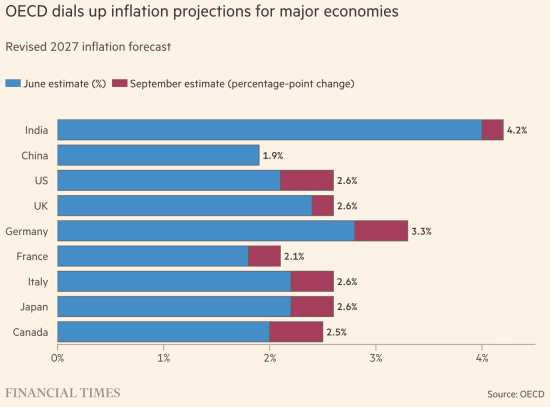
If this is all they can do, why are they making this their goal?
At the same time, as the FT notes:
Surging government bond yields are a “major concern” to countries' public finances given the mounting share of spending being consumed by debt interest, the OECD said on Wednesday, as it urged nations to rein in expenditure.
As far as I could see, everything else that was noted was pretty much padding.
They did note that France is doing a great deal more to help people with the costs of energy price increases than anyone else, not that it appears to be helping Macron very much.
They also said that the UK does not need to increase interest rates to solve any pending inflation problem that we might have because, in their opinion, existing high rates, coupled with the poor state of economic confidence in the UK, are, in combination, sufficient at this moment to suppress the economy sufficiently in this country to ensure that interest rate rises are not really needed.
Add it all up, and you get a summary of an economic system that is, against the targets it has set for itself, failing. Neoliberalism says growth is the goal, but if that is happening, the benefit is not being perceived. And it says debt, as a metaphor for government action, must be constrained, and it is not being so, despite which growth remains poor.
The OECD, as a champion of neoliberal thinking, does, of course, package its comments in a way that suggests the economic threats that we face can be managed, but if it had bothered to think about what it was writing, what it would have realised is that what it is looking at is an economic system that is failing, at least in the terms that it has set for itself.
Unfortunately, like the UK Treasury and most economists and governments around the world, the OECD does not give itself the opportunity to think about, let alone appraise, the big questions that the data it produces might suggest. As a result, its prescription for the world economy is that we keep doing the same thing in the hope that next time it might be better.
It won't be.
The neoliberal system is over. Next time we have to do something different. The problem is, our politicians have not realised this yet, and our economists, rare exceptions apart, do not have the intellectual ability to imagine anything other than what they were told was required of them when they were students, after which they gave up thinking altogether.
Thanks for reading this post.
You can share this post on social media of your choice by clicking these icons:
There are links to this blog's glossary in the above post that explain technical terms used in it. Follow them for more explanations.
You can subscribe to this blog's daily email here.
And if you would like to support this blog you can, here:

 Buy me a coffee!

No doubt you saw the ONS announcement last week that they have revised productivity figures for the UK for the last three decades by changing they way they estimate the denominator (productivity = output / hours). There was a systematic upward bias in their labour force surveying which overestimated the amount of work being done.
So now they say that productivity grew by 2.0% per year before 2008 (not 2.1%) and by 1.3% afterwards (not 0.7%). That is, most of the depressed productivity after 2008 – which feeds into lower growth – was a statistical mistake. The growth in productivity fell back a bit. It did not collapse. Politicians were making decision to address a “problem” that did not exist. A turnip ghost to frighten the dull witted.
Similarly mantra of chasing GDP growth – the nunerator in productivity – is also chasing a statistics phantom. We can increase GDP in all sorts of destructive ways. It ignores many things we want, adds in things that do not exist, and estimates many others. Most importantly, it does not tell us who benefits from growth.
You quote the FT’s concern that a growing share of government spending goes on debt interest. Firstly, a bond yield rising means the capital value of existing bonds has fallen, but for most of them, the internet payable remains the same. Interest only rises if new bonds are issued at higher rates than the ones repaid (and on index linked bonds, systematically over counted because increases in amounts due on redemption are booked immediately as interest). Secondly, hardly anyone asks who gets the interest. The money is not thrown down the drain. Holders of bonds are getting income that could in principle be taxed and then spent productively in the economy.
Thank you.
And productivity is still down.
Neoliberalism is not working.
This reminds me of the WW2 analogy – the war was won shortly after D Day, but it was up to the Axis powers, how much death and destruction there would be between D Day and VE/VJ days.
Unfortunately, they insanely opted for maximum suffering and damage.
Neoliberalism is OVER, and they can either surrender now, or choose to fight on pointlessly, till VECC (Victory in Economics & Climate Catastrophe) Day, in which case, there will a lot of pain and suffering and death for us all.
But these billionaires, tech bros and their political and media lackeys have LOST.
I hope you are right. And that the suffering is minimised.
In the here and now I think it is quite possible that we are in a period of self destructive stupidity that we may not be able to escape from.
What ever is left of human history after this though is where the final judgement will be made.
It is crowded in my house sharing it with a herd of elephants…
I read that Einstein was quite taken with the rule of 72 when explained to him.
If we started in, say, 2000 then 2% GDP growth will mean that by 2036, using the rule of 72, to sustain that growth we will need two London’s, two Birmingham’s,… and two of lots of other things. Growth is strongly related to population? I suppose I can wear two shirts and two pairs of trousers. I can have a go at eating twice as much. But I can’t do two jobs at the same time though I could work 16 hours every day. I can’t drive two cars at the same time.
In short GDP growth just will not happen at 2%. Looking from the other direction with the fertility rate at about 1.4 when it needs to be 2.1 to stand still, the 2036 target will not be met. Yet government is basing policy on unattainable growth rates.
Along with the long-game thinking you propose we need to prepare for a different population profile with smaller population? Once all the baby-boomers have died off, I am one, then things might be easier in this country. In particular renewable energy generation, energy storage and sustainable food production will see that reduced population in good shape. We’ve never had it so good but we do have a chance to make it better. Shame I won’t be around to see it.
Chris Rick
Thank you.
This is causal tangential? Foreign correspondent Chris Hedges who has lived for 20 years internationally in societies in collapse, explains USA’s own collapse in psychosis ” if hope becomes something that you express through illusion then it is not hope it is fantasy. ”
The cult of the self is in biblical terms a form of idolatry- everything is about you, whether it is the worship of money or power it all.goes back to the self, it all goes back to creating little monuments to yourself all investment into a particular goal into self aggrandisement ”
“We are replicating past civilisations under collapse, an elite that is no longer connected with the real that retreats into their bubbles, like the forbidden city or Versailles, it has total polotical power, the crumbling of infrastructure, civilisation always decay, their cities always go first, we’ve already done that, the retreat into illusion. The danger is that this time we go down the whole planet is going with us. ”
“The corporate state has made a war against critical thinking and in particular humanities, because humanities at their best are about teaching people how to think rather than what to think. They’re about teaching people how to question assumptions and structures. The discipline of the humanities is subversive. ”
“people interpret their problems as personal problems rather than political.or social problems. ”
“The lunatic fringe in times like that suddenly siezes power….n breakdown of society… clamour for their own enslavement. Unfettered unregulated capitalism is a revolutionary force. As Karl Marx understood it exploits everything. Everything becomes a commodity, human beings become a commodity, the natural world becomes a commodity, that it exploits until exhaustion or collapse and that is why the environmental crisis is imminently twinned with the economic crisis. ”