
Every morning starts, for me, with a review of the many overnight emails that I receive, most of them from news organisations.
There was a recurring theme of woe this morning. The New York Times' 'On Politics' newsletter contained this quote from its Chief Economics Correspondent, Ben Casselman:
If A.I. succeeds, then it may kill all of our jobs. If it fails, then the whole economy falls apart, and your 401(k) blows up, and maybe you still lose your job. You can kind of understand why maybe people aren't super enthusiastic about the state of things.
A 401k is a US personal pension. The article then went on to list woes about inflation, diesel and petrol prices, stock market risks, and wages lagging behind the cost of living. And, at the top end, the concern is that consumer spending will collapse if share prices do. There were few silver linings.
The FT's headlines told much the same story. I am not providing links; if you have access, the stories will be easy to find.
This story followed the New York Times lead, focusing on the growing diesel shortage worldwide:

And it would seem that Trump has noticed the consequences of his actions:

I am not expecting him to be heard on this occasion.
Then there was this:
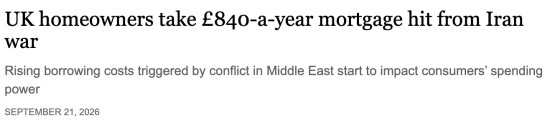
As I keep saying, we are in a war economy. Burnham has not noticed, but has AI:

As have the staff in AI companies, who it seems don't want to end the world, even if their bosses do:

All good news then, today.
Thanks for reading this post.
You can share this post on social media of your choice by clicking these icons:
There are links to this blog's glossary in the above post that explain technical terms used in it. Follow them for more explanations.
You can subscribe to this blog's daily email here.
And if you would like to support this blog you can, here:

 Buy me a coffee!

Add in the fact that 7 of the 9 planetary boundaries have been exceeded by highest levels to date adds to the good news. France and Switzerland still in severe drought, no significant rain since May, 830 mm of rain in 48 hours on an island not so far from Tokyo….the list goes on.
Market forces goons would no doubt say it’s an opportunity for Japan to export water…
Notice how the GOP members of Congress and Trump have difficulty accepting that the real reason for petrol. deisel and aviation fuel shortages etc is the US/Israel war on Iran.
Chatting with a family member, who is in IT, about the use of AI to process job applications I was told that the companies all tend to use the same software. You get rejected by the first organisiation. Your rejection is “stored” in the software. Guess what? You apply to another company using the same software, your previous” rejection” comes up and you are rejected again.
What a waste ot talent.
This seemed implausible. I put your whole first para into AI and asked if it were true. The response was:
No, this is completely untrue. This is a widespread myth and a misunderstanding of how Applicant Tracking Systems (ATS) function.
There was much more detail about why it wasn’t true (violation of GDPR for example).
I don’t know whether it’s true or not. But the comment risks spreading misinformation. 🙁
I note that.
I posted the comment a little uneasily.
This just highlights what a dystopian mindf**k we’re all in danger of being sucked into.
Your family member in IT is describing browser cookies.
Interesting to see how the US Diesel export ban will prevent their refineries from producing.
Basically if they cant sell the stuff they will run out of storage space and have to shut down
It’s hard to be optimistic in these times, so below is a link to the good news for September. Enjoy!
https://www.youtube.com/watch?v=K_ToMu4_p98
🙂
Many thanks for this link.
Seems like a quite a few people (in senior positions) inhabit a diff reality.
I find AI quite useful.
Latest use: an update on European weather specifically impacts on gas demand and El Nino with a focus on Jan, Feb, March 2027 when things may get very interesting – ultra cold periods etc.
Yes I know El Nino brings “milder” weather. The problem is “on average milder weather” but ultra cold events can (& have) happened even in El Nino years. Couple that to low levels of gas storage – and weather “events” @ the end of winter when storage is ultra low. I’m not “pro-AI”; I just find it useful for things like this (& it only reports if there are exceptions, so it is hardly using vast amounts of energy).
Its entirely possible that the raft of scare stories about a new technology that’s in the middle of an expanding investment bubble serves the major plays. It’s certainly a distraction from their own economic vulnerability and the dusk being kicked up will cloud the path to inevitable regulation.
The overwhelming power of the technology is being emphasised and there is a fight by each company to demonstrate they are the safe pair of hand, worthy of continued investment and eventually regulatory protection which will give commercial advantage.
The big question is AI so different from other massive technological advanced that did mark there end of one world and the start of another.
I’m sharing a very long and sober substance article which examines possible futures for today’s biggest AI with some old fashioned analysis for the commercial and economic fundamentals. It reflects on the long history of innovation and sets down clearly many of the alternative and inevitabilities that lie ahead. No answers. It’s to early. We can but guess at the secondary and tertiary impacts. The decisions being made now by governments will be critical.
I’m (just) old enough to remember the existential worries about nuclear. I’m optimistic about the ability of humans to adapt and survive. Less so the ability of our leaders to lead. And accepting that it takes a mass crisis before we do what we know needs to be done.
The future is the consequence of what we do today.
https://aswathdamodaran.substack.com/p/ais-bar-mitzvah-moment-from-hope?utm_source=share&utm_medium=android&r=2k55lx
The AI companies are in competition with each other to prove that their technology is safe but there are problems with other AI software. They are gaming a monopoly where they get to set the terms of the license. 1 company becomes a national champion and when the ai crisis comes, this champion is too big to fail and is handed a big bail-in from the government. We have lived with national champions before. The problem is that politicans are not making the case for a national champion. They still talking about market innovation.