
What is a business? The conventional economic answer tends to focus on firms, markets, capital and profit. I think that misses the most important part of the story: people.
Business is organised human activity. People work together to make things, provide services, solve problems and meet needs. Companies, markets and capital can all play a role in that process, but none of them is the same thing as business itself.
That distinction matters because it changes how we think about profit. A genuine business needs sufficient income to survive, invest and continue its activities. But that does not mean maximising profit is its purpose. Profit can be a means of sustaining a business rather than the reason why the business exists.
That then raises a much bigger question. If human work creates value, why does conventional accounting treat labour as a cost while treating the residual profit as belonging to capital?
I also look at the responsibilities businesses have to workers, customers, suppliers, communities, government, and the environment they depend on, and stress that business and capitalism are not synonymous. Understanding the difference might fundamentally change how we think about business, companies, work, profit and who should benefit from economic activity.
This video is part of my Understanding Economics series, which explains economics as it operates in the real world. You can find links to other videos in the series here.
This is the audio version:
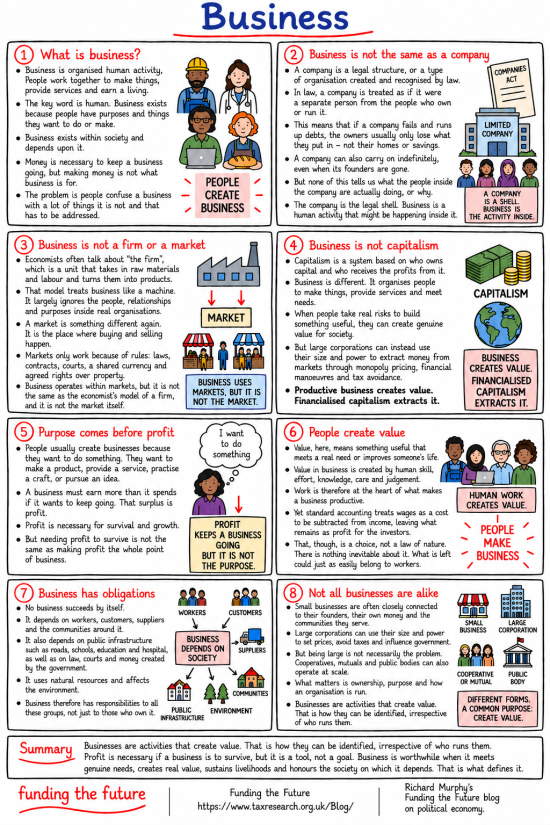
This infographic supports this video:
This is the transcript:
Hello, I'm Richard Murphy, and this is Understanding Economics, the series of videos that I'm making to explain the world of economics in the way that I see it. Now, I stress that is about the way I see economics. It is not the way in which every economist sees the world, but I want to explain that world in a way that I think you will understand and not in the absurd way that most economists present.
So, accepting that point, I am asking questions about the real world and what goes on in it. And in this video I want to ask the question: what is business? That's because very often that term ‘business' is confused with other forms of activity and other descriptions of types of economic organisation. And so we need to cut through and answer that question: what is business?
Well, in my opinion, business is organised human activity. It is people working together to make things, to provide services, and to earn a living. And the key word in the statement I've just made is ‘human'. Business exists because people have purposes and they have things they want to make and things they want to do. Businesses exist within society to meet needs, and they are dependent upon that society to do so.
Money is necessary to keep a business going, but making money is not what business is for. The problem is, people confuse a business with a lot of other things, and that's the first issue I have to deal with in this video.
Business is not, for example, the same thing as a company. A company is a legal structure or a type of organisation created and recognised by law. In law, a company is treated as if it were a separate person from the people who own or run it. This means that if a company fails and runs up debts, the owners usually only lose what they have put into the company and not their homes or their savings. A company can also run indefinitely even when its founders are gone. But none of this tells us what the people inside the company are actually doing or why.
The company is a legal shell. Business is a human activity that might be happening inside it. But let me be clear: just because an activity is undertaken by a company, it does not mean that it is a business. There are different types of economic activity that I will mention shortly that could be undertaken by a company, and they're not businesses at all.
Let's also be clear. Economists often talk about a thing called the firm, which is a unit that takes in raw materials and labour and turns them into products. This is how they might describe a business, but it is not what I call a business. The reason why is that this is a description of something like a machine. It largely ignores the people, relationships, and purpose inside real organisations. And as such, it doesn't describe that essential human element that I ascribe to business activity.
So the business is not the firm that economists describe. Nor is a business a market. A market is something different again. It is the place where buying and selling happens. So of course, businesses are present in markets, but that doesn't mean to say they are markets.
Now, markets only work because of rules, laws, contracts, courts, a shared currency, and agreed rights over property. So, as I stress, businesses operate within markets, but they are not the same thing as the economist's model of either a firm or of the market itself.
And business is not about capitalism. Capital means the money, buildings, machines, and assets that investors put into a business. Capitalism is not the same as capital. Capitalism is a system built around who owns capital and who receives the profits from it. Business is different. It is the activity through which people organise to make things, provide services and meet needs.
When people take real risks to build something useful, they can create genuine value for society. That is obviously true. But some large corporations, maybe most large corporations, focus less on making useful things these days and more on using their power and size to extract value or money from markets through monopoly pricing, financial manoeuvring and avoiding taxes.
Productive business and that kind of profit-seeking activity have very little in common. That's the critical point I'm making. Capitalism does not equate to business, and business does not equate to capitalism because capitalism describes a particular form of money extraction and business describes a form of productive activity.
And when we come to business, let's be clear: purpose comes before profit. People usually create businesses because they want to do something. They want to make a product, provide a service, practise a craft, or pursue an idea. And I have, in my career as a chartered accountant, advised hundreds and maybe thousands of such businesses over time. I have also been a business person.
A business must bring in more money than it spends if it wants to keep going, and that surplus is called profit by economists and profit is therefore necessary for survival and growth. But needing profit to survive is not the same thing as making profit the whole point of business activity.
Economists who claim that business activity is all about profit have almost certainly never been near a real business. And they most certainly will never have run one, because anybody who has will know that profit is not the day-to-day focus of any business. Keeping the thing going is. Profit helps that process, but it is by no means the sole focus of attention inside any genuine business activity. And that is because it is people who create value.
Value here means something useful that meets a real need or improves someone's life. It is tangible. Value in business is created by human skill, effort, knowledge, care and judgement. Work is therefore at the heart of what makes a business productive. That is why profit is not, because it is work that is the focus of a business activity.
Yet standard accounting treats wages as a cost to be subtracted from income, leaving what remains as profit for the investors. That, though, is a choice and not a law of nature. I'm questioning whether that is right, in the case of genuine business activity. There is nothing inevitable about this choice. What is left could just as easily belong to workers as it does to capital, and I am genuinely wondering whether it should. Have we got accounting right in that case? We might be accounting for capital when we construct accounts in the way that we do now, but business, as I've already said, is not the same as capital or capitalism. It's an entirely different form of productive activity.
But at the same time, let's be clear, business has obligations, and these should be reflected in its organisation and in its accounting. No business succeeds by itself. It depends on workers, customers, suppliers, and the communities that surround it. It also depends on public infrastructure such as roads, schools, education, and hospitals, as well as on law, courts, and money created by the government. It uses natural resources, and it affects the environment. Business, therefore, has a responsibility to all of these groups and not just to those who own it.
The idea that the shareholders are paramount is, therefore, for the fairies. It is nonsense. It is untrue, and as a matter of fact, it is not what is reflected in UK company law.
There's a final distinction to make, and that is that not all businesses are alike. Small businesses are usually connected to their founders' purposes, their own money, and the communities they serve in which they exist, and from which they draw their main resource, which is people.
Large corporations often work very differently. They can use their size and market power to set high prices, avoid taxes through offshore arrangements, and shape political decisions in their own favour.
But size alone is not the issue here. Co-operatives owned by their members and mutual organisations, such as some building societies, as well as public bodies, can also operate at scale while serving broader purposes.
What really matters then is what the purpose of the organisation is, who might own it, and what is it trying to do?
This is what matters. Doing something is what identifies a business, and so too does how it is run identify a business, because if it is run to create something genuinely useful, that is a business activity. If it is run to simply extract money from others, that is capitalism, and this distinction is real and has to be remembered.
Business is organised around human purpose. Profit is necessary if a business is to survive, but it is a tool and not a goal. Business is worthwhile when it meets genuine needs, creates real value, sustains livelihoods, and honours the society and planet on which it depends. That is what defines it. Everything else is something else.
This is one of my Understanding Economics series. You will find a playlist for others in this series down below this video. Please have a look at it. Start at the beginning because they are made in a particular order, and that is the best place to start in this case. We hope you enjoy them. Please let us have your comments. They will help us decide where we go next.
Poll
Thanks for reading this post.
You can share this post on social media of your choice by clicking these icons:
There are links to this blog's glossary in the above post that explain technical terms used in it. Follow them for more explanations.
You can subscribe to this blog's daily email here.
And if you would like to support this blog you can, here:

 Buy me a coffee!

Thanks to all for another inviting, informed infographic!
”A system is corrupt when it is strictly-profit driven, not driven to serve the best interests of its people.” (Unknown)
You’re absolutely flying with this series. Just watching the “work” one – a matter close to my heart as my comments may have made clear.
Keep it up!
Thank you. It was slow to take off. It was worth persisting.
This is a very good perspective on what business is really about. I can think of many small businesses I’ve come across where the owner and employees were very much in tune with what you describe. They nearly all believed they were serving the community first and last. Profit was a side issue which only became a concern when they couldn’t cover costs.
They tended to fail only when the demand fell off, or they couldn’t cover costs and their clients couldn’t afford to pay much more.
I’ve absolutely nothing against bigger businesses, provided they put customer need and their workers’ welfare above profitability while still making sufficient to justify the business.
Dear Professor Murphy
Forgive me if you receive 2 comments from me, the first one has vanished. I read your infographic on Business with interest. I ran a speech and language therapy service in the nhs which organised people to collectively provide a service based on human skill, effort, knowledge, care and judgement, was it therefore a business as it provided services that met needs?
I loved the clinical work the politics were awful
I think that is a business, yes.
[…] Understanding economics: What is business? […]