
Who really creates wealth in our economy? Is it the people who own businesses, property and financial assets, or the people who actually do the work?
In this episode of my series on Understanding Economics, I argue that work is the foundation of economic value. Without human effort, care and creativity, money would still exist, but there would be very little worthwhile to buy with it.
That raises some important questions about how modern economics values work. Much socially essential work, including caring for children and elderly relatives, volunteering and supporting communities, is unpaid and largely ignored by measures such as GDP. At the same time, many people in paid employment are prevented from making full use of their skills, judgement and creativity.
Since the 1980s, power has also shifted from workers towards employers and shareholders. Trade unions have been weakened, insecure employment has grown, and work has increasingly been treated simply as a cost of production rather than as the activity that makes production possible.
Artificial intelligence makes these questions more urgent. AI may eliminate some existing jobs, but there is still an enormous amount of socially useful work that needs doing.
If we want an economy that serves people, we need to rethink what work is, what creates value, and what our economy is actually for, which is why Understanding Economics, because in the series I ask what economics looks like when people really matter. You can find links to other videos in the series here.
This is the audio version:
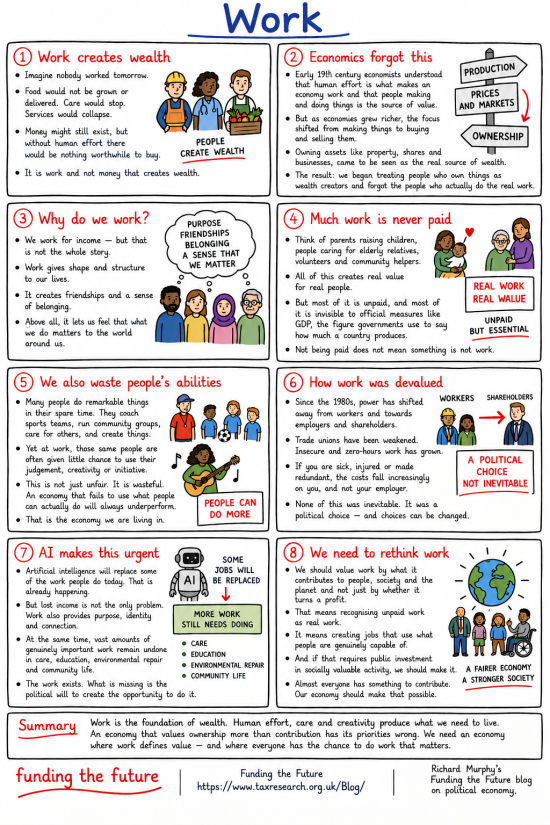
This infographic supports this video:
 This is the transcript:
Hello, I'm Richard Murphy, and this is Understanding Economics. That's the series of videos that I'm making, which explains the way in which I think our economy works. Now, I have to stress that this is how I think the economy works. It is not how most economists think the economy works, but their stories about the economy have led us to be in the mess we're in, and I'm trying to build a narrative around the way that things actually work. And that is what I think is important, and that is what I think adds value by creating a series of videos that ask questions about the world in which you and I actually live.
And in this video, I want to talk about work and what it is, what it does, and how we should value it.
Just imagine that nobody worked tomorrow. No food would be grown. There would be no care services. Services in general would collapse. There would be nothing to buy. Money might still exist, but without human effort, there would be nothing worthwhile to exchange in any known marketplace. It is work and not money that creates wealth. That is my point in saying that. We have to understand that work is the foundation of our economy.
Early 19th-century economists, those who existed from Adam Smith to the time of Karl Marx, all understood this. They realised that what makes an economy work and what creates value is the people who undertake the activities that create things that we need. But as economies grew richer from about the 1870s onwards, the focus shifted from making things to buying and selling them. And that is true of the real economy, and that is true of economics. It changed its focus and purpose to justify this shift from production towards the basis of extracting money from business ownership, property ownership, and the management of these resources in a way that wasn't about creating real wealth, but about creating financial wealth.
We began treating people who owned things as wealth creators, though as a result, and forgot the people who actually do the real work. That distinction became very real, and it continues to this day.
But why do we work? Well, obviously we work for an income. Most of us have no choice. That is the way we are going to get the resources that we need to survive. But that is never the whole story about work, or it isn't for most people. Work gives shape and structure to our lives as well. It creates friendships and a sense of belonging. And above all, it lets us feel as though what we do matters to those in the world around us. And I see this everywhere in the interactions I've had throughout my career, and now with the people who I engage with in all the businesses that I have dealings with. Those interactions reveal that people get from work something very much more than their pay.
And there's good news to that because a great deal of work is never paid. Think of parents raising children, people caring for elderly relatives, volunteers, and community helpers. All of this activity creates real value for real people, but most of it is unpaid, and most of it is invisible to official measures like GDP, the figure that governments use to say how much a country produces.
But not being paid does not mean something is not work. We all know that because we all know that there is work that we have to do, which will never be paid for, but which nonetheless does either provide value to us or to someone else, and as a result, improves the lot of human well-being, and that is what work is all about.
At the same time, there is a problem with much of paid work. When I go out and about, what I see is people doing remarkable things, very often in their spare time. They coach sports teams. They run community groups. They care for others, and they create things. Yet at work, these same people are often given little chance to use their judgement, creativity, or initiative. That is not just unfair. It is deeply wasteful.
An economy that fails to use what people can actually do will always underperform. And that is what the UK is doing. We have a problem with productivity in this country. It is because we do not let our people do what they're best able to deliver. This is the economy we are living in.
And since the 1980s, work has been devalued, and that has been a deliberate policy choice. Power has shifted away from workers and towards employers and shareholders. Trade unions have been weakened; insecure and zero-hours work has grown; and if you are sick, injured, or made redundant, the cost falls increasingly on you and not on your employer. None of this was inevitable. It was a political choice, and it was a choice to undermine the value of work. And choices like that can be changed, which is an important point to note.
AI makes all of this even more urgent, though. Artificial intelligence will replace some of the work people do today. This is a process that has always happened. I can recall when there were things called typing pools. There is no such thing today. The word processor has eliminated the need for typists, and AI will eliminate the need for some jobs. But lost income is not the only problem that will arise as a result, because work also provides purpose, identity, and connection. And if that is lost because of the mass introduction of AI, as some fear, this will have a significant impact on the well-being of people in this country.
But I've got to stress at the same time that there are vast amounts of genuinely important work that is simply not being done in our country at present. There is too little care being provided. There's too little education. There's too little environmental repair, and there's definitely a shortage of investment in our community life. Work exists, in other words. The opportunity to do it is what is missing. Politicians will not fund people to do the work that is required and are wringing their hands over the work that will disappear. There is no reason why we couldn't see this as a moment of liberation. A chance to refocus work on what is needed rather than what has been done, but which is no longer required.
We need to rethink work in other words. We should value work by what it contributes to people, society, and the planet, and not just by whether it turns a profit. This means recognising unpaid work as real work and changing our measures of production to reflect that fact. It means creating jobs that use what people are genuinely capable of creating. We need, in other words, to use people's talents. It's a crime that they're left to go to waste. And if that requires public investment in socially valuable activity, we should make it.
Almost everyone has something to contribute. Work is valuable. Work creates the value in our economy. Our economy should exist to make those things possible. And if it doesn't, we've got our economy wrong. And that's what the focus of Understanding Economics is all about.
Let's be clear: work is the foundation of wealth. Human effort, care, and creativity produce what we need to live. An economy that values ownership more than contribution has all its priorities wrong. We need an economy where work defines value and where everyone has the chance to do work that really matters.
This is why I think it's important to create a series like this on Understanding Economics as if people matter. If you agree, there is a playlist down below this video, which you could watch. There are quite a number of videos in this series now, but all of them are only about 10 minutes long, and you could watch them in order and begin to understand that a different form of economics - an economics that serves you and your interests is possible, and that is what Understanding Economics is all about.
Poll
Thanks for reading this post.
You can share this post on social media of your choice by clicking these icons:
There are links to this blog's glossary in the above post that explain technical terms used in it. Follow them for more explanations.
You can subscribe to this blog's daily email here.
And if you would like to support this blog you can, here:

 Buy me a coffee!

While I think its getting better, the comment – admittedly from a typist was that the introduction of the Word Processor meant that a lot of the skills needed to lay out a document were lost
Last September I sailed up the Dart to Totnes on the paddle steamer Kingswear Castle, a small coal burning ship about 100 feet long. Not many people came although it was the last trip of the season.
I was able to talk to staff from the Company that operates her – the Paignton and Dartmouth Steam Railway and Riverboat Company which is a commercial not volunteer organisation and there was a real sense of ‘excitement’ about the work that was going to be done to the ship that winter. The Engineers and Shipwrights were really looking forward to what they were going to do and what they had achieved so far in her major rebuild.
Theres a similar feeling when I go to my local ‘garden stone’ supplier, yes thats what he does these days but his lorry and digger are in ‘supershine’ finish- he’s really a haulier as are his brothers over the road.
Again more people getting something out of what they do and taking pride in it.
I meet a lot of such people.
Thanks to all for such a fine foundation for socio-economic thinking!
Might the writings of John Rawls (1921-2002) be of interest/relevance?
”While the distribution of wealth and income need not be equal, it must be to evertyone’s advantage.” (John Rawls in “A Theory of Justice”)
Rawls is a big influence on my thinking.
I really like this one. It’s at the heart of what I used to do for a living. A favourite maxim was ‘If you want people to do good work, give them good work to do’ Unfortunately my memory won’t give up its knowledge of who first said that.
It’s good
I may have mentioned some of this before so apologies if there is some repetition.
Both our sons are autistic (have definitely mentioned that here before). My wife has been the main carer to both of them and has not gone back to paid work since our eldest son was born. But, she has supported both of them to an amazing level throughout that time. Whether that is working to get their diagnosis, constant meetings with schools or education authorities, dealing with social security to get DLA/PIP or to get it back when the scum take it away and many, many other tasks. And that has included having to stay on the phone for ages waiting to speak to someone and listening to music bad enough to drive you insane. She has done an amazing job.
For years, we struggled to come up with a response to the question ‘What does your wife do?’ . Now, I go my wife is a carer to our two autistic sons. It’s a bloody tough job and she gets nowhere near the credit she deserves.
My wife works and works hard. My gut feel is that there are many in the same or a similar situation. But because she doesn’t get paid other than the pitiful carers allowance the value of what my wife does rarely gets appreciated.
Craig
Thank you, Craig, for sharing this. I really do recognise what you are describing, and I think you are absolutely right to say that your wife works.
She has devoted years of her life to making sure your sons get the support, education, recognition and security they need. She has advocated for them when institutions have failed them, fought bureaucracies on their behalf and presumably worried about them in ways that no job description could ever capture. That is work, and from what you say she has done it remarkably well.
I also like your answer to the question, “What does your wife do?” She is a carer to your two autistic sons. That is not an explanation for why she does not work. It is a description of the work she does.
And you are right: she deserves far more recognition and support than she receives. So do the many thousands of others doing similar work every day. We have made their contribution largely invisible simply because nobody pays them properly for doing it. That says something deeply troubling about what our economy has been taught to value.
Thank you.
Craig
“Politicians will not fund people to do the work that is required and are wringing their hands over the work that will disappear.”
This is very true.
Here in Germany for example the car industry is declining more and more and politicians as well as companies are despairing about it.
In a podcast I recently heard some interviews with union leaders, who said that they were looking for alternatives.
They looked to produce agricultural machines, trams, busses,… to replace the reduced work but ultimately had trouble to do that, as “the demand for those things was too low”.
What they ultimately settled for was the war industry (It’s not defense, I’ve seen the abysmal videos companies like the Israeli company Rafael are posting “proudly”).
One union leader also said (abbreviated):
“Who has a moral problem with it, goodbye.”
That’s what seems to be important to politicians now and unions are giving up their purpose for.
To invest in destructive work that, according to Tom Krebs in his book “Kapital & Krise”, has a return of 50 Cents for every 1 Euro put in it and is morally more than questionable.
In the context of this podcast also a quote from Heraclitus was mentioned in an excerpt of a right-wing podcast:
“War is father of all and king of all”
And yes, war is able to fund much new things.
But that is because the most potent investors, governments, are MASSIVELY investing at these times (btw weird to hear that in a podcast that constantly is against state intervention).
So in my opinion at least economically it’s not war but government funding that’s the “father of all and king of all”.
Using work to produce Trams would have been better.
Something you haven’t mentioned is the Protestant work ethic – where work is a calling. The British people have, to a considerable degree, abandoned Christianity, but I’m of the opinion that large numbers of people still follow many of the tenets of Protestantism even if they are irreligious. You could call them Godless Protestants.
However, the Protestant work ethic does not mean that you do work in one form or another. It means that you earn your crust. The result is that doing voluntary work whilst on unemployment benefits is frowned upon by society as well as the DWP and politicians. There are probably over a million people in Britain who are doing some form of voluntary work whilst on unemployment benefits, but their work is not officially counted, and they are persistently told to look for paid employment. The DWP has no facility for a person to do unpaid work for a charity and claim unemployment benefits over a long period of time without having to look for paid employment and make regular applications for jobs. There is also little public appetite for such a scheme.
Because the Protestant work ethic is about earning rather than working, it throws open the door to activities which extract wealth rather than create it. It’s acceptable to sit on your backside all day acquiring money from interest or rent, but it’s unacceptable to do voluntary work whilst sponging off benefits or handouts from others.
Looking at the point about economists forgetting the fundamental importance of work, I was reminded of the insight you shared elsewhere about accounting and where profit is attributed and distributed. I wondered whether the forgetting by economists was/is paralleled by that structural decision to do accounts as if capital was king? In fact is correlation (if it is that) a hint that there may be a common cause?
The two ideas are obviously linked, so, yes.
This is a crucial observation and, as I often find, an historical perspective can help us sort out what is really important in navigating the changing landscape.
You have traced the rise of capital as the villain of the piece and in many ways this is fundamental to the place we find ourselves in. The pursuit of profit and an ever-growing economy has not only undermined the value of those who perform the work but has allowed the exponential growth of the population and the rise of the technology to cope with the overwhelming numbers. The trick has been, consciously or not, to create a problem and the answer to it while getting rich from the process.
The jobs that AI will replace are mainly those that were created by this process and a return to the value of real work alongside the inevitable shrinking of less necessary production as energy and materials become scarcer will prompt greater involvement in growing and other production of basic necessity alongside repair and perhaps novel uses for local materials.
There is of course some speculation in that scenario which can be argued over but the message is that a liveable future is likely to be as much about a return to older, simpler ways of living as it will be about novel technology.
If the likes of ‘The consciousness of sheep’ and Craig Tindale are to be believed, the idea that renewable energy sources will allow our descendants to enjoy a lifestyle based on such massive amounts of cheaply available energy as we have enjoyed for the last 100 years is nothing short of a fairy tale. The energy needed to create and maintain the massive amount of renewable energy producing infrastructure is not available (the energy cost of energy is something few people appear to have properly considered), nor are the physical resources, especially copper, that will be needed. A return to a simpler way of living implies a much lower human population on the planet.
I’m coming to understand that these ideas are not an option, they are unavoidable. What is in question is the road from here to there and how we navigate it. How soon will the status quo be destroyed and f**k up your and my current comfortable retirement? How much will your children’s children and perhaps their children’s children have to suffer before a new stability is achieved? I greatly applaud Richard’s attempts to educate those currently in power to rearrange the current economic system to the greater benefit of all mankind but at times I am unconvinced that the current version of democracy and/or global co-operation as we know it can be reformed before it is simply swept away by events and human history is governed by our animal instincts rather than any notion of ‘civilised’ reasoning.
As ever in these moments of gloom, nothing would give me greater pleasure than to still be fit, happy and healthy in 20 years time and proved utterly wrong.
https://consciousnessofsheep.co.uk/2026/08/30/an-end-to-medieval-economics/
https://ctindale.substack.com/p/the-copper-residual
Let me be clear: we cannot sustain the way of life we have.
I do not think anything, but the restoration of democracy can, however, deliver the changes we need.