
The Bank of England has held interest rates at 3.75%, but three members of its Monetary Policy Committee wanted an immediate increase. With inflation rising again, the threat of higher interest rates is very real, and the Bank say they may well raise rates soon.
But would raising interest rates actually tackle the inflation we now face?
The problem is that much of this inflation is being driven by disrupted energy supplies, food pressures and geopolitical instability. These are supply-side problems. Higher interest rates cannot produce more oil, gas, electricity or food. They can only reduce demand by making households and businesses poorer.
In this video, I explain why I think the Bank of England is using the wrong economic tool for the problem we face. Higher rates increase mortgage costs, put pressure on rents, discourage investment and can increase unemployment. At the same time, they increase returns for many owners of financial wealth.
I argue that the appropriate response to supply-driven inflation is very different. We need investment in energy security and food resilience, targeted fiscal support for those hardest hit by rising prices, and lower interest rates to reduce unnecessary pressure on households and investment.
Monetary and fiscal policy should work together to maintain economic and social stability. Instead, we risk having one foot on the accelerator and another firmly on the brake.
This is the audio version:
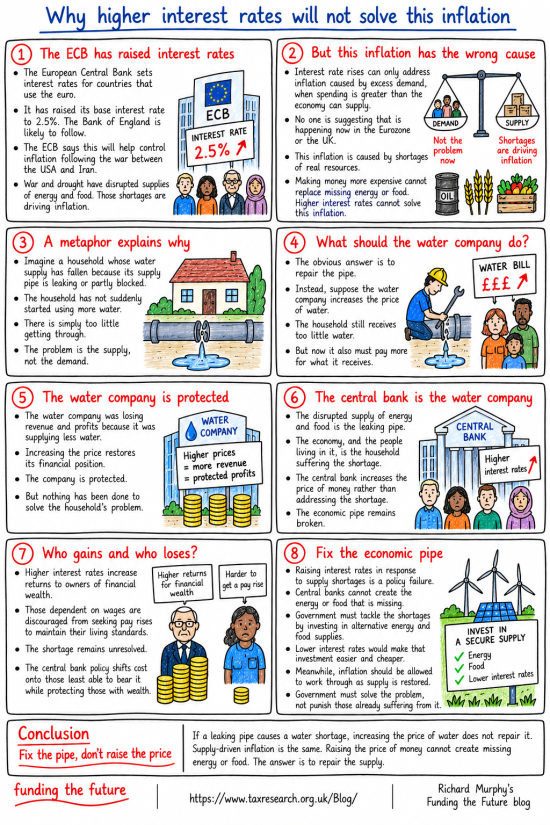
There is no debate ammunition for this video, but this previously published infographic supports it:
This is the transcript:
The Bank of England made a serious mistake yesterday. It didn't raise interest rates, we have to give it credit for that. But at the same time it warned that it will have to do so following the example set by other central banks. They say they will have to do so to tackle rising inflation.
But let's be clear: it is disrupted energy supplies, food shortages, and drought that are driving this inflation. There is no excess demand problem to solve in our country at present, and it is only inflation caused by excess demand that an interest rate rise can ever address.
That is the serious mistake in understanding that the Bank of England revealed in its thinking yesterday. Most especially higher interest rates cannot create more energy or food, so they cannot solve any known economic problem.
And let's be clear: the inflation we are witnessing right now is supply-driven. It reflects shortages of essential real resources. Energy, food, and supply chain disruptions are its causes. Demand is not excessive. In fact, for millions of households in the UK, it is already inadequate. They do not have enough to spend because they are suffering a cost of living crisis. To pretend that they are driving up inflation as a result is quite absurd. As a consequence, this interest rate rise addresses none of the issues implicit in the situation that we are facing in our economy at this moment.
Let me use a metaphor to explain how wrong the Bank of England's actions are. Imagine the water supply to your house has a blockage or leak in it. Your house is receiving less water than it needs because the supply pipe is failing. Now, I stress you're not paying for that water, but you still have a problem. You haven't got enough water in your household. That's a supply-side problem.
The obvious solution is to repair the pipe. Instead, the water company increases the price of water to you to maintain its income and profits, even though you have less water than you need. You will pay more as a result. But the shortage remains. Nothing is fixed.
This is precisely what the Bank of England is doing. The economy has shortages of energy and food. The Bank has responded by increasing the price of money. Doing that does nothing to increase the supply of either energy or food. It just protects financial interests while making everyone else's problems worse, and the economy very much weaker. The Bank of England actually knows that, and the most staggering thing is that it is doing this anyway.
So, how should we describe this action on its part? We could call it economic illiteracy, except they know what they're doing. In that case, the only other description I could think of is class warfare, not a phrase I use very often, but which in this situation seems to be entirely appropriate.
Workers are being explicitly discouraged from seeking pay rises to protect their living standards because this policy will deliberately increase unemployment. And meanwhile, households will face increased living costs, and borrowers will face higher mortgage costs, and those in rental accommodation will see higher rents. And that will all be because of higher interest rates.
And at the same time, those already making excess profits from shortages, and we know that oil companies already are, will be left entirely untouched by this interest rate change. In fact, they may be better off because they, along with the wealthy, will be earning more interest as a result. The owners of financial wealth are then being protected, while working people will pay the price. That's why I think this is class warfare.
So what should have happened? The real causes of inflation should have been addressed . The supply disruptions driving this inflation are geopolitical in origin. No interest rate change created by the Bank of England can resolve a war in the Middle East. But government investment in alternative energy and food supplies could have been made now as a matter of urgency to solve those real underlying problems in our economy. The only problem is that those investments will now be more unaffordable because of increased interest costs.
What we need is more investment in our economy. And the Bank of England has just made that very much harder with a decision that looks even more incomprehensible as a consequence.
And what we also need is a joined-up economic policy. At present, we have the Bank of England running monetary policy and the Treasury running fiscal policy in this country. Monetary policy, with a threatened increase in interest rates, is trying to put a very hard brake on our economy at present. It is trying to create a recession, and more unemployment, and reduced demand. At the same time, the government has promised a better standard of living. It's trying to boost the economy. The consequence is that we're running economic policy with one foot on the brake and one on the accelerator, and we will be going round in circles as a consequence.
The government should end this farce. It should take control at this moment. The Bank of England's independence has to be suspended. We are facing a crisis. The government should say we are going to have to go through an economic transition where it looks likely that food and energy costs are going to rise, and it must reduce costs elsewhere as a result. What is the obvious cost it can reduce? That is the interest rate.
Doing that, it could solve the supply-driven inflation that we are facing. And history shows that these supply-driven inflation shocks do always pass over time, where time is usually a period of less than two years. And in that meantime, the government could announce that it will intervene, and provide price support, and tackle shortages and try to help those who are in real need as a consequence of that inflation . That is within its fiscal power, and it can afford to do it. Doing so will in fact be much cheaper than letting interest rates rise. So, reassurance and targeted action from the government are required, and not deliberately imposed economic pain.
So, that's what should have happened, and what would that look like if it had happened? Well, interest rates should have been cut. They are the wrong instrument for this problem. And cutting them would have, in fact, helped boost the economy at a time when it is going to be suffering stress already. That's the consequence of these prices working through the system. So cutting rates would've rebalanced people's ability to afford what is going on. Instead, everything is going to be made harder.
Fiscal policy should have been used to protect those who are hardest hit by rising prices.
And the government should have announced investment in domestic energy security and food resilience.
And why do this? That's because the central banks must serve economic and social stability , and not financial markets. Raising rates solves none of the causes of this inflation, and using them as a political choice is the wrong one.
That's what I think. What do you think? There's a poll down below. Let us have your opinions. Please like and share this video. Please do also subscribe to our channel and hit that bell, so you will be notified when we produce a new video. And if you'd like to donate to the channel, there is a link to do that down below, and we'll be very grateful.
Poll
Thanks for reading this post.
You can share this post on social media of your choice by clicking these icons:
There are links to this blog's glossary in the above post that explain technical terms used in it. Follow them for more explanations.
You can subscribe to this blog's daily email here.
And if you would like to support this blog you can, here:

 Buy me a coffee!

Might a democracy seeking government of a secure/reasonably valid polyarchy and a democracy-seeking, objectivity-seeking main stream media explain why the (secretive) political choice has been made to not use, as you suggest, a fiscal policy instead of the current “monetary policy which is engineered to force workers to bear the cost.” ? (AI Mode)
Is it reasonable to ask why successive and the present U. K. goverments have (deceitfully?) chosen, and still do, to protect capital mobility, asset values and systemic liquidity insead of protecting the socio-economic welfare of much the most of the British citizenry, and their children and so enhance the U. K. economy? (From AI Mode)
I hate to say this, but what I am seeing in the cold light of day is in one sense not ‘crazy’ at all.
What we are seeing is what our Neo friends call ‘rational self interest’ at work.
Rational self interest often comes to the fore when there is chaos like this, because it has been allowed to be so by poor regulation and protection of markets by governments captured by this self interest. Whether buying out companies and creating duplication, asset stripping perfectly decent companies to privatisations and putting up interest rates under false flags the whole system is about sucking out any value and re-allocating to the few who have the money to buy everything.
But, what is rational to capital is indeed crazy to the rest of us. It indicates that capital has created its own little bubble in which to exist and insulate itself from the effects it creates and from natural law itself. Capital needs to be brought to heel and serve society, not just those at the top. The legal rights and identity of capital needs to be critically examined. If we are to change, we need to start right there in my view.
You may be right
I’ll be optimistic for a change. I think the BoE’s latest actions are SO ridiculous that with or without some economic understanding, people see them as ridiculous. The argument they use, based on SLMs (Street Language Machines) is –
“I have a personal cost of living crisis (petrol, energy, rent/mortgage, food) so the government want to prevent inflation by putting interest rates up, which makes things more expensive??? DOH!”
All the BoE has to do in my view is watch the interest rate and ensure that it does not add to the woes people are suffering at the moment. The economy needs to keep working even though it many ways it is not working anyway!! The BoE is addicted to inflicting pain I’m afraid – it is causing misery/hardship inflation at 3.75% .
The other big issue is the acts of omission and commission of the supposed ruling government who seem to content for the tale to wag the dog.
It makes you ask the question of Burnham et al ‘ What do you think you are here for? To rule or be ruled?’.
How in an authentic democracy can it be that people have voted to hurt themselves?
My conclusion is that what we are witnessing is un-democracy in action. I do not over state my case either.
It’s an institutional double whammy that both applies the wrong medicine and hides the true source of accountability – our Government.
Nothing to prevent the Government launching a major energy conservation plan – there are still a lot of un insulated walls and probably roofs as well. That and cutting speed limits which would save lives as well.
Having driven on a 70mph dual carriageway recently which included passing a tractor and a bus stop I dont think its safe for that speed.
There could also be curbs on speculative trading in food and oil
Agreed
In the 1970s limit of 50mph I regularly drove from Glasgow to Aberdeen on single track roads in 3.5 hours. Today doing 70mph on dual carriageway I can do it in just under 3 hours. If you regularly check the average speed record on modern cars it is surprisingly low.
I agree.
I long agree; I realised that hurrying when driving rarely made much difference to arrival time, but it makes the journey much more relaxed.
But as usual – it is the bland ‘reporting’ of the BBC that is really chilling. It is taken as read that interest rates have to go up if there is inflation<p>
Despite many heterodox economists saying what Richard is saying – not a flicker of interest from the beeb in asking such people to contribute. Or even to ask – ‘will higher interest rates really bring down the cost of oil from the gulf?'<p>
This is a managed democracy – manufacturing consent.<p>
I am beginning to agree
Indeed a cut was needed for the reasons you say, while Government puts other measures in place to address the causes and consequences of key element scarcity.
But it’s nevertheless striking to see MMT arguments acknowledged and deployed in the dramatic reduction of QT. Your recent infographic was pretty directly quoted (without acknowledgement, but the connection is now being picked up by economics journalists like Sky’s Ed Conway.) Of course they need to go further and it may not please you to see your arguments blended in with some conventional monetarist ones but something is going on over there. Do we give credit to HM Treasury if you won’t take it?
They are not reducing QT.
They are completely committed to it.
Rent seeking par excellence from the BoE!
I’m comparing box 5 and box 6 in the infographic. I can at least understand the motivations of the water company. As a private company and currency user, it needs its revenues to not exceed its costs. But the Bank of England is neither a private company needing to make a profit nor a currency user and in theory is supposed to act in the best interests of society as a whole. That makes the motivations behind what it is doing much more difficult to understand. Class warfare does then seem plausible. To (misquote) Sherlock Holmes, “When you have eliminated the acceptable, whatever remains, however objectionable, must be the truth.”
Just read this back and realized I said “needs its revenues to not exceed its costs” when clearly it should have been vice-versa! Whoops!
In the infographic, the wealthy man who is benefiting from the increase in interest rates looks pretty displeased, as does the women from the household whose costs have risen. I think a more sincere graphic would show the wealthy man with a shit eating grin on his face…… Just saying! Yes, the best thing for the wealthy man is everyone to have financial security, but he doesn’t acknowledge that, he really only cares about his bank account, and you know it. Love your work
The Infographic using the water company analogy demonstrating why interest rates can’t control inflation was one of your best yet. It’s simplicity seems hard to refute.
Thank you
Richard; perhaps you have already addressed this question elsewhere.
I assume that, if pushed, the Powers That Be would would give a justification for raising interest rates that would be other than primary inflation (‘rising prices’). They know that (primary) is caused by exogenous shocks. So what do you think that justification would most likely be, and assuming it’s wrong, why?
I’m guessing the mostly likely culprit is ensuring rising primary prices do not result in secondary (follow-on) inflation.
The Bank accepts that higher interest rates cannot create energy, food or other resources. Its defence is therefore that a supply shock might generate “second-round effects”: workers seek higher wages to recover lost purchasing power, businesses raise prices in response, and inflation expectations become embedded. That is its justification for its actions.
My objection is that higher interest rates are an extraordinarily crude way to tackle inflation. They deliberately reduce demand, increase unemployment and weaken workers’ bargaining power, while simultaneously increasing mortgage, rent and business costs.
In other words, the policy largely works, if it works at all, by making people poorer so that they cannot recover the living standards lost to the original price shock. I do not regard that as either an economically sensible or socially acceptable response. The Bank of England clearly disagrees. I think they live on another planet to me.