
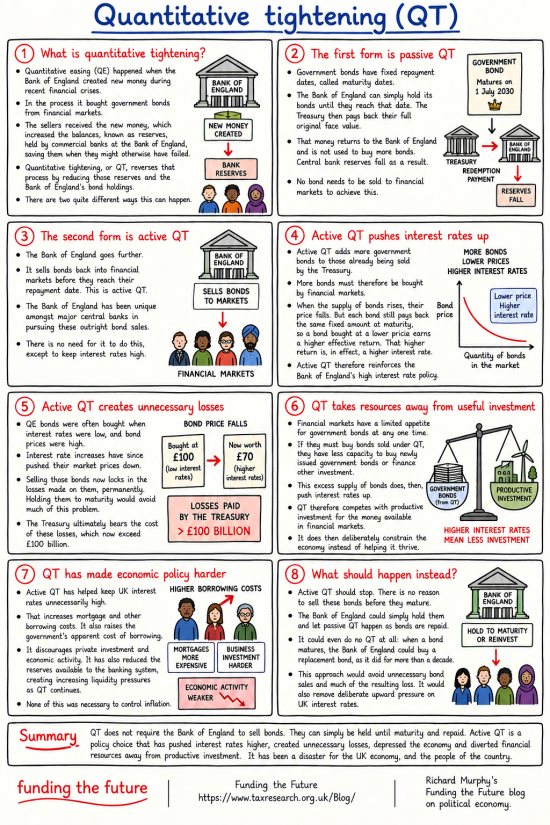
How to expand this image
If you press CTRL or Command and the Plus (+) key on your keyboard, your browser should increase the size of your page every time you do this. Press CTRL or Command and the 0 (zero) key together to restore the screen to normal.
How to download this image
If you right-click the image, you should be given the option to download it to your computer. So long as you do so without the intent to make a profit, you may do so without further permission. Commercial use requires consent. But if you just want to share it, do so with whoever and wherever you want. That is the purpose of these infographics.
The image library
We have a library of these images. It is available here. All downloads are free, but donations help our work.
AI use
I wrote this infographic. I used AI to create the final image.
For information, my infographic on quantitative easing (QE) is available here.
Thanks for reading this post.
You can share this post on social media of your choice by clicking these icons:
There are links to this blog's glossary in the above post that explain technical terms used in it. Follow them for more explanations.
You can subscribe to this blog's daily email here.
And if you would like to support this blog you can, here:

 Buy me a coffee!

Which group or groups in our society does the Bank of England serve?
Bankers and their wealthy clients who actually still get a service from them.
What I have never understood about the Central Bank buying and holding government bonds is that they still count as government debt. Why can they just cancel them early and reduce the debt?
On the Whole of Government Accounts, they are shown as cancelled.
The central bank reserve account balances are substituted.
The claim that they are still debt is best described as what it is: a lie.
The other element is the lack of real justification. The Bank of England stated that the reason for Quantitative Tightening (active or passive) is to ensure it has the opportunity to do more Quantitive Easing in the future if it needs to.
Aside from trying to fix the roof while it’s raining by engaging in tightening while there is a cost of living challenge still, this fails to recognise 2 things – firstly, that active tightening creates losses and market impacts that passive tightening doesn’t, and secondly that it doesn’t have any real fixed amount of bonds to mean it needs to reduce its holdings to support a future easing round.
Discussion should be about whether there should be any passive QT in the current economic conditions. Active QT should be rarely, if ever, undertaken, but that’s what the Bank of England decided to do.
“The Bank of England stated that the reason for Quantitative Tightening (active or passive) is to ensure it has the opportunity to do more Quantitive Easing in the future if it needs to.”
The follow-up question for the BoE is then: what does this actually mean? To undertake further QE, the BoE just needs to issue further liabilities againt itself in its own unit of account, so as to balance the bond asset it is accquiring. How does the fact that it did so in the past constrain its ability to do so in the present? That’s like claiming that I am going to run out of feet and inches to measure things!
Or it could just purchase bonds directly from the treasury and end the entire farce…
QE was never nededed, ever.
Direct financing was.
Thanks for the graphic Richard. Unfortunately it has probably increased my level of bafflement rather than reduced it. May I ask/comment?
Box 1, where it talks first about QE, says that new money is created when the BoE buys government bonds. But aren’t these bonds just savings deposited with the government? How does this then create new money? I thought that it just swapped a liquid and tradeable asset (bond) for bank reserves?
Second question (which I think has already been asked but…) when the BoE buys government bonds, why does it hold onto them? Surely the process of buying the bonds is just like the original holder withdrawing their savings, which should result in the bond being destroyed?
Box 3: how is this different to selling bonds in general? I thought that the government/BoE routinely “sold” bonds because organisations with giant sums of money that need parking somewhere always want to buy bonds.
More generally, the distinction between the Treasury and the BoE is also confusing. Of course course I can see that these things are different, but the Treasury is really just a bunch of civil servants. The money sits at the BoEh which is wholly owned by the State. So isn’t this just a rather elaborate game of rearranging the deckchairs?
(Um, I guess maybe all financial transactions are like that. But it does feel like the distinction between BoE and Treasury is just a cunning way to enrich the bankers)
On the first point, you are right that QE is an asset swap, but the Bank of England creates new reserves to make that swap. So new central bank money is created, whilst no equivalent new net financial wealth is created: the bond is replaced by reserves.
On the second, the bond is not destroyed because the Bank of England bought it in the secondary market. The liability represented by the bond still exists, but is now held by another part of the state. Economically, I agree that this begins to look decidedly peculiar. In accounting terms, the bond is cancelled: it falls under consolidation, to use accounting jargon.
That also explains Box 3. Normal government bond issuance creates a savings instrument for whoever wants to hold one. QT is different: the Bank of England is selling bonds it acquired through QE specifically to withdraw reserves from the banking system.
And your final point gets close to the heart of the matter. The Treasury and Bank of England are legally and institutionally distinct, but both are parts of the state and their financial operations are necessarily intertwined. Pretending there is some absolute economic separation between them creates a great deal of unnecessary confusion, and has helped justify substantial payments to the financial sector.
I wanted a more indepth answer to your reply above Richard, so i put it into chatgpt and it replied with this in the response which was funny ( Classifying them as liabilities does not make them equivalent to household borrowing.)
In the Whole of Government Accounts, the Treasury’s liability on gilts held within the public sector is eliminated against the corresponding asset. The reserve balances created to buy them remain as liabilities. It would be wrong to count both as debts owed outside government.
The distinction is between eliminated on consolidation and legally cancelled: the gilt contract remains, which allows the Bank to sell it back to an outside investor. That distinction matters when QT happens.
Calling reserves “debt” needs care. They are liabilities denominated in money the central bank itself issues, with very different repayment and refinancing characteristics from gilts. Classifying them as liabilities does not make them equivalent to household borrowing.
So your central accounting point is correct: QE substitutes reserve liabilities for externally held gilt liabilities; QT reverses that substitution. That is why withdrawing £100 of reserves through a bond sale does not reduce consolidated liabilities by £100—the externally held gilt replaces them. My earlier explanation should have made that distinction clearer.
Regarding Panel 8 on passive Quantitative Tightening – may I refer you to an insistence you made on June 15 2022 at 10:02 am
that such a policy would be deeply recessionary. Why would you now advocate for that?
The statements are consistent.
Seems BoE today reduces overall QT sales target by about 1/4. 2/3 of what remains to be achieved passively, reducing active QT p/a from about £75 bn to £20. Someone is picking up on your arguments over there though they could obviously do more if not face saving or trimming in the face of market expectations.
-dramatically slows reduction of commercial bank reserves and restores some lending capacity
-restores some UK budgetary headroom? likely lower yields and/ or greater gilt sales capacity
-combined with holding rates appears to implicitly acknowledge that inflationary implications current input cost increases cannot be counteracted by classic monetary constraints
See the post just published for my reaction to this