
Interest rate markets are in turmoil. Government bond yields are rising, inflation fears are growing, and financial markets are demanding higher returns. But there is a problem: centuries of interest-rate history suggest that what is happening now is highly unusual.
In this video, I look at Bank of England research tracing interest rates back more than 700 years. The long-term trend is striking. Both nominal and real interest rates have fallen dramatically over time. During major wars, real interest rates have often become strongly negative as inflation exceeded the returns paid to savers.
Today, we appear to be doing the opposite.
With war contributing to inflation, financial markets are nevertheless seeking positive real returns on government debt. That has profound distributional consequences. Higher interest rates reward those who own financial assets while increasing mortgage costs, rents and pressure on government spending, employment and the wider economy.
This is therefore about much more than bond yields. It is about who bears the economic cost of war, whether governments should submit to financial markets, and whether attempting to maintain high positive real interest rates could create both economic and social instability.
Markets are trying to overturn a historical pattern that has persisted for centuries. Can they succeed, and what happens if governments let them try? Will the cost be too great for society to bear?
This is the audio version:
This is the transcript:
Interest rate markets are in turmoil. Government bond yields are rising rapidly around the world. Investors fear inflation as a result of Donald Trump's continuing war in Iran, and they're selling bonds because they think those bonds are overpriced, and that's how they force the interest rate up.
But are those market reactions rational? Are all the messages wrong? Are governments also misreading this market reaction? Are we heading for a market crash as a consequence of what is going on?
To look at this question, I've gone back into history. The Bank of England has done the research on which I base much of my commentary here, and they have looked at the history of interest rates in England, around the world, and then in the UK over a period from 1317 to 2018. Now, that's pretty absurd, but the data does appear to be available, and this first chart provides a background to the information we are looking at.

The data shows real interest rates over that period, 1317 to 2018. And real interest rates are those which reflect the interest that is paid, having allowed for inflation. In other words, it reflects the real return that you can get on saving your money. And you'll notice that the figures have oscillated wildly, but the oscillations have reduced of late, and there are only a couple of exceptions to that point.
During the First World War, interest rates were incredibly negative. During the Second World War, the pattern repeated, and since around 1990, the pattern in the UK and around the world, let me be clear, has been for interest rates to fall heavily.
But over time, there's one overwhelming trend to look at, and that is the little dotted line that runs through the whole series, and that is that there has been a strong downward trend in interest rates over this entire period. In 1317, you could have expected a real interest rate of around 8% to reflect the risk that you were taking by lending anyone money. Now the expectation is 2%, and in fact, in 2018, worldwide real interest rates were well below that figure. The trend is downward, and it has always been so. There has been no change.
And the second chart I want to look at is of headline global rates.
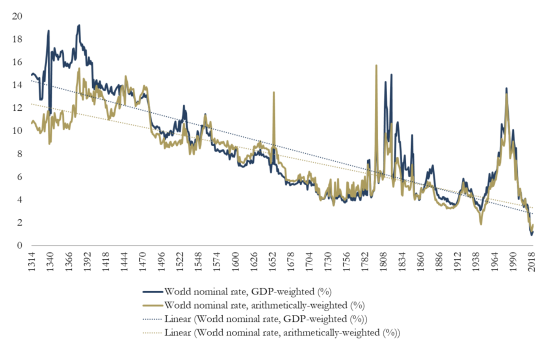
These aren't adjusted for inflation. These are the figures that people were actually paid. And this is worldwide data, I stress. This is not UK data. This is average data from all the sources that are available, looking around the world. And there are two trends shown, but don't worry, they are broadly similar. The basis of averaging is different, but that doesn't really matter for our purposes.
The point is, look at the trends again, and they are strong, and they are markedly downwards. The nominal rate moved from over 14% in 1314, when, for some reason, this particular chart begins, and by 2018 the nominal rate was running at below 4%. There has been this steady downward trend.
The exceptions are, let's be clear about it, during the Napoleonic Wars and in their aftermath, the early Victorian era, if we are talking from a British perspective. And also during the period from the mid 1960s through to just after 1980. And that was the tumult caused by the end of the post-war economic consensus. That period created ever-rising interest rates that led in the UK to the debacle of 1992 and Black Wednesday, and from there on, rates have steadily fallen as we've worked out that trying to force currencies into particular situations really does not pay.
And now let's look at a third chart.

On this chart, we are back to real interest rates, those that are adjusted for inflation. And this chart is slightly simpler to look at, and some trend lines are put on here, which show various trends over various periods with an emphasis upon the more recent history of interest rates.
But the point is this: look at these real interest rates, and the message is very clear. The dashed blue line shows this strong downward trend. We're heading towards zero by 2018, and that is not, in fact, an aberration. It is the logical point to which interest rates are heading because that is the historic trend.
The exceptions, again, are periods of wartime, and note in particular the aberrations that the First and Second World Wars present on this chart. They had strong, negative real interest rates, and those were very unusual. But in recent years, the trend in rates is markedly downward, and that is the point I'm making everywhere by looking at this historic data.
Now, let's look at more recent British experience. This is the chart on the screen now for the cost of long-term government bonds in the UK from 1950 to 2026.
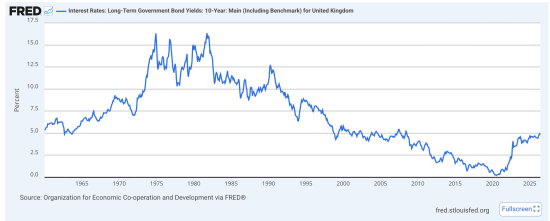
In fact, the data is up to date until June, but we do know there have been some oscillations since then, with a continuing upward trend.
And you'll see what has happened. You will see that we went through a period of confusion. Rates peaked around 1975. That passed from 1982 onwards.
What happened then? We had the immediate after-effects of the USA coming off the gold standard in 1971. We had the movement towards floating exchange rates. We had the uncertainties in the market that that created. And from 1982 onwards, when Thatcher had done her worst, and she most certainly had done her worst, creating 3 million unemployed people in the UK, which the world reacted to very adversely when it came to interest rates, the trend has been markedly downwards.
We have, in other words, followed the international trend. And in fact, in 2020, we hit an effective rate of near enough zero on government bonds in the UK, and that trend has now reversed.
The reversal was not because of COVID. The reversal was because of the development of inflation. And that wasn't because of COVID. That was because of war in Ukraine. And that has been because of wars that have been persistent since then, particularly in the Middle East . And the trend is increasing because Trump is pursuing war. Let's be clear: that's why we now have an interest rate of around 5%.
So what does all this begin to tell us? It tells us that today's interest rates are an aberration from the historical trend. To have a positive interest rate as we have at present, because the interest rate on government bonds is above 5%, and UK inflation is around 3%, is nothing like the norm.
We don't see 2% positive interest rates in recent years. Go back to the first chart that we looked at is on the screen again now, and you'll see how unusual that is. For us to have a pattern of interest rates of around 2% positive real figures is just against all recent history. And I'm talking here about recent history over a couple of centuries. So what is going on?
Why are we trying to create something, in other words, which has not happened for a long time? Something that has not also happened during periods of war.
Look at that chart again. Look at what happened during wartime. In World War I, real interest rates became decidedly negative. They became nearly negative 10%. During the Second World War, they became nearly negative 5%. The wealthy, in other words, lost money as a consequence of war, but they gained the benefit of having their well-being protected.
But what's happening now, if we look at the last chart we looked at for UK interest rates - that is the one on the rates on government bonds - that one shows that we are currently seeing a situation where markets are trying to create a positive real interest rate at this moment, and we are suffering inflation because of war. We should be having a negative real interest rate as a result. Today's markets are trying to reverse that historical pattern. That is why we are suffering stress.
This should not be happening. We should be seeing real interest rates fall at the moment. In other words, they should be below the rate of inflation. They should not be above it. That is what happens in this wartime situation. But markets are trying to do the reverse.
This is creating positive real redistribution of wealth inside our economy, and we're seeing demands that people - those on benefits, those on pensions - should be contributing to this by giving up their benefits so that the wealthy may be paid these interest rates, which do not fit any historic pattern at all.
The wealthy are demanding that war benefit them. War has never benefited the financial returns of the wealthy , at least when it comes to their savings. It might have done so with regard to the long-term benefits of the development of business which has arisen as a consequence of wartime. There's no doubt that happens. But interest rates during wartime should be real-terms negative, and markets are trying to do something otherwise. This is why we are living through a period of stress. We should not be letting markets try to do something which is historically has never been possible.
Of course, we're going to have major disputes and conflict within society if the City here, the Wall Street markets in the USA, and other markets around the world try to do things that are simply not possible. If we try at this moment to extract the value from the most vulnerable people in our society to pay for war, we are inevitably going to end up with social conflict as well.
The distributional crisis that we are facing as a result of these efforts to deliver positive interest rates at this moment creates a choice that is going to have to be political and not economic. Markets are trying to beat centuries of interest rate history. Governments will have to decide: Are they going to resist that? That is the choice they have to make.
If governments do not take control at this moment, and if they do submit to financial markets, the evidence is that people are really going to suffer. There's no way around that. This is something that will create stresses that society cannot tolerate at a time when it will also have inflation arising from war. And if the government concedes to the demands of markets and lets interest rates rise, the costs of those interest rate rises will be seen in terms of increased mortgage costs, increased rents, reduced employment, reduced financial well-being, stresses to the economy and the recession that will inevitably follow.
We have to therefore decide. Governments have to therefore decide. At this moment, the trend in interest rates is deeply destructive inside our economy. It conflicts with the history of our interest rates. It does so because markets are trying to deliver something that is not possible. You cannot have positive real interest rates in a time of war. That is what history tells us. If we try to do that now, most people in our society are going to suffer considerably.
I'm worried. I'm very worried. What the markets are trying to do is punish people in a period of stress, which is what we're suffering. A period of stress created unnecessarily by the government of the USA, the government of Israel and those governments like ours that are still tending to support them in their endeavours. And if, at the moment, that stress is increased by rising interest rates, we're going to face a social as well as an economic crisis. History tells us we must allow negative interest rates at this moment. That is what must happen.
That's my opinion. You may differ. Let us know your opinions. There is a poll down below. Please do like and share this video. Please do subscribe to the channel. Please do click that bell button. You'll then find out when we publish new videos, and if you'd like to buy Tom and me a coffee, that would be great.
Poll
Thanks for reading this post.
You can share this post on social media of your choice by clicking these icons:
There are links to this blog's glossary in the above post that explain technical terms used in it. Follow them for more explanations.
You can subscribe to this blog's daily email here.
And if you would like to support this blog you can, here:

 Buy me a coffee!

Might it help the/“our” government to manage this situation of attempted exploitation by a well informed, cohesive and particularly powerful group in our quasi democratic, but actually polyarchic, socio-political set up, if our being a polyarchy were made clear to the citizenry?
I interpret that as “Would it help government resist exploitation by powerful, organised interests, such as finance or wealthy elites, if citizens understood that these groups exercise disproportionate influence over what is supposedly a democracy?” The answer is yes.
Puts pedant hat on.
I did The Canterbury Tales in A Level English and it was clear that Usury was illegal during that period – C1390
So how did the BofE get interest rates for that period?
Oh & I suggest that our medieval forebears had the right idea.
Since when has something being illegal meant it did not happen?
I noticed this article this morning, extract below (my emphasis)
https://www.theguardian.com/business/2026/sep/15/bank-of-england-bond-selling-cut-uk-borrowing-costs-john-healey
“John Llewellyn, a partner at the consultancy Independent Economics and a former chief economist of the OECD, said the idea that there was a firewall between the Treasury and the central bank was a “fiction” and Bailey should expect to negotiate with the chancellor to minimise costs.
Since active sales of QE bonds began in late 2022, the Bank has overseen one of the fastest reductions in central bank bond holdings among advanced economies, cutting the portfolio from a peak of £875bn to under £490bn.
A year ago it cut its annual target for sales from £100bn to £70bn and is expected to lower that again this week to £50bn. The US Federal Reserve stopped actively selling its portfolio of bonds last year.
Christopher Mahon, a senior fund manager at Columbia Threadneedle Investments, and a visiting fellow at the Open University Business School, said rising costs showed the Bank “should scrap active sales outright”.
He said the Bank’s methods had proved to be twice as expensive as the European Central Bank’s and four times as expensive as the US Federal Reserve programme, mainly due to the type of bonds it bought, which have collapsed in value since 2008.
The Office for Budget Responsibility (OBR), the Treasury’s independent forecaster, has estimated the Bank’s bond sales will add about £47bn to government debt by 2031, assuming active gilt sales of £32bn a year.”
I have already referred to the comment by John Llewwllyn in a later post.
I will deal with QT as well – there is an infographic coming on that.
QT is class warfare and a disaster.
What are the practical mechanisms for intervention? Simply instructing the central banks to set interest rates close to 0%? Stop issuing bonds to match spending that exceeds tax levels?
I have answered these questions many times, because the mechanisms are actually quite straightforward.
Yes, government could require the Bank of England to maintain much lower interest rates. Central bank independence is a political choice created by legislation, not a law of nature. I would favour rates being kept low and stable rather than using them as the principal tool for controlling inflation.
I would also stop quantitative tightening.
And there is no requirement that government issue bonds to match the difference between spending and taxation. Government spending creates money; bond sales do not fund that spending. Gilts should instead be regarded as savings products, issued when there is a good economic reason to provide them.
Inflation would then primarily be managed through fiscal policy, including taxation, alongside credit controls and measures addressing particular supply constraints.
None of this means abandoning economic discipline. It means using the right tools for the job instead of deliberately imposing high interest rates on households, businesses and government in the hope that creating financial pain will control inflation.
Wars are decided on by the powerful, and the war expenditure aims to protect or improve their position, so they naturally pay a price in terms of negative real interest rates.
The markets now demand an someone else pays the price.
Meanwhile, the Bank of England claims that interest rates are ‘neutral’ despite being higher than inflation. ‘Neutral’ would logically be matching inflation, so that’s just incorrect analysis. Additionally, given the signs of stress, concerns about job numbers, unemployment increases being seen as a risk by the Bank of England, there’s every reason to suggest that ‘neutral’ is higher than it should be anyway.
The Bank of England therefore compounds its mistakes by aiming for the wrong kind of balance and misidentifying the current balance, all while misinterpreting the likely effect of the lever it is pulling. There are definitely some within the rate-setting committee – particularly Huw Pill, but also others like Catherine Mann, who almost always prefer increasing interest rates to decreasing them, dismissing the impact on household finances as less important than the markets. These are people who largely live in the US and who seem increasingly detached from UK life, which should disqualify them from their positions.
I agree. High real interest rates are not neutral: they redistribute income towards those with financial wealth and impose the cost on borrowers, businesses, renters and taxpayers.
And claiming to know the “neutral” rate when it cannot actually be observed only compounds the Bank of England’s fundamental error.
A brief story on Google news feed earlier today said that the Telegraph ( can’t open it) are reporting that Andrew Bailey has said that QT is to halt. Do we know if this is true, and if so what’s behind it? Surely AB hasn’t been reading your blog and has ben converted to the path of righteousness suddenly?
If it is true is is Treasury pressure