
The leaders of the SNP, Plaid Cymru and Sinn Féin signed this agreement yesterday:
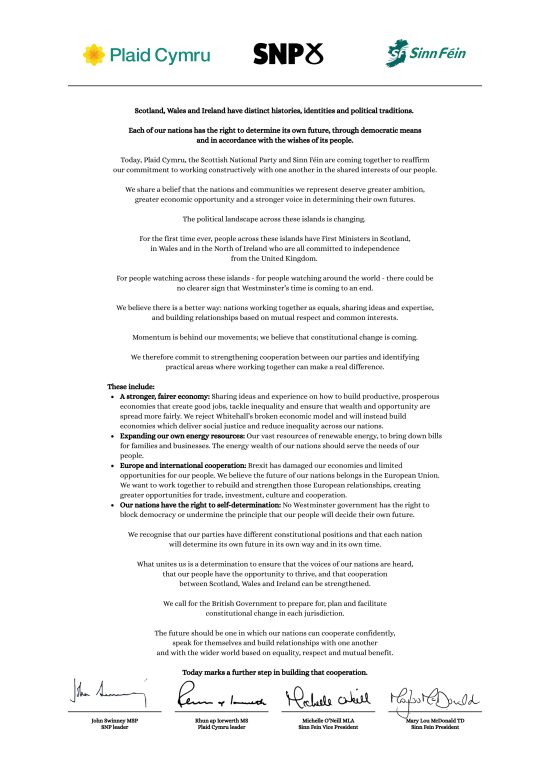
Since the text is a little small, I'll highlight two sections. First, the opening which says:
Scotland, Wales and Ireland have distinct histories, identities and political traditions.
Each of our nations has the right to determine its own future, through democratic means and in accordance with the wishes of its people.
And then, from the concluding paragraphs:
We recognise that our parties have different constitutional positions and that each nation will determine its own future in its own way and in its own time.
What unites us is a determination to ensure that the voices of our nations are heard, that our people have the opportunity to thrive, and that cooperation between Scotland, Wales and Ireland can be strengthened.
We call for the British Government to prepare for, plan and facilitate constitutional change in each jurisdiction.
The future should be one in which our nations can cooperate confidently, speak for themselves and build relationships with one another and with the wider world based on equality, respect and mutual benefit.
Today marks a further step in building that cooperation.
I support this call. I look forward to the days when there is no longer a UK, but four nations, including a united Ireland.
And what does Burnham say? It's a straight no from him.
No wonder so many people in so many places have had enough of Labour, and never want to see it again. He's the last Labour PM unless he begins to understand why, and this issue is one of those he has to address.
English exceptionalism based on imperialism is not a basis for governing. It is time he recognised that.
Thanks for reading this post.
You can share this post on social media of your choice by clicking these icons:
There are links to this blog's glossary in the above post that explain technical terms used in it. Follow them for more explanations.
You can subscribe to this blog's daily email here.
And if you would like to support this blog you can, here:

 Buy me a coffee!


I wonder what life as an enemy alien will be like? (Born Glasgow, Scots Mum, Welsh Dad, brought up in England).
The arrogance of the Westminster establishment constantly amazes me, as does their selfish short-termism & stupidity. Strangely, both Starmer and his northern clone, Burnham, seem to have had plenty of Celtic advisers (Morgan McSweeney, Pat McFadden, Douglas Alexander, Stephen Kinnock) to bolster their arrogance, and keep the steady flow of insults coming.
Unfortunately, these “advisers” are only interested in what benefits them and their career within the status quo. Therefore, they’re absolutely terrified of anything that could jeopardise that.
The confirmation emails sent out by FTF today seem to contain malformed links – on my android phone they are opening the search page in Chrome, when they should open the comment page in Firefox. Old confirmation emails work normally so it isnt my phone! I’ll send this by email also, as I cant currently confirm any of my comments.
We are addressing this asap
Thanks for highlighting this Richard. I was also pleased to see your involvement in Common Weal’s initiative to create a blueprint of the practical steps required to achieve independence for Scotland. It’s good that it will be apolitical; the SNP’s offering ‘Scotland’s Future’, produced prior to the 2014 referendum was highly political and at 600+ pages, way too long.
I am involved…and in good company.
How do you envisage the separate nations operating in terms of currency? Would each need to create its own sovereign currency, or would they continue to use the GBP or EUR?
Each would necessarily have their own. Ireland, of course, has the euro. That will be NI’s fate. I have written on this many times. Google it.
Thank you. Have just read this post of yours from last year and it has answered all of my questions!
The economic fundamentals of a Scottish currency
Thank you
> Ireland, of course, has the euro. That will be NI’s fate
Not necessarily (I hope). The argument can and hopefully will be made, that the united country is a new state therefore entitled to negotiate entry into the EU on its own terms. Could this not open the door for a Swiss/Norwegian/Polish/UK (pre-brexit) arrangement? I’m perhaps grasping at straws but clearly this Ireland or a new one has no immediate prospect of sovereignty without its own currency.
If you have time Richard I’d love for you to examine the period when Ireland arguably was most sovereign and successful in its history i.e. post ERM collapse, pre euro. In that period (~1992 – 2002).
I’m no nostalgist for the so called celtic tiger but such that it had a positive period (“good” fdi, big infrastructure investment, plentiful housing, healthy pension reserve, normal counter cyclical economic policy) it dovetailed with unprecedented monetary sovereignty (+/- 15 fluctuation band post ERM).
One can of course write this off as coincidence and there are other plausible explanations (euro arrival was locked in which acted as a confidence stabilizer for the Irish Punt) but I’d love to hear your opinion on it.
Is a new country a chance for Ireland to reset it’s relation to the EU to a point where we still benefit but escape the neoliberal treaties?
Noted, and I apologise but I cannot see me getting time to do that, although is a topic to which I’ve given much attention in the past.
I am happy for, I would like, people to decide their own future. Of course they should do that.
The difficulty in the UK is that England has a disproportionately large population. This leads to “the English” “controlling” the three smaller nations. Actually, I’m not sure this is the case. If you look, for example, at the number of senior Scottish politicians, particularly Chancellors, they seem to be very well represented. But, whatever, the perception, understandably, is that of imperialism.
But many in England feel equally disenfranchised. Their regions seem to be ignored by Westminster. To his credit Burnham seems to realise this, though probably not enough.
If we consider the US it has 50 states. Based on England’s smaller population it should have about 10 states plus the smaller nations. And that, to me, is the real problem. We need to be a confederation of smaller English states and nations for democracy to (have a chance to) work properly. These states need independence to tax and have other policies they choose.
Small states need to band together to share their power for things they need to do collectively (like defense and trade). That’s the idea of the European Union, an idea that I support. So the British States need to club together, but in a way that preserves as much sovereignty as possible. That’s something the EU is supposed to do but in which has not wholly succeeded.
So, yes, British nations need more independence. But we need much more than just that.
You miss the point. England can have states. Wales, Scotland and Ireland are not states. They are countries, and that is very different. I disagree with your suggestion. It is more exceptionalism. Sorry.
My ill-informed guess is that he wants to concentrate power into Regional Mayoralties (populations around a million), at the expense of councils. Government with a regional accent, with a devolution of responsibility rather than real power.
Under Fascism the regional Mayors then become Gauleiters.
Effective local democracy disappears, into the same black hole that swallowed many district councils. If GOV wants to put a data centre near you, they just do it – legal changes already in the pipeline (it’s a sewage pipe).
Celtic self-governing nations don’t fit into that scheme.
Much to agree with
I’m not sure why it is English exceptionalism? Parts of England, Dumnonia (Cornwall, Devon, and parts of Summer set and Dorset), Mercia, Northumberland, Wessex, East Anglia, probably more, were once independent Kingdoms. And those, now regions of England, would probably like more independence. Or have I missed a statute of limitations on regaining independence? What makes an historic nation eligible for greater independence and which are excluded?
The reference is to far-right politics, Tim, not geography per se.
Burnham has set the hare of devolution running.
But his version is not proper devolution which will result in the end of GB/ the UK and the establishment of either four new nations or heaven forbid a decent federal system.
It’s the Treasury and England still rule.
Burnham is tinkering believing that this is all the change the UK wants/needs.
Burnham will produce the worst of all worlds and is not likely to do anything that will stop the rot to Reform/Restore.
It will also destroy Labour.
“Labour” as the political party was destroyed by Starmer and McSweeney. McSweeney said publicly that it was his intention to destroy Corbyn and change the rules so no left leaning MP could become Leader. That was despite Corbyn being the democratically elected leader, bolstered by two massive votes of confidence.
Corbyn himself was almost an irrelevance. Starmer proved that a party can be hijacked.
There is not much of Labour left for Burnham to destroy. The question was really how much could he resurrect.
How would life change for the average English person if the UK separated? I can’t see much actually changing. I understand why Westminster wants to keep it’s claws dug into Scotland and Wales, but when the average citizen says they don’t like the idea I just don’t get it. Loss of perceived prestige? There are ways to separate the countries and still maintain all the required links, open borders, trade, defence and security. I just see Westminster turning it acrimonious.
In England, no one will notice. Most have never been to or even really heard of Scotland, Wales, and NI. In those countries, the change will be massive – and they will thrive. No country that has left English rule has ever asked to come back, for a very good reason.
There was a fairly serious proposal that Malta should become a part of the UK after WW2
I am sure they are pleased it did not happen
That is why I am so keen on the idea of independence. Seeing those countries thrive will shine a light on our failings and hopefully galvanise English voters. I do fear our country is more likely to fall into some kind of corporate cryptocurrency hellscape, though. We could potentially be bad neighbours. My wife and I would have to call on our Welsh heritage to get a passport out in that case.
And when Malta sought independence, UK commentators said that Malta couldn’t survive as an independent country; they said the same about Singapore!
Indeed….
‘No country that has left english rule has ever asked to come back, for a very good reason.’
( Ref: Richard Murphy)
Well spotted Richard!
Your article excellent and well balanced as ever.
Thank you
It’s called colonialism, Tom. Most likely Westminster will make it acrimonious. It’s always had a colonial attitude towards Scotland, Wales and N Ireland. When I went to school (1947-1960) in Scotland, its native languages (Lallans Scots, Doric and Gaelic) were not only not taught, they were forbidden in the classrooms on pain of the tawse.
Its national flag (the Saltire) was nowhere to be seen except on St Andrew’s Day: civic buildings flew the Union flag the rest of the year. When Scotland played international football and rugby matches, the only flag available to Scotland fans was the Lion Rampant, which is the flag of British royalty in Scotland, not the Scottish people.
In Westminster, 84% of the seats are held by English MPs, so the devolved MPs have no effective impact on voting. This has allowed Westminster to interfere with and overturn intra vires legislation passed by the devolved nations’ parliaments.
These are classic colonialist practices to destroy the culture and identity of the colonised and I apologise for repeating myself yet again on this, but it strikes me that these are not widely understood by a large percentage of English folk or the entire British media with the exception of The National.
Much to agree with
I live 5 miles from the Welsh border. My fear is that when not if the countries are split England will show its true colours. As you say wales Scotland and Ireland have heritage traditions, cultural days, and the way what you quoted about these three wishing to have a happy healthy thriving population this makes me afraid. We don’t have the tuition fees like Scotland, the EU ties like Ireland, okay wales has stupid 20mph roads but what’s still helping something, what will England have… our traditions are hidden merged in with being the UK, we have little culture celebrated even ST George is appropriated. Englands policies led by the muppets in westmenister will continue to squash and control and as far as thriving, I can only see the harm of the government bearing down on us, no thriving.
I can only see my self looking to that Welsh hill 5 miles away wishing/longing that border would move, wondering why I am stuck in a country that harms and no one working for its people (and no moving house is not an option right now). So I will remain in poverty pinning for what should/ could be (especially if wales get free swimming)
Respectfully, I would disagree. I suspect Englishness is all around you, simply re-packaged as ‘British’ though I do think that there might require a level of re-discovery of the English identity too.
I’m all in favour of the Scots making their own decision, but I am concerned that such a major change should be made if only 50.1% of the population agree. The US and Australia, and maybe others, require higher hurdles for constitutional change.
A 50.1% vote could result in flip-flopping, or post-purchase regret, like Brexit.
Your thoughts would be appreciated.
(Expatriate Scot from the Antipodes)
Why do you not believe in majorities? Achieving more than 50% on a major constitutional question is usually difficult enough.
More importantly, requiring, say, 60% does not create neutrality. It gives the minority opposing change the power to prevail with just 40.1% of the vote. Why should that minority have greater democratic authority than a majority wanting change?
The real safeguards should be an informed electorate, a clear question and a properly conducted referendum, not weighting the rules in favour of the status quo. The 2014 Scottish referendum used a straightforward Yes/No question.
A few years ago I made a tongue in cheek suggestion that us three Celtic nations should get together and kick England out of the UK. Later, I suggested a Celtic Alliance where we all joined forces to rejoin the EU. I think they might have taken my comments seriously. Time I stopped trying to be funny I think.
Keep going, I say
In spite of everything you have taught me over the past year, Richard, and living in Wales for over thirty years, I am still not convinced of the case for independence (as distinct from greater autonomy). Wales has a population about equal to that of the West Midlands; its main resource is people, other resources have been attentuated by the decline of traditional heavy industries. There are excellent universities and maybe independence would encourage more Welsh graduates to remain in Wales. However I do not see how an independent Wales could credibly issue its own currency – and joining the Euro as an alternative would be suicidal. Additonally, Wales as a Nation of Sanctuary would have an enormous border problem with England. Are there credible forms of independence that could overcome these problems?
I suggest you look at this list of European countries. Wales would come in at around 32nd. https://en.wikipedia.org/wiki/List_of_European_countries_by_population
There are many smaller.
What is the issue?
I think the lack of north-south infrastructure is.
But none of these other places is begging for a saviour. Why should Wales?
Indeed.
Wales is bigger than Latvia, Lithuania and Estonia, far bigger than Iceland (and not so long ago had a similar sized population to New Zealand) – all countries as sovereign states (and in no need of a ‘saviour’).
Nicola Sturgeon said at a YesCymru event two years ago, that devolution (and greater autonomy) is always at the mercy of Westminster legislation, and as such can always be repealed and revoked by a Westminster government – as indeed Restore is hinting at (abolishing devolution and creating a caged ‘unitary’ UK).
Independence is the only alternative.
Much to agree with
Have just finished reading the blog entry from last year linked by Jake L. Weighty stuff!
I’m all for independence if the various countries vote for it, but if the Squid and other new currencies were to rise against Sterling, does that not imply a general drop of Sterling against other global currencies with serious consequences of it’s own for the poor English (as well as us ex-pats living on Sterling pensions). Would Scotland then face an illegal immigration crisis requiring a rapid rebuilding of Hadrian’s wall?
Tell me why and how you think such an event might happen.
And you might like to watch tomorrow morning’s video too
I should have said “does that imply…” since my reason for asking the question was that I am not clever enough to know one way or the other. I will watch the video, though I am under orders to start planting spuds first.