
Britain is being told to fear a Russian invasion and spend accordingly. The evidence says otherwise. Russia is losing an estimated 30,000 soldiers a month in Ukraine, according to the Financial Times, with casualties now exceeding 500,000 killed and 1.4 million in total, or roughly one in every hundred Russians. Recruitment is failing even with £40,000 signing bonuses. This is a country that cannot defeat a vulnerable neighbour, let alone mount a conventional invasion of a NATO state.
The real threats are cyber attacks and drone warfare, which is cheap, deniable, and already happening, yet current defence spending is still aimed at ballistic missiles, aircraft carriers and tanks that are increasingly vulnerable to the drones doing the actual damage. This video argues that the "conventional invasion" fear narrative serves a purpose: it justifies ever-rising defence budgets at the direct expense of social care, the NHS, education and climate spending, while benefiting what General Eisenhower called, in 1961, the military-industrial complex.
The real risk to Britain isn't tanks crossing a border. It's internal, from people disenchanted with a society that isn't providing for them and who are rejecting democracy as a result. Politics should be built on evidence about actual threats, not on manufactured fear that serves vested interests.
This is the audio version:
The Debate Ammunition for this video is available here.
This is the transcript:
Why are we being told to spend much more on defence? Russia is being presented to us as the overwhelming military threat, as it has been throughout my lifetime, and these claims are being used to justify the demand for additional public spending in the UK and across Europe to appease Trump. The costs are expected to fall on other public priorities, but we should be asking for the evidence to support the demand that we increase our defence spending.
Does that evidence, in fact, match the political rhetoric? Let's have a look at some of the facts.
Russia has a population of about 143 million. Give or take, that's almost exactly twice the population of the UK at present, and Russia's population is also in long-term decline. Just look at this chart.
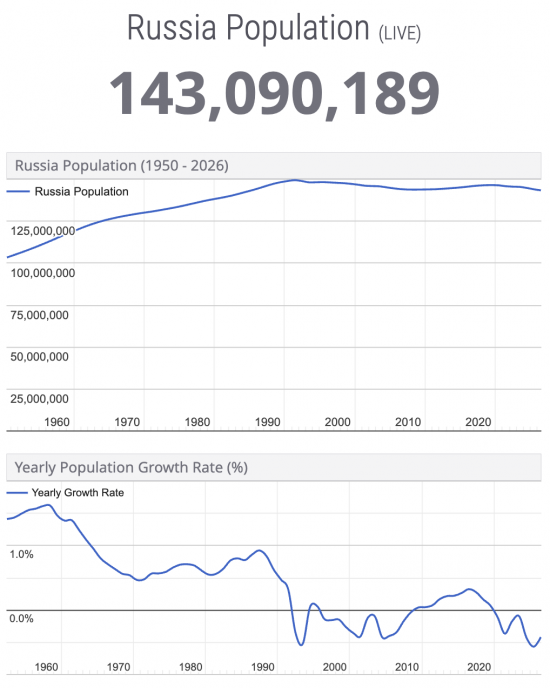
The pattern here of population change is so different from that in the UK. The population is falling, and that's because they, like us, have an ageing population, but unlike us, they have nobody queuing up to get into the country, and you can understand why, when the consequence would be going straight into the military.
So, demography is becoming a strategic constraint for Russia, and that's an important point to note. The cost of the current war that Russia is pursuing against Ukraine is immense in terms of human lives lost and impaired. Russia is believed to be losing around 30,000 soldiers every month. That's a figure I have taken from The Financial Times, not some odd internet source, and these losses are rising monthly at present and not falling.
Total losses are now thought to exceed 500,000 people killed and more than 1.4 million total casualties. That is one in 100 people in the whole of Russia. That is staggering. It means that every family in Russia must have lost somebody or knows somebody who has lost a relative. That is going to make a big difference to its national psyche, and that's also having a big impact upon the recruitment of new soldiers into the Russian army.
Russia is now offering around £40,000 to attract new recruits, but even those payments are not solving the problem of recruitment. People value their lives more than that, and the life expectancy of somebody who goes to the front with Ukraine is not very high. People know the risks and don't want to fight because this is a deadly war.
So in that case, is Russia a conventional military threat to the rest of the world now? It's already proved that it cannot win a war against a vulnerable neighbour. Why is it going to win a war against anybody else in that case? A depleted military in Russia is not going to want another conflict now, or for a long time to come. It needs to restore its resources, and at the same time, Putin is getting older. The case for fearing expanded war deserves serious scrutiny in that case.
And let me be clear, I'm not saying that isn't a threat from Russia. I am asking the question whether there is a serious threat of conventional warfare from Russia. Cyber warfare and drone attacks are possible. They're easy to stage. Just imagine it. You could launch a drone attack on the UK from a Russian tanker sitting in the middle of the North Sea, and who would know without good radar defence, that is? Cyberattacks and espionage can destabilise countries from a distance. Those risks should be taken seriously. But they are very different from the threats of conventional invasion, which is what all our military personnel and all our politicians want to talk about.
We need to appraise the risk properly, and we need to do so because the government is talking about increasing defence spending at cost to other budgets. Other budgets like that for social security, that for social care, and that for the NHS, as well as that for education, and so many other things. The trade-off is also being made that we need to actually look at increasing defence spending whilst letting the planet burn as a consequence of climate change.
None of this makes sense unless the argument for the threat that we are facing is clearly laid out. There is no apparent threat from conventional warfare. That's my point. So, why do we need ballistic missiles, aircraft carriers, tanks, and weaponry that drones could disable in minutes? Why don't we instead need to concentrate on the actual risk we face: cyber warfare and drone warfare? Those risks do need to have money spent on them. The rest, frankly, are not an issue we need to debate.
This is what we do need to talk about because political economy is about choices. Everything about political economy is about power and the way in which it is used to secure an advantage. Warfare is about power and securing an advantage through the use of military force. So political economy is about warfare, and we are told that more defence spending means less support for vulnerable people, but that isn't necessarily the choice we need to make. That's the point I'm also making here.
Every such budget reallocation does reflect our political priorities. And what is the political priority of this moment? By all means, defend the country, but defend the country against the risks that exist, not those that are made up. That is the issue of importance that we need to address, and at the moment, I do genuinely believe that most of the threats that we are being told exist are made up and we are not putting money into what we really require.
Spending decisions are never economically neutral. This one is not. We do need to work out what the priorities are. If we presume there are scarce resources, and I admit that assumption is itself one that could be challenged with regard to the government because money spent on things like social care could not be reallocated to spending on defence weaponry because the people who work in social care cannot be employed in defence manufacturing. They have different skills. So we can afford to spend on both, but we are being presented with this as a choice when that is also an artificial construction. And we have to therefore demand the evidence as to what that choice is all about.
We also have to ask, as we also do in political economy, who does benefit from the current narrative? That is the essential question of this moment. Fear can become a powerful political tool, much loved by political right-wing and military-industrial complex spokespeople. But military spending creates winners as well as costs.
The military-industrial complex has obvious interests. It has, since General Eisenhower, the American president, who had previously led the European invasion in 1944, which led to the emancipation of Europe, created this term, “The Military-Industrial Complex”, because he saw the threat from it inside the USA. He coined the term in 1961. We should still be aware that our threat does come not just from external sources, but also from over-militarisation of our economies because of make-believe threats that do not exist at all.
Public debate on these issues should be realistic, is my demand. Why not? Why shouldn't we talk about whether there are real threats and how we counter the ones that really do challenge the future of our economy? And as I've said, I'm not doubting that such things do exist, but I am questioning whether we are going to see tanks rolling towards us or any other European country at present. Right now I cannot construct that case of a threat from Russia. So why are we spending?
We might as well be talking about fairies at the bottom of the garden as far as I'm concerned when we come to talking about a threat from the Russian military, because it isn't going to happen. Resources should instead address the country's real vulnerabilities and the threats that we really have, including the fact that people who are so disenchanted with our society because it is not providing for them are an internal threat to our democratic stability, and we need to ignore the threat from Washington.
Politics should serve people before it serves vested interests. At present, I think this debate about defence is serving vested interests and not people, and that's why it's wrong.
That's what I think. What do you think? There is, of course, a poll down below. Please do let us have your comments. Please do like and share this video. Please do subscribe and hit that bell button because then you know when we publish something new. And if you'd like to buy Tom and me a coffee, that would be great because these videos do have a cost to make.
Poll
Thanks for reading this post.
You can share this post on social media of your choice by clicking these icons:
There are links to this blog's glossary in the above post that explain technical terms used in it. Follow them for more explanations.
You can subscribe to this blog's daily email here.
And if you would like to support this blog you can, here:

 Buy me a coffee!

[…] video that this Debate Ammunition supports is available […]
Good morning Richard
I agree with your argument that as things stand Russia is not a credible conventional military threat to the UK. However, I still suspect that if all European states had decommissioned their armed forces, Russia may may well have used it’s military strength to annex whatever territory it fancied. There are other potential aggressors too. Might Greenland be swallowed by Trump without some threat of resistance?
I feel that some level of conventional deterrence is necessary for probably all Eurpoean States, either individually or collectively, as well as defences against drones, cyber-attacks and sabotage. And there’s not much doubt that the UK’s armed forces have been run down to the point that they are barely able to function, so actually there may well be a need to invest more.
The problem of course is that our industrial capabilities have also been run down to the point that the UK is barely able to build anything any more (look at the glacial progress on high speed rail and nuclear power; the total absence of work on the new reservoirs that we’re going to need to irrigate our farmland, the wretched state of Britain’s housing stock…). .ideally we’d be developing and building our own equipment, rather than buying it overseas.
What’s really needed is a long-term plan to re-skill and re-equip in a very wide range of industries, which is going to demand a major re-balancing of the economy away from the banking/financial/legal sector.
In the late 50’s and early 60’s there were massive demonstrations in the UK against nuclear weapons. I didn’t join in – but I did support the notion that possession was more damaging than investment in other forms of spending and international relations.
Now, the use of nukes would, in all likelihood, be catastrophic for the aggressor nation as well as the initial victim – but also for humanity worldwide.
The potential use of them relies, at present, on – a trusting and cooperative relationship with government of the United States! Is that what we have?
The manufacture and maintenance of nukes involve activities which produce massive quantities of CO2.
We could do much better by, for instance, supporting poorer countries in need.
Why invest human resources and spend money on nukes?
Cybernetics: actions produce reactions. Even at its height the SovU (& its allies) could not have mounted a credible invasion (note that word) of the UK. Putin wants a legacy and this would seem to be enfolding Ukraine back into erm.. “Mother Russia”. As for the rest (Poland, Baltics, Finland) hmm. Might cause trouble on the border – not much more. There have been military exercises (2025 and 2026) involving Ukraine and NATO. From a NATO PoV they did not go well – whole battalions wiped out before they got off the start line (due to drones). Its all public. No 1 in the world with drones – Ukraine. No 2 Russia. Now look at what is happening in Russia & Ukraine not in terms of troops killed, but behind the front. Think it could not happen here? How to protect? It was/is claimed that Russia has/had the best air defences in the world.That’s not working out well is it. & the UK? But the Uk doesn’t have any Wildberries warehouses .. does it?????
This is not about ballistic missiles, this is about drones. Russian vid of a Flamingo drone with a 1 tonne war head flying at tree top height (for a couple of thousand kms). The best defence is no war/peace. & what I have not seen is much mention of China, not wrt Taiwan – but Russia – & the bits of Russia that it took off China in the 1840s – Norht ofthe Amur river (& maybe it wants a few bits more?) – Xi’s “legacy” to China?.
Ideally a country would be strong at home and abroad. The increase is also Europe wide to help support NATO capabilities too. The Geran-2 — Russia’s version of the Iranian Shahed kamikaze drone…1.5 million drones were produced in 2024 and it was “not enough”, and are used along with various missiles at the same time in attack waves to overwhelm air defences.
It is rather challenging to try to work out what the aims of the majority European powers – and that obviously includes us – with respect to foreign and defence policies, because they should be mutually reinforcing, when clearly they are not.
Firstly, jaw-jaw is clearly preferable to war-war, as Churchill memorably said, but where is diplomacy these days, when there is clearly a major need for it?
Secondly, a strong defence is built on a strong industrial capability that is able to support the material, never mind the human, demands of war. Where is our “necessary “industrial capacity?
Having observed the actions of us and the EU and our successive governments over recent decades and particularly since the start of the hostilities in Ukraine, I only shake my head in amazement at the sheer Clousseau-like amateurism that we are daily confronted with.
Our leaders explain everything with a closely coordinated narrative. A narrative is simply a story, but that is a consequence of neoliberal thinking – it’s how they try to get away with it all the time. The problem is that having created it, they then make the cardinal error of letting it guide their actions. I will leave it there, after adding that in my opinion this all bodes badly for us.
Yes, agree, our threat assessment needs to be much more sophisticated: https://gezwinstanley.wordpress.com/2026/08/08/how-we-should-defend-ourselves-the-lessons-from-delivery-drivers-at-the-battle-of-the-mons-drones-in-the-ukraine-and-continual-top-down-class-warfare/