
As The Guardian reports this morning:
Eight of the biggest oil companies amassed profits of more than $90bn (£67bn) in just three months as the Iran conflict sent energy prices soaring and the emissions-fuelled climate crisis caused deadly heatwaves.
The windfall war profits have reignited calls for oil and gas supermajors such as Saudi Aramco and BP to pay for the environmental damage caused by “cashing in on human misery” and fund a rapid transition to renewable energy.
Guardian analysis found that the eight listed oil producers made almost $93bn (£69bn) in the three months to the end of June – the first full financial quarter after the US-Israeli war on Iran triggered a surge in global oil prices to highs above $126 a barrel.
The Guardian notes, using a graphic, that these profits are exceptional:
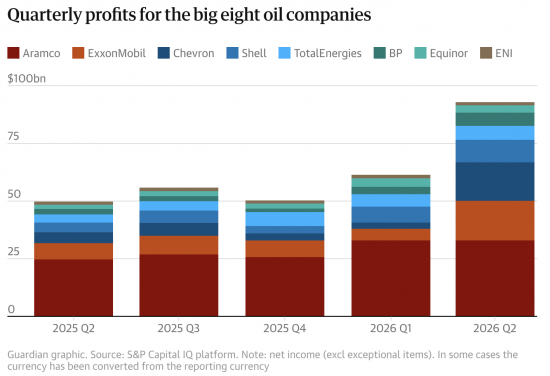
The case is appropriately made that war profiteering must be taking place. As a result, The Guardian focuses on the social and environmental consequences of this, and I would recommend reading the article for that reason.
I highlight the data for another reason. The reason is that this data has profound consequences for any decision the Bank of England makes regarding changes to interest rates.
As we already know, three of the nine members of the Bank of England's Monetary Policy Committee voted in July to increase the Bank of England's base interest rate from 3.75% to 4%, giving as their reason the concern they have that inflation will become embedded in the UK economy and that this must be stamped out through the use of higher interest rates to suppress demand. The assumption implicit in this suggestion is that there is excess demand in the UK economy, giving rise to price increases, and that it is only by reducing that demand that the inflation target can be met.
This data show that this assumption is wrong. There is no evidence of excess demand in the UK economy at present. Instead, there is excess profit-taking as a consequence of price manipulation due to war, and this is changing the profile of demand in the UK economy by increasing the prices of some base commodities, including oil, gas, and products derived from them.
The reaction within the economy is not to increase the overall level of demand. That is very unlikely because for most people the capacity to spend more does not exist: they are already living at their financial limits. Instead, this price gouging, which is possible because of the price inelasticity of demand for oil-based products, will cause demand for other products to fall, because people will still have to buy oil and gas and pay more for them.
There is, in other words, no overall increasing demand in the UK economy as a consequence of these oil price rises. What will happen, as their consequences work through the economy, is a fall in demand elsewhere, with a significant impact on the overall level of economic activity in the country, as spending is reoriented towards oil-based products and away from other forms of consumption.
The economy can, in other words, adjust for this situation, albeit very painfully and over time and with a high risk of recession arising as a result of people's own changed spending preferences, imposed upon them by the need to buy excessively priced oil, petrol, diesel, gas and domestic fuel, the prices of which will have risen through no fault of their own, and entirely because oil companies have exploited an international crisis for their own gain.
The consequence of those changed spending preferences will be a fall in demand for other products, in turn providing a double whammy for the companies supplying them, who will face their own increased production costs and a simultaneous fall in demand for those products they create, resulting in stress throughout the economy as a whole whilst the oil companies continue to count their profits.
Does the Bank of England need to raise interest rates as a result of this? The answer is very clearly that it does not, but the evidence is that it is very likely to do so, nonetheless. All it can do as a result is create a recession and increase unemployment, and all because of the economics of economic extraction, which is at the core of our economy being pursued by these oil and gas companies, to which the government will look the other way because that is what the economics in question tells them to do, as much as it tells the Bank of England to raise interest rates.
The capacity to destroy value inherent in late-stage capitalism knows few limits. The evidence is all around us.
Thanks for reading this post.
You can share this post on social media of your choice by clicking these icons:
There are links to this blog's glossary in the above post that explain technical terms used in it. Follow them for more explanations.
You can subscribe to this blog's daily email here.
And if you would like to support this blog you can, here:

 Buy me a coffee!

I am doing some work on how the energy pricing system destroys EU industry (& thus by extension UK industry).
What price does Chinese industry pay for its energy? How is gas priced that is supplied by Russia to China? Oil? (from assorted sources) – how is that priced?. How has the profile of oil-consumption changed in China? In some respects this is an extension of the question: what is the cost of capital to Chinese companies?
Argument: the well-being of the EU & UK citizens is being sacrificed on the altar of the fossil rabble. I note that Shell has off-loaded all of its renewable assets to Total. This at a time when German auto companies are being eviscerated by drop in demand in China & the threat of a tsunami of low-cost EVs hitting Europe (VW – 100,000 jobs – GONE). Where does that leave Shell (wot? build re-charging stations? – you might find that is a very low margin business). & so on & so forth. A child can see the direction of travel – but apparently not the main boards of many of the fossil mafia. & the cost of money? – to UK business? (vs that paid by e.g. Chinese companies) never ever occurs to the imbeciles in the BoE to even consider this……oh no – gotta keep an eye on inflation that’s wot counts.
Rant over. !!
So much to agree with
If an economist were to investigate medicine, they would conclude that aspirin will cure all known diseases. The idea that the same symptom may have different causes is too difficult.
Might the words, actions and avoidance of action by our politician, main stream media and financial classes combined, concerning the well-being of regular citizens and their children, indicate that the U. K is more a polygarchy than a democracy?
So, in a sane world the MPC would be looking to reduce the base rate towards zero, and we’d slap a massive windfall tax on the fossil fuel companies? I would be all for it.
The profiteering has reached the stage where even Trump is complaining about it. Presumably the oil companies didn’t cross his tiny palm with gold.
When I donned my pair of Neo-lib sunglasses, all I could see was that the ‘MPC Nine’ actually increasing the value in the economy – the value of rentierism – those who were extracting rents, and of course the supply side. And with all that money of course, there will be enough spare cash to bribe our political parties to keep them in the manner to which they have become accustomed and keep strangling greener sources of power at birth.
All I see is the pure logic of greed and monopoly. Then I think of the consequences for you and me and in agreement with Richard, it makes no sense at all.
And it’s no good telling these extremists that they will cut their own throats in the long run. That is something the state sorts out – isn’t it? When people can’t afford to live? I mean, that’s how its been for the last 40-50 years?
This might sound like whistling in the wind but with your permission Richard I would like to send this post to my MP, a Lib Dem I know, urging her to urge the Government to use the power of the Treasury to stop the inevitable rise in interest rates. I will obviously fully reference my source. This is an excellent post that so clearly sets out the case. MPs need to be educated about this.
Please do.
A genuine naive question: where is growth meant to come from if the BOE increases interest rates and thereby reduces disposable income and demand?
Not naive at all, and a good question.