
Farage and Reform failed again in the Manchester mayoral election on Thursday, which was announced late on Friday. This was the BBC's summary of the first preference voting:
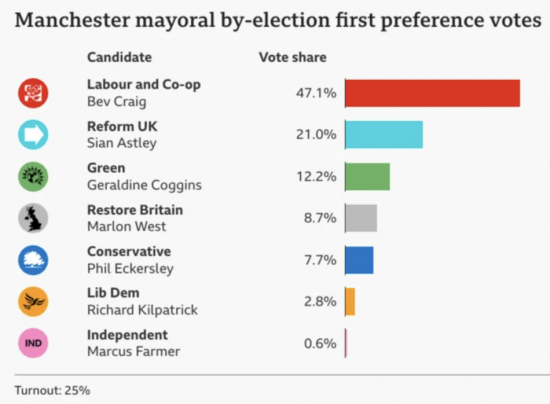
On second preferences, Labour won by a 2:1 margin over Reform, with all other candidates having been eliminated.
There is a very clear pattern emerging here. Farage is losing. This is the third time this year he has lost in Manchester, an area where Reform has to win if it is to have any influence in creating a future government.
Admittedly, the result points to tactical voting. This, though, probably helped both Labour and Reform. The LibDem vote did, I suspect, either move towards Labour or the Greens, whilst the Tory vote presumably went to Reform. Something has to explain the Conservatives' abysmal performance and the increase in the Reform voter share on second preference, presumably from both Restore and the Tories, justifying my description of all three as being on the far right in the minds of voters.
That said, I think it's fair to draw some conclusions.
The first is that voter turnout was incredibly low, but nobody would choose to hold a by-election at the end of July, although I note Farage has opted to have one in the middle of August, showing how little he knows about these issues.
Second, whilst it is clear that Farage can still command the right, leaving both the Conservatives and Restore trailing, it is apparent that his appeal is fading. His own immature antics in calling a by-election in Clacton, his evasion of questions about his funding, and the sense of sleaze that now surrounds his party are all leading to a stench that is making it very hard for enough people to support Reform, wherever they stand, to secure sufficient votes to win when it matters. The fact that so many of their councillors elected in May have already quit does also provide an indication of the lack of suitability of those standing for this party to hold office.
Third, that said, as the second preferences revealed, one third of the UK electorate are willing to support the far right, ignoring the sleaze when doing so. There are no grounds for complacency in this result, but there are definite signs that the Farage bandwagon is coming off the road, and that the man himself has no clue how to deal with the problems that he has created for himself, his party and the credibility of far right politics in the UK, if it ever had any.
Thanks for reading this post.
You can share this post on social media of your choice by clicking these icons:
There are links to this blog's glossary in the above post that explain technical terms used in it. Follow them for more explanations.
You can subscribe to this blog's daily email here.
And if you would like to support this blog you can, here:

 Buy me a coffee!

I would enjoy Reform’s plateau (and now decline) more were it not for Restore lurking in the shadows and ready to replace them.
Greater Manchester is divided into 27 parliamentary constituencies, from 2024 General Election, Lab 42.8% Reform+Cons 33.2%. Similar figures.
Very fair.
All I would say is that there does seem to be a lot of positive expectation concerning Burnham becoming PM and this may have changed the mood.
It will be interesting to see if Burnham’s impact is sustainable and we all have our concerns over that. The issue being, if all of sudden – as does happen – the gloss comes off his premiership, Farage (or something worse) becomes viable again.
And this takes me to my other concern – does Burnham and his team know the cost of failure? Not to the Labour party, but to British democracy and politics? The Guardian (Timothy Garten Ash) is reporting that the Democrats may not be prepared for the mid term elections and that they are not offering anything really to the U.S. voter. My point is that whether Labour or the Democrats, they both need to not only sound different but let people FEEL that they are different by actually rolling back the vice like grip of Neo-liberal based polices that lock in stasis. This is actually high stakes stuff.
Totally agree with you about the lack of anything hopeful from the Dems in USA.
They lost in 2024 largely because they had no proper alternative and mid-terms still feel much like “anyone but Trump”.
In her foundational book The Authoritarian Dynamic, political psychologist Karen Stenner established that about 33% of citizens across Western democracies possess a latent authoritarian predisposition. (from google)
This will increase if people are under threat or perceive themselves to be. And I expect would diminish in peaceful times.
One can argue this but the vote for more extreme right wing parties seems to peak at about a third and that holds across Europe. Le Pen gets about this in run offs elections in France.
The Conservatives with polices like leave the ECHR, end net zero, support for Israel etc are pitching for the Right wing vote. In the UK the Reform /Restore and Conservative vote often tops 40%.
I don’t feel comfortable with this but there are grounds for hope. More if the other parties can bring themselves to work together.
Hannah Arendt identified this trend many years previously in her thoughts about the banality of evil.
The relatively large vote for Restore is worrying. They seem to be outflanking Reform on the ever farther right wing, as Reform themselves did the Conservatives.
They are very active in this area with large tub-thumping rallies which are not publiciesd outside of their “circle”. Very concerning as I see people I know getting sucked in.
“Is Farage over?”
Let us hope so!!!
Farage is nothing but excessive nasty noise affecting the governing process.
I read the data as worrying. Too many, 37.4%, voted to the right in some form or other. First past the post may well give a right wing government, perhaps as a coalition.