
The FT provides a plethora of headlines about a bizarre world this morning, each sending out wildly different signals.
BP issues one of the weirdest predictions, claiming it needs to cut costs because of the risk of a global glut of oil and gas and the potential for oil and gas prices to collapse. Maybe they have not noticed there is a war on in the Gulf:
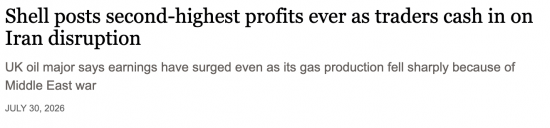
 Shell, meanwhile, is raking it in, exploiting the opportunity provided by Trump to fleece us all:
Trump is having an impact elsewhere. The US economy is not doing as expected. No wonder he is, and should be, worried about the midterms:

The arms trade is, however, enjoying the bonanza:

Others are not. I know Foxtons are not a typical estate agent, dealing mainly in the high-end London market, but when that market sneezes, everyone else gets a cold, and the FT notes;

Mind you, things could have got worse for them yesterday. The Bank of England held off rate rises, but it will not be for long. The idiots on the Monetary Policy Committee really do think they can change oil price-driven inflation by changing interest rates:

And the FTSE 100 fell, but not by enough for anyone to notice. The madness goes on.
Thanks for reading this post.
You can share this post on social media of your choice by clicking these icons:
There are links to this blog's glossary in the above post that explain technical terms used in it. Follow them for more explanations.
You can subscribe to this blog's daily email here.
And if you would like to support this blog you can, here:

 Buy me a coffee!

The glut of crude oil is due to the massive damage being inflicted on refineries, both in West Asia (“Middle East”) and Russia. We cannot fill our cars and trucks with crude, it needs to be refined into petrol and diesel. This is why the pump prices keep rising even though the crude barrel price is relatively low. And there is also the issue of demand destruction, which will become increasingly significant as people switch away from fossil fuels where they can.
In recent years, people have ‘forgotten’ a fundamental point – income is the thing not capital growth, per se.
Over any long period, the London market has always yielded something close to 5%, as did Wall Street up until the 1950s, and the long-term mean has the habit of reasserting itself when least expected. Today, the FTSE100 yields about 3%.
The purpose of investment is the purchase of an income, and once commensurate with the risk being taken. If the real and risk-free return on cash or bonds is something of the order of 2% to 2.5%, investors ought to expect something significantly more for the risk they accept with equity investment.
Dividends are ‘real’ since they come from the profits of business, which themselves adjust their prices to reflect the prevailing rate of inflation.
So, a FTSE100 yield of 3% is not so attractive with RPI at 3.1% and cash on deposit of 5% (2% ‘real’) similar to 10-year gilt yields. Pension funds can be converted to insured lifetime income of 7%-8%, depending on age.
Growth is cumulative. This means that if growth slows it is still growth and therefore that headline about the USA having slower growth is a biased way of saying the US economy has hit another all time high. It’s the biggest country size economy the world has ever seen. A lot of people who heard the first State of the Union address and applauded “the experiment entrusted to the hands of the American people” speech had their doubts but the USA keeps proving them wrong. And we in the UK, us clever commentators from the old world, carp at their slowing growth and call it part of today’s ‘madness’.
Noted.
But your credibility would improve if you did not pretend to be an early US president.
‘The idiots on the Monetary Policy Committee really do think they can change oil price-driven inflation by changing interest rates’ I had a good chuckle at this parting line. I’m ashamed to say that I belonged in that idiot group or at least the ignorant group before taking an interest in actually trying to understand economics thanks to youtube channels and blogs like yours.
It’s tragic how economically illiterate this country is when it probably the single biggest factor affecting all our lives in a negative manner (unless you happen to be wealthy) and is entirely fixable with better education, even if it was just our political class.