
The Bank of England's Monetary Policy Committee issued its quarterly report yesterday, coinciding with its interest rate announcement.
The rate is staying fixed for now, but three of the nine members wanted an increase, apparently thinking that inflation caused by oil price increases, in turn caused by war, represent excess demand in the UK economy that they must stamp out with an interest rate rise, when the exact opposite is true: the inflation is a sign of shrinking demand in the eocnomy as spending power is shifting to oil and we need a rate cut as a result.
But what do these people know anyway? This is the first chart in their report and shows their forecasts for February, April and July this year:
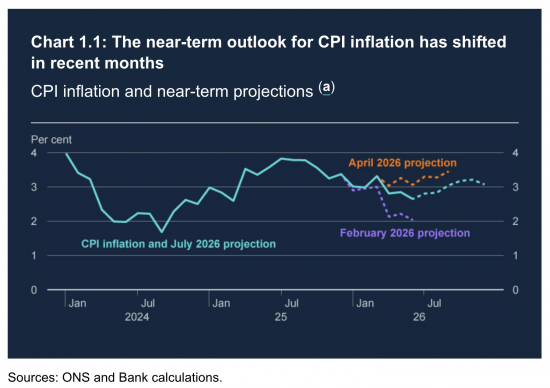
Those forecasts are wildly different.
That indicates three things.
The first is the Bank's failure to take a longer-term view: like markets, they appear to think Trump's words are more important than his actions, or what is happening on the ground.
Second, the wild swings suggest events are more important than anything the Bank does, in which case the obvious question to ask is, why are they doing anything in that case?
Third, if they can change their minds this often and produce forecasts with such variation over a period of a few months, why do they think their only currently available tool to control inflation, which is the base interest rate, changes in which are widely thought to take two years to have an impact, is an appropriate tool for the task they have been given?
If you want evidence of this committee's irrelevance, but also of the harm it seeks to cause nonetheless, I think this chart and their clear intention to raise rates early in the autumn provide it.
No one but a fool would run an economy this way.
Thanks for reading this post.
You can share this post on social media of your choice by clicking these icons:
There are links to this blog's glossary in the above post that explain technical terms used in it. Follow them for more explanations.
You can subscribe to this blog's daily email here.
And if you would like to support this blog you can, here:

 Buy me a coffee!

Might the Bank of England represent the financializing sections of U. K. society rather than the whole of society?
Might the “thinking” of any controlling group of an organisation which does not include the recipients of its functions be likely to be distorted?
I am surprised Richard does not realise that few things have a greater effect on rainfall or the Straits of Hormuz than Bank of England interest rates. Seriously, apart from their irrelevance, interest rates help “haves” rather than “have nots” and are yet another driver of inequality. Also seriously, should we stop talking about increasing the “cost of living” and start talking about increasing the “standard of living”?
The bank of England’s interest rate setting is utter nonsense for the reasons you have given here and previously.
They clearly they have no understanding of dynamic system theory, which many engineering students study. This is about the stability of feedback systems. In such systems a significantly lag between cause and effect adversely affects stability. Interest rates have a long lag, as you have pointed out, taking one to two years to take full effect. So you would expect adjusting interest rates have a high risk of causing economic instability. They seem to know nothing of this. Perhaps that’s because in their fantasy economic world economies tend to equilibrium, which is clearly false.
They also seem to have an almost religious devotion to the theory of the non-accelerating inflation rate of unemployment, commonly known as NAIRU. In this, if unemployment is too low inflation not only increases but continues to increase, it accelerates. Then, according to this theology, to stop inflation continually increasing unemployment has to rise. But, if it only rises a bit, then inflation rate remains high, though it stops accelerating. So you can, if you believe this, end up with both high inflation and high unemployment. Their belief in this possibility makes interest rate setters extremely nervous. They err towards high interest rates and higher unemployment to avoid, in their view even higher rates of both.
But NAIRU is nonsense. There is no way to measure it and, worse, they seem to believe it changes all the time. Fundamentally there is scant evidence that it actually exists. Yet they continue to believe and fear it.
Time to get rid of these people and abolish the independence of the Bank of England.
Bill Mitchell has done a mountain of research on NAIRU over the last 4 decades and a search for that term on his blog will give you enough reading to last a lifetime. One of the key points he makes is that a graph comparing unemployment to NAIRU shows that the predicted value of NAIRU roughly follows the unemployment figure with a delay of a few months. If unemployment falls and inflation does not rise, then NAIRU must be falling as well. If unemployment rises but inflation does not fall then NAIRU must be rising as well.
Apparently there are people people who get paid to carry out this highly complex, technical economic analysis!
According to detailed research (here) Financial Resilience Report 2025
Nearly one in five UK adults have less than £100 in cash savings, with a similar number only able cover bills for one month or less if they or their partner couldn’t work due to illness. So, fully 40% of the UK adult population lead a “hand to mouth” existence and, surely, these are the very people who should benefit from a fairer society. As an IFA, I find it true that many people know so little about financial matters and that they are ‘scared’ of seeking the help that is available. Most people can benefit from organisational help to improve their financial lives.
A couple of years ago, I met with a single 64-year old slowly drowning in expensive debt which was impacting his physical and mental health. I was able to show him that he had over £100,000 in DC pensions, a fact that had completely passed him by as he simply didn’t understand the correspondence he had been receiving. After quite a bit of work, he was able to clear all his debts, thus giving him a ‘pay rise’, by using his tax-free cash allowance, and we also agreed to set up an RPI-linked annuity increasing his monthly income, in the round, by nearly £800 gross.
I bumped into him recently – he has been able to say debt-free and has saved a little emergency fund and was looking forward to getting his state pension next year with a spring in his step.
That is transformational
Having often acknowledged how much a better human being you are than I am, I still think that calling these people ‘fools’ is far too nice.
🙂
Calling it stupidity assumes the committee has the wellbeing of the people or country at heart. They know what they’re doing. They only serve their own class. Call a spade a spade. It’s pure GREED.
The MPC are making decisions based on one criteria only; their own wellbeing and future prospects. They believe this is the way the wind blows in the UK and the world. It’s selfish greed, as pointed out by others here.
We can only point out to people that this is happening and it shouldn’t be in a decent and caring society.
Obviously, they have no shame, and seem to be typical of more recent right-wing ideologies.
Modern mainstream economics seems to be like modern art criticism; the orthodoxy is so stupid only educated people can believe it.
Incidentally, I came across these two explanations of the source of commercial bank lending.
Can they both be true?
From Yahoo:
Deposits form the most significant source of funds for commercial banks, typically accounting for about 90% of their total liabilities. Think of deposits as the fuel that keeps the banking engine running. When customers deposit money into their accounts, banks don’t just store this money in vaults – they use it as a primary source of funding for their lending activities.
Or AI:
Commercial banks create most of the money they lend through the process of making loans, which generates new bank deposits. This means they do not lend out existing deposits but rather create new money electronically when they issue loans.
Just checking that you would confirm that it’s AI, not Yahoo, that understands commercial bank lending, Richard.
I thought I had said that….sorry.
Thanks. It just shows what an uphill task you have trying to combat the inertia of ignorance that politicians, economists and the media are perpetuating at the expense of a decent and fair society. Where DO they imagine all that money sloshing around looking for safe investment homes comes from?
PS I hope your kidney stones are finally sorted