
Oil is back above $100 a barrel. But when does a higher oil price stop being just another headline and become a genuine crisis for the UK economy?
In this video, I explain why the answer isn't today, but it may not be very far away.
The latest rise in oil prices is not an isolated event. It is the consequence of the continuing conflict in the Middle East, the disruption in the Strait of Hormuz, and growing threats to shipping through the Red Sea and the Suez Canal. These are some of the world's most important trade routes, and when they are disrupted, the consequences spread rapidly throughout the global economy.
I explain why these problems take time to work their way through global supply chains, why shortages of fuel, industrial gases and key raw materials may emerge over the coming months, why inflation could return, and why recession becomes much more likely if governments fail to prepare.
Most importantly, I ask when the tipping point arrives. Could Britain muddle through the summer? Does the real danger begin in September? Or is October the moment when businesses and households start to feel the full impact of rising oil prices and disrupted international trade?
The issue is not simply the price of petrol or diesel. If shipping routes remain under pressure, transport costs will rise across the economy. Businesses will pay more to move goods, manufacturers will face shortages of essential inputs, and consumers are likely to see higher prices in the shops. This is the sort of external supply shock that interest rate changes cannot solve and that governments need to plan for well before it arrives.
The UK currently has no obvious plans in place to deal with this crisis. Other countries have. They have taken steps to strengthen their energy security. We seem to be waiting for markets to solve the problem. That is not a strategy when markets themselves are already being disrupted by war. Our government needs contingency plans for fuel supplies, essential industries, public transport, healthcare, and the wider economy if it is to minimise the damage, and we need to know what they are.
This isn't simply about the oil price. It's about inflation, energy security, economic resilience and whether the UK government has any credible plan if the Middle East conflict continues to disrupt world trade. If these risks continue to grow, the consequences could affect every household and every business in Britain.
This is the audio version:
There is no Debate Ammunition for this video.
This is the transcript:
Let's be clear. The oil crisis has returned. Oil has gone back over $100 a barrel, and that was foreseeable. This is exactly what I warned would happen months ago. I said the crisis in the Strait of Hormuz would continue whatever Donald Trump was saying, and it has.
The supposed ceasefire in June was not real. The parties didn't agree with each other. They kept on lobbing weaponry at each other. The war is continuing, and it's even escalating.
And most worrying of all, governments like that in the UK still appear totally unprepared for the consequences of the crisis that is coming their way, having been as naive as markets about what was really happening in the Gulf and having the stupidity to believe what Trump was saying.
Let's have a look at the issues here. This is the chart of the oil price.
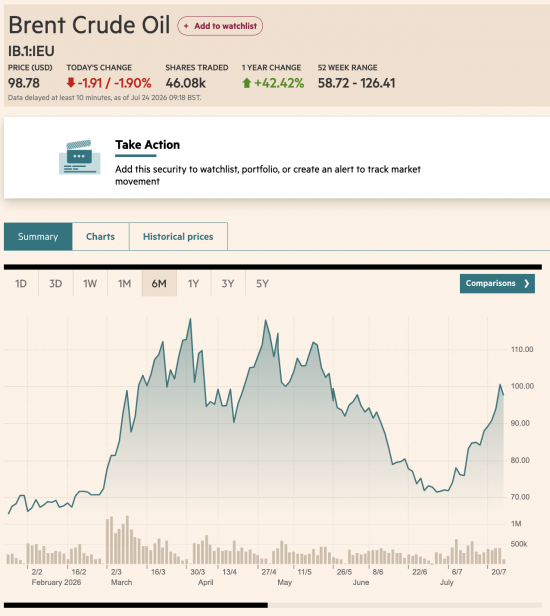
The fall in June was the result of misleading claims by Trump. We know he makes them now. We know he makes them deliberately. We know he does so to let people profit from his announcements. We know that people will be doing that again now as the price rises again. But we need to look at the reality.
And the reality, which is what I've always talked about, is the fact that we have an ongoing war, which Trump and Netanyahu, lest we forget him, created in February, and which has no resolution in sight. That is what I have been saying for ages. I said this war would get worse in August. I said the crisis would be in the autumn. I see nothing to change that forecast.
The illusion of a lull was false. There has been no recovery. The oil shortages that I've been predicting are going to hit because world oil reserves are now much lower than they were. China has helped a bit by reducing its oil consumption, but no one else in the world has, and other raw-material supplies have not been resolved and are real and are impacting businesses even as you listen to this video.
The war is ongoing, and the risks are growing again. Global trade is in fact becoming more fragile. That's the big point here. The Houthis in Yemen are now effectively closing the Red Sea, and the Suez Canal route looks as though it might also be at risk now.
So not only is the Strait of Hormuz closed with regard to oil, but the Suez Canal might be closed with regard to all the traffic that is moving between the Far East, as we call it, quite unfairly, and Europe and parts of the USA. And we're going to see many transport costs rise as a result.
The fact is, tea drinkers amongst many other people who will be consuming commodities from that part of the world should be paying attention to this video. You're going be paying a lot more for what you want very soon because, and I've seen this indication, tea did cost 10 cents per kilogram to bring to the UK. Because of the time it takes to take it around the Cape of Good Hope in southern Africa, it cannot be successfully shipped that way. It will have to be air freighted. The cost might rise to $4 per kilogramme if it is air freighted into the UK. Imagine what that is going to do to the cost of your cup of tea if that happens very soon.
This stuff is serious, and we're not talking about it, and there are other shortages to come. Let's be clear, it's not just oil. It's not just jet fuel. It's not just diesel. Although we are seeing that very often in the UK already, because it's not available at many pumps right now. But industrial materials such as sulphuric acid, helium, and carbon dioxide are all going to be in short supply. And those have a massive impact upon everything from industrial manufacturing, to MRI scans, to your fizzy drinks.
The economy is going to feel the consequence of all of this. Higher transport costs will feed directly into inflation. And let's stop pretending this isn't going to happen now because we know there is no resolution to this war and we don't believe there's going to be one. And although Donald Trump says he's going to obliterate all the weaponry and all the infrastructure in Iran, what we know is that for all the claims that he's made, that has not happened and there's no evidence that it will.
As a consequence, businesses are now going to face long-term operating cost increases. Supply chains are going to become less reliable, and growth will most certainly not only slow, but cease. And the reality of recession as a consequence of war is now becoming very much more likely.
So in all of this, where is the government's plan? Our governments keep talking, and our new government keeps on talking, about growth. But what happens if we can't have growth because there are external supply shocks that prevent it? What happens if fuel shortages really do become real? How will essential supplies be protected? How will businesses survive? What will happen to the need to get people and children to work, and school and elsewhere? And what will happen with interest rates? Will the Bank of England be told to cut them, which is the appropriate response in wartime? Or will they increase them because we are inevitably going to see inflation?
None of these issues is being discussed as far as I can see, and yet they need to be. We need plans. Without them, we cannot operate successfully when the crisis hits.
When is the most likely time for the crisis to hit now? Probably October, if I'm honest at this point. I think August, we'll get through. It's summer. The pressure is off. September, it will grow because it'll be clear that conflict isn't resolved. By October, the shortages are real.
In some countries this will not be the case. China has already appeared to conserve oil. Through active state intervention, it's cut its consumption already. It has put strategic reserves in place instead. But we aren't. We have no equivalent strategy. We are waiting for markets to solve the problem for us, of course. That's what we always do. There is no market solution to a war. It's time our government realised. It's time our government understood that energy security demands government action.
Hope is not an energy policy in that case. We are entering a prolonged period of risk. The government needs a contingency plan now, and we need to know about them because we too have to plan. We're all in this one together, quite seriously. Energy resilience should become a national priority, and that's why it needs to be shared with us. We cannot assume markets will solve this crisis.
The question is whether anyone in government is ready and understands all of that. In my opinion, it seems not. Andy Burnham is more worried about the price of bus fares. He's more worried about whether we can get to the pub, but that's the small-scale stuff. I'm worried about the risk of meltdown, and this time it won't just be loo rolls that are in short supply. Everything might be, and what's he going to do about that?
That's what I think. What do you think? Do you think we've got a crisis coming? If you do, let us know. There's a poll down below. Let us have your comments. Please share this video. Please like it. Please do subscribe. Hit that bell button because that means you will be notified when we produce another video. And if you'd like to buy us a coffee, that would be great.
Poll
Thanks for reading this post.
You can share this post on social media of your choice by clicking these icons:
There are links to this blog's glossary in the above post that explain technical terms used in it. Follow them for more explanations.
You can subscribe to this blog's daily email here.
And if you would like to support this blog you can, here:

 Buy me a coffee!

I’m with you Richard, we’re going to need the loo rolls as it really is about to hit the fan.
Maybe we need a crisis like this to get people paying attention; the quiet stuff (who’s buying up the assets while everyone’s distracted) never gets the same airtime as the panic.
“It’s a gas gas gas” as the oap Rolling Stones say. Gas consumption in Western Europe is seasonal 6:1 – winter: summer. Summer is when one stocks up. The Germans have been somewhat lax in this area (ditto other EU countries). UK? have very little storage – so how is that going to work out? (storage used to be equated with North Sea gas fields – which are in long term decline). As for China, the shift to EVs has massively reduced the need for oil. Burnt-ham’s solution for the UK appears to be more drilling. How does that address this winter? Doesn’t. How does this impact the price of oil? Nope. In the case of Iran – USA, events are being driven by a flailing tRump who wants to avoid a republican wipe out (thus war is the preferred option).
Inflation? BoE & co have that well covered, they will….raise interest rates, cos that’s what you do. There are no serious people in the UK gov, not politicos, not the bureaucracy, both are composed of a mix of amateurs, fantasists and yes-people. This situation has developed over 46 years.
“if governments fail to prepare”
IMAO, the only way to ensure domestic energy security is conversion to 80% non-fossil fuels.
It may take years but it can happen. Imagine the USA if Ronald Regan had not cancelled in 1980 Jimmy Carters solar energy programs.
It really can upset the mind if one thinks about it.
Much to agree with
Perversely, I’m looking at the war in Iran as a major benefit to solving/mitigating the climate crisis. Short term it is worrying, but in the longer term this war is the biggest weapon we have against big oil and increasing CO2 levels. Once the AMOC tripping point is reached the UK will be totally f**ked for thousands of years.
And not forgetting the cult of wealth
“when the tipping point arrives”
With regards to you US voters, the tipping point arrived when oil hit $80.00 a barrel.
The voters will respond in the 2026 Midterm Elections. The Republicans and MAGAts (not necessarily the same thing) are quaking in their boots. Voters are at the “torch & pitchfork” level of upset and disgust.
Example from the past adding inflation in. Crude oil first broke the $100 per barrel threshold in January 2008, driven by surging emerging market demand and a weakening US dollar. $100 in 2008 is worth about $155.11 in 2026. This change shows a total price increase of 55.11% and an average inflation rate of 2.47% each year.
So?