
Thanks for reading this post.
You can share this post on social media of your choice by clicking these icons:
There are links to this blog's glossary in the above post that explain technical terms used in it. Follow them for more explanations.
You can subscribe to this blog's daily email here.
And if you would like to support this blog you can, here:

 Buy me a coffee!

Thank you for this. I’ve seen lots of documentaries about why the money system is broken because we came off the gold standard.
But this has started to teach me the constraints of a gold stand.
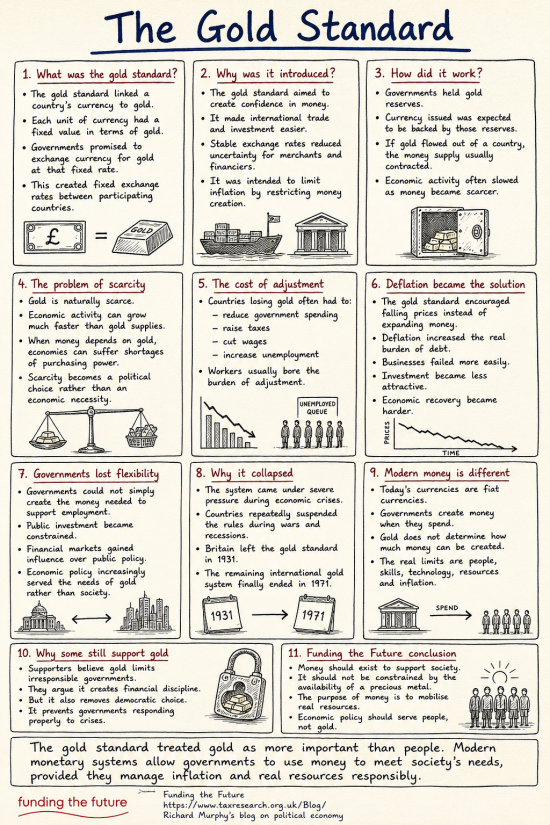
In the summary “the gold standard treats gold as more important than people”; has echos of today’s issues, where “balancing the books is more important than people”.
Thanks. I realise these things will take quite a lot of time to write now. But I like them.
I like them too!
Several times I have printed out copies and delivered them to friends adding my own handwritten notes.
Thanks. There will be more. Maybe, many more.
Another good one. Well done. Easy to follow.
Thanks. Jacqueline is checking them now. She sees what I get wrong.
The late 19th century saw a 20 year depression. Inflation was low but poverty was high.
Some, especially in the USA, advocated monetising silver to increase the supply of money. The words of Willian Jennings Bryant still resonate, “You shall not press down upon the brow of labor this crown of thorns; you shall not crucify mankind upon a cross of gold.”
Faced with a choice between some inflation and more unemployment, the bankers will still opt for unemployment.
Much to agree with. That Victorian (in our terms) agricultural recession, in particular, is now forgotten. It ended at the turn of the century with major upturns in trade, technology driven.
It’s probably common knowledge to most on here, but it was a revelation to me when I found out a few years ago that the reason that we have the ‘pound sterling’ is because it was originally a pound (weight) of sterling silver, which was then sliced into 240 pennies. Presumably at some point the silver standard became supplanted by the gold standard.
Yes
At the risk of sounding like Bernard in Yes Minister, there is also a ‘pennweight’ which is one twentieth of a troy pound (named after the French city of Troyes in N E France) The troy pound is smaller than the avoirdupois pound we used to use and is divided into twelve ounces -as the Romans did. So here are 240 pennyweights in the troy pound and they equal 24 grains or 1.55 grams. Some people -probably Americans-still use the system for precious metals. ( and elderly Conservative who prefer ‘English’ units ! )
All the these tables were printed on the backs of exercise books in the 1950s but probably not by the time Richard went to school. Being a bit of a nerd I learnt them but wondered why we were never taught them.
The metric system makes things so much simpler.
I remember those tables!
Another good one.
Thank you.
I see the makings of (cartoon) book here? Seriously………….
This one reifies that money is not gold, nor anything else that is ‘natural’. Money IS man made, a human domain, and it is therefore never a shortage of money that should hold us back – it is the capacity to spend it or not that is the real world constraint and consequence.
If we can get the human ownership of money creation over to people, then we can start asking questions about the lack or why it should costs so much to make something out of nothing. Which money is, essentially.
Is it worth a mention of what a fiat currency is in brackets?
Fiat currency is coming soon….
Thanks again for another helpful infographic.
It probably would be too complicated to add also how the price of gold (and other metals) is also ‘fixed’ daily by the London Bullion Market Association, again based upon ‘supply and demand’ principles.
https://www.royalmint.com/invest/discover/gold-news/what-is-the-gold-fix/
It would be too complicated, and in this context, not relevant.
Though the same actors in the City involved in ‘wealth creation’ playing roles in the different markets as traders as well as fixing pricings for selling?
I don’t know how that could be portrayed in an infographic; perhaps in some intertangled web map?
I am not sure…
Agree!
I am so sick of hearing about gold. Every other YouTube commercial seems to be an advertisement to purchase gold bullion.
Even YouTube shows with sponsors have the host (presenter) breaking in to try and sell you gold coins, gold certificates or some gold product I have no idea what it is.
I have set my limit: The day Dan Snow or Jonathan Pie starts hocking gold is the day I will unplug from YouTube content except Funding the Future!
In must get a gold sponsor…. 🙂
@Richard Murphy
“In must get a gold sponsor….”
Selfridges or Maybelline would be more entertaining!
Excellent. What is interesting and worrying is that many people still act as if we were on the gold standard – raise taxes, cut spending etc!!!
Agreed
Brilliant again – these should be an A4 size book.
In time…..
MMT puts the currency on a ‘labour hour’ standard rather than a gold standard via the operation of the Job Guarantee – which pays a fixed amount of the currency for an hour of labour.
That works in a similar way to the gold standard, but with an anchor asset that is non-hoardable and productive in the hands of the currency issuer.
The net consequence of that is stable prices in the way the gold standard promoted, but ends unemployment permanently. The operational employed buffer will be about 2% of available labour rather than the widely variable unemployed buffer under a gold standard.
It’s also utterly undeliverable.
As much a fantasy as the gold standard ever was.
Just aim for full employment and stop wasting time talking about meaningless, costly and intensely wasteful job creation programmes which would serve no purpose if we planned for a fully functioning economy instead.
[…] preparing an infographic on the gold standard, this follow-up seemed to be […]