
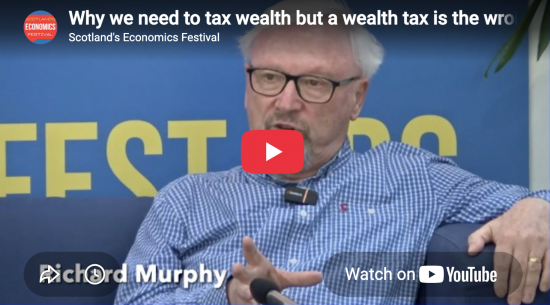
This was recorded at Scotland's Economic Festival in March, and nothing has changed since then. Thanks to William Thomson for clipping this.
Thanks for reading this post.
You can share this post on social media of your choice by clicking these icons:
There are links to this blog's glossary in the above post that explain technical terms used in it. Follow them for more explanations.
You can subscribe to this blog's daily email here.
And if you would like to support this blog you can, here:

 Buy me a coffee!

I looked at the various aspects of wealth and concluded that there were inherent problems with taxing wealth. Its an issue as there are obvious inequalities but dealing with them is problematical.
https://www.cornwallecon.com/post/the-problem-of-wealth-to-tax-or-not-to-tax-2
https://www.cornwallecon.com/post/dealing-with-disparities-in-wealth-some-options
https://www.cornwallecon.com/post/taxing-wealth-assets-some-issues
It is quite simple. It is a distraction.
We could have a wealth tax. Other countries do. At the levels generally suggested – a percentage point or two for the wealthiest – it would not bring in much revenue.
It would be easier and raise more revenue from the wealthy if we reform other existing taxes on wealth. In particular, the implicit subsidies on income and gains from wealth compared to for example earned income.
Agreed
It’s also communism to take 2% of someone’s wealth. You’d basically be stealing it over the course of a human lifetime, so perhaps wealth taxes at 2% should better be called stealth communism.
I’m glad that we are opposed.
I do not think you know what communism is.
Communism involves the abolition of private ownership of the means of production. A 2% wealth tax does nothing of the sort. It leaves ownership intact. You may disagree with such a tax, but calling it “communism” is simply using a political label instead of making an argument.
Nor is taxation theft unless you deny the legitimacy of the state itself. Every organised society has taxation because every organised society has collective obligations. The question is not whether there should be tax, but what should be taxed, at what rate, and for what purpose.
If you believe there should be no taxation, then your disagreement is not with me. It is with the very idea of organised government.
So yes, we are opposed. But it would be better if we debated what wealth taxes actually do, rather than attaching labels that bear little relationship to reality.
Mike, with respect, that is nonsense on stilts.
A democratic state has mechanisms to protect individual right and also to decide how everyone should contribute to the common purse. Whether that is up to 45% of earned income or 39.35% of dividends or 24% of capital gains or 20% of most expenditure. Or indeed 40% of inheritances. Or 2% of wealth.
None of that is communist. A communist state would insist that all assets belong to the people collectively. In practice, during a revolutionary transition, rich people are often taken out and shot. You might call it a one-off 100% wealth tax. Now, that is confiscation.
Where does this hyperbolic talking point come from?
The debate is not about whether the wealthy should pay tax or not – they have the broadest shoulders and should bear a larger share. It is about how we do that effectively.
Can Mike give a rational explanation of why the taxes on earned income – on labour, as it were – and more generally the burden of taxes on the poor, whether VAT or excise duties or council tax – are consistently higher than the taxes on unearned income and capital gains? Why are the wealthy more deserving of state subsidy that everyone else?
Thanks
To answer some of Andrew’s point if I am to be given the right of reply, all too often not available in regimes that limit free speech:
We seem to agree that traditional communists will confiscate your property, typically in a single day or act. If they did the same over a couple of years it would still be communism. Stealth communism does the same thing but stealthily, so over a 50 year period in the case of a 2% wealth tax, shorter than a human lifetime.
You make a good point that there are a lot of high taxes in income and consumption that are democratically voted for. Some of the ones you mentioned are very good, taxing income from wealth for example. Some not so, but they are all charges on what you do or get in the future and you can vote to change those, or not consume or earn as much if you can manage to. A wealth tax is retrospective. Like government debt being the cumulative difference between spending and income, wealth is the cumulative difference between income and spending.
A government cannot or at least should not go back in time and say that they shouldn’t have spent on X or taken taxes on Y to retrospectively reduce the debt. Imagine that there were some years when you paid 65% income taxation and didn’t spend it all, and then the government comes and says we want all of that difference back now (and is unlikely to say please). In fact they say we want 2% of it back every single year until you die.
Stealth communism is the best phrase to describe that.
Tax incomes from wealth, but do not tax wealth as Richard has said so well many times.
You are wrong, I do say we should tax wealth, for example on inheritance.
And you still prove yourself utterly unable to comprehend communism.
You have had two goes and decisively proved yourself both ignorant and a fool. Don’t call again. I have editorial freedom.
Mike, a 2% wealth tax will not take 100% of your wealth over 50 years. If you wealth does not change otherwise, in year 2 you will only have 98% of the wealth from year 1 so the tax payable will be smaller. Almost all policy proposals have a floor below which the tax is not paid. Say 2% of wealth over £10 million. So you’ll not go below that. And a person with assets of £10 million is not by any measure poor. One of the weaknesses of the proposal is the narrowness of the taxpayer base – estimated as 20,000 people with assets over £10 million or just the top 0.04%. The number of people who pay any capital gains tax is also tiny but about 20 times that – about 400,000 each year.
Secondly, if you or your friends have wealth of over £10 million and you are getting an annual return of 2% or less then I think you should sack your investment adviser. A 2% would take some of the dividends, interests or capital gains you are earning. I expect your wealth will still in increasing.
We tax earnings multiple times already. Income tax and NICs when your earn it. Income tax again if you earn interest on your savings. Capital gains tax if you buy an asset and make a gain. VAT and perhaps excise taxes if you spend it. Corporation tax for a business that sold to you. Inheritance tax if you still have it when you die.
And finally, arbitrary execution and confiscation of assets is very different to tax policy reached through normal democratic processes. Breathlessly describing it as “stealth communism” might work down the pub but it doesn’t do anything to advance your argument here. It feels like trolling.
Thank you
I’m afraid this is a blank box for me.
Incidentally I noticed a post on Facebook from Modern Money Scotland about the GS program suggesting he needed to start with MMT …they talk about how “taxation deletes money from the ecomomy” ….just thinking about the discussion around yesterdays post MMT Another View.
I think a wealth tax is a way for the elite to pretend they are dealing with inequality while doing nothing about it. Apart from the fact that such a tax will raise little it opens the way for years spent arguing about values of assets, tribunals and court cases which will cost a lot and delay any action.
I agree.
I have a blank space where the video should be. There is no link, nothing to click to access it.
I often feel like that Maggie.