
Thanks for reading this post.
You can share this post on social media of your choice by clicking these icons:
There are links to this blog's glossary in the above post that explain technical terms used in it. Follow them for more explanations.
You can subscribe to this blog's daily email here.
And if you would like to support this blog you can, here:

 Buy me a coffee!

A mixed economy of messages can only help. A great effort.
I still think it important to point out however that the bank the Government borrows from is its own bank – the BoE which it owns – and the BoE will never send out final demands to a democratically elected government. This bank creates pounds that the government gives legal existence to. That loophole needs to be closed here otherwise people will think that Goldman Sachs lends the British government money, and has them over a barrel.
After all, what is the point of parliamentary sovereignty if that were possible? It would be like handing over the rule of the country to a bank. Banks manage money – not countries – which is what the private banking sector would like. Banks who are owed money put their repayments and interest above anything else don’t they?
The government is an issuer of a currency. When you issue something it goes out and that is accounted for. That is all this ‘debt’ is – a record of money issued and in circulation . That is all a Homes and Communities Agency grant is for new housing or a benefit payment to an individual. The ‘debt’ is just a ledger entry of a pro-active government to me. This is how I see it anyway. The payback is an economy that makes a nation and sustains its functions. The lower the ledger, the higher the pot holes!
What we have is a denial of state money making power; the denial to take back money in the form of tax to combat inflation/change destructive behaviours; the anti-democratic desire to capture the power of the state to be enjoyed by a few who deem themselves more worthy than others.
I agree with much of what you say, but I would make one distinction.
The government does not borrow from the Bank of England in the conventional sense. The Bank is part of the state. Looking at the Treasury and the Bank separately often obscures what is really happening.
The “national debt” is not evidence that the government has run out of money and gone cap in hand to the markets. It is, in large part, the record of the net financial assets the government has created and left in the economy.
Where I strongly agree is that Parliament, not the financial markets, should determine fiscal policy. Markets can express opinions, but they should not have a veto over democratic decision-making.
Tax is also an essential part of the story. It does not fund government spending. It creates demand for the currency, helps manage inflation, redistributes income and wealth, and influences behaviour.
The real question is whether we believe democratic government should have the capacity to mobilise society’s resources to meet society’s needs. I think it should.
Richard I thing it’s worth making a list what makes up the Government Debt because it is so weaponized. Of the top of my head it included our money in our bank accounts, investments, pension pots & pensions, and of cause the rich have billions of savings. I am sure I have missed some.
I am working on that, right now?
As a pure technical distinction I fully accept what you are saying. As often happens here, we dip into the other narratives to make a point to get issues over to people and the ‘borrowing from the bank’ analogy seemed adequate here to me.
FWIW My actual view on this is effectively that of Stephanie Kelton – that the state is sovereign concerning money and borrows from no one. And also, have created legal tender, cannot be put under pressure to pay back to itself what it has created as long as it can be accounted for. Nor can the state practice its law upon itself – as we see in local government a lot with section agreements in highways for example. Someone has to be in charge.
However, as always I learn something from these interactions, and your point about the assets created by state money creation is extremely interesting and fired my imagination somewhat.
If I was a greedy, pleonexic, Neo-liberal, anti-state millionaire, I would find the state’s creation and ownership of assets totally intolerable to my monopolistic way of thinking. No wonder privatization exists; no wonder there are those wanting to strip the state of assets – even the people who are its assets – students with free education, under resourced public services and armies and even the poor. It’s not about efficiency or value for money is it? It’s about acquiring stuff exclusively as chattels of the private sector. 100 % Ownership, that’s what matters to these people and the exclusive rents that flow from asset transfer. And that is not democracy and it is not even economics. Interesting……..
Thanks.
I will muse on this.
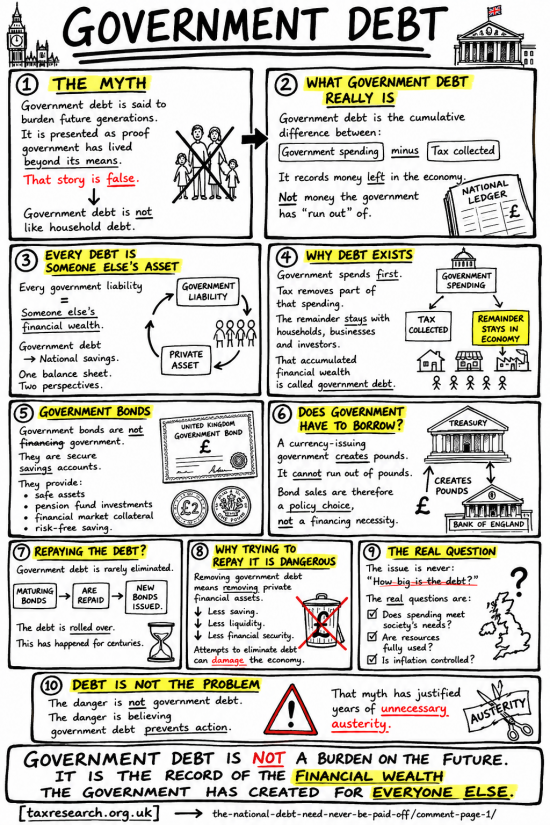
That graphic just needs to be put on billboards!
Plain and simple!
Thank you!
How about a hook up with Lions Led By Donkeys?
No disagreement with the content. However, it has 10 boxes versus the 5 for MMT so it looks a bit crowded. Now, that is probably not very helpful and I am not sure how you cut it back…. but that is my observation.
I have no answer to that. I can still read it.
I’ve been trying to explain the accounting principles behind MMT etc to friends/family, and this is a brilliant way to explain it! I shall definitely print it out for ease of reference. Thanks very much indeed. It’s quite hard to grasp the idea that government debt is the money side of everything, and even idiotically valued shares are only realised into cash by virtue of government debt, essentially… hence the (um acknowledged, even denied) enthusiasm for government debt amongst zillionaires
Thank you
Thank you for this excellent crib sheet. I will circulate widely.
It works for you?
The above is brilliant.
Any chance it can be provided as a jpeg?
My only other point is that (and this is partly my fault with aging) the print is very small.
This is exactly what is needed to get the message across.
I want to print a load out and give them to friends and neighbours.
It is in .png format which most graphics programs will print to your printer.
Right click on the image and save it to a folder on your computer..note its name and location. Then go to that location and click on the file and you should have a graphics program on your computer/phone that will open it. Then save it as a .jpg file to a folder on your computer..note its name and location.
Thanks.
I hesitate to say this, but isn’t the difference between government spending and tax collected the ‘deficit’ while the ‘debt’ is the value of bonds in issue?
I’ve tried to separate these concepts in people’s minds and now you’ve discombobulated me…
This is absolutely brilliant, thank you.
I prefer the look and feel of this graphic compared with the MMT one.
The small drawings and more subtle font and use of colour (especially red) feel more friendly and politically neutral. I found the MMT one slightly aggressive and a bit old school ‘Leftist’.
I’m glad there are no red stars here…!!
I lost my text. Second go. Apologies if brief.
Love these new forms, thank you.
The main idea I am offering was adding and reinforcing the concept ‘government spending to invest’. The insertion of 2 words ‘to invest’ might help shift the concept of debt as a national threat, as what I am understanding is debt is actually national nurture – gov spending to fund affordable homes, energy transport health etc.
As long as debt is perceived as threat, austerity will be the forever antidote.
When debt is understood as nurture, i.e. evidence of government spending on public good after tax, austerity will become the threat, because it attacks and reduces nurturing capacity.
I like point 10, would this be better at the top and re-iterated at the bottom.
Point 3 ; maybe instead of perspectives – two sides of one coin as easier language.
And point 5 risk free savings at the top of the list – we are doing them a favour so not beholden to the bond market at all!
Am I right in thinking that the ‘Government Debt’ is different from the ‘National Debt’?
My understanding is that ‘Government Debt’ is the total difference between what the government have paid out and what they have collected in tax 9since the Bank of England was established. The ‘National Debt’ is that money that has been saved in various savings instruments such as Gilts, Premium Bonds and NS&I Bonds. Is this correct?
I ask because I can’t see how the government can repay the ‘National Debt’ and reduce the ‘Government Debt’. If Gilts are bought back by the government, they would have to pay an equivalent sum to the Gilt holders, so, although the ‘National Debt’ would decrease, the ‘Government Debt’ would remain the same. The only way to reduce ‘Government Debt’ is to increase taxes and remove money from the economy!
Given the clarity and power of this presentation of the realities of the alleged National Debt, how and why is it that so very many parliamentarians, the main stream media, the Treasury etc., etc., still mislead/deceive so many citizens and the next generation of voters?
Where might such “experts”, separately or collectively, be reasonably placed on a spectrum between the contrasting poles of ignorance and deception?
I can foresee this approach really having some cut-through.
You and your team are to be commended and should be encouraged and excited.
Are these fairly quick to produce? For much as I enjoy a good essay, these are a great summary – aide memoire or starting point. Many thanks! I need to find the printer…
Is it possible to do some work in a similar schematic style to explain how/why what the government spends, the unrecovered ‘debt’ ends up in the hands of so few people?
eg – every man woman and child in the UK should have £41,500 in savings ( £2.91tn / 70million) – if you haven’t got yours then who has?
I will think about it.
I like this format, it’s attention grabbing and easy to follow. I note this one in particular is getting some “peer review” in the comments, but that can only be a good thing.
When you’ve got say six or so of these as finished products, how about packaging them up and sending them to Rachel Reeves as a leaving present?
@ Therese
In that case there should be seven. Send her a set of nice clean teat-towels, one for every day of the week. I’d buy that!
Love it . This format really works for grabbing the attention of people with just a passing interest in the subject. How about adding to the title -or placing underneath it – the words ‘fact check/er’ , to emphasize that it’s a serious piece of work.
Noted
Point 6: “A currency-issuing government creates pounds”. Well, not exactly…
Maybe:
“Being a currency-issuing government, our government creates pounds”
“Our government issues currency, and so creates pounds”
Paul
Just a wild thought: would it be possible to get a group like Led by Donkeys onboard on MMT? Obviously the messages they convey would have to be only a small part of the process of opening the public’s eyes to the neoliberal lie. I hope that I am not wrong about this but I am starting to detect a growing public realisation that the current neoliberal economic theory is wrong and that inequality is becoming extreme. In a curious way, all the current exposure about Farage’s finances and Reform’s questionable funding may also be helping. The journalist/rapper Lowkey has an illuminating video on this on Double Down News. Maybe the tide is starting to turn….
We can live in hope.
https://www.cityam.com/the-devastating-prognosis-for-the-uks-public-finances/
Is a link to yet another article screaming death and destruction of the UK due to our horrendous levels of debt.
I keep asking myself whether this is just plain ignorance or what do the very rich hope to gain from repeatedly saying it. It stands to reason that people spending money will grow the economy and, as you say, government money is free money.
Agreed
Really like this format. The white background makes it much clearer to read than the sepia ones, The use of graphics breaks up the texts and helps those of us who like pictures
the text is sharp and to the point and I like the looser font, underlining, highlighting etc
I would suggest adding some branding that emphasises its provenance ie vlog branding/naming to differentiate from any random commentator. I wonder if more colour in the graphics would make it even more eye-catching. May be worth playing with?
these are excellent and communicate succinctly the heart of the issue. Kudos to whoever though of creating this form of content
The branding is on the later post.b
Why do we need the Debt Management Office to balance the Government’s cash on a daily basis?
We don’t, of course.
This is brilliant! Thank you ❤️
Lots have people have already said that this is excellent. And I agree – it’s excellent.
Can I make one detailed comment though? I find the direction of the arrows in boxes 4 and 6 very confusing.
In box 4, government spending points at tax paid. I know that the tax paid can only be taken out of government spending, but it still feels like the arrow is going the wrong way. People might think “What? It’s me that pays the tax, not the government!”.
And in box 6 the pound appears to be creating the treasury? Baffling.
Maybe it’s just me. But please look again. Don’t want an otherwise fantastic graphic causing confusion…
This is a prototype. It will be reworked.
Do you not need to mention or deal with the interest payments on government debt? If you don’t, I expect your critics will weigh in.
That is another topic
How would a similarly presented ‘Private and Shadow Banking Debt’ look compared to the one presented for ‘Government Debt’.
The general public message ‘myth’, presented and played up by MSM and main stream politicians is that Government debt is to be feared or to be seen negatively, even though if used wisely it is a force for public good.
The greater private debt imposed on the many by the few through various financial products is often played up as a beneficial aspect of our society. More often than not, I suspect, it is the negative effects of a much larger private debt figure that drives austerity and misery for the many for the benefit of a few.
A very good question. I will address it.
Richard
Excellent
I’ve been mulling over this all day – and the last 13years
The difference between govt. spending and tax returned is either a debt or it is not a debt
“rolled-over” implies a debt
, but” remainder stays in the economy” implies not a debt
Overall, debt just seems the wrong word
I really like this approach, clear and concise, even Gary Stevenson might read them.