
THE RICHARD J MURPHY YOUTUBE CHANNEL
DEBATE AMMUNITION
WHY IS THE BANK OF ENGLAND KEEPING INTEREST RATES SO HIGH?
Funding the Future | June 2026
TODAY'S TOPIC
Why is the Bank of England keeping interest rates so high?
THE CORE ARGUMENT
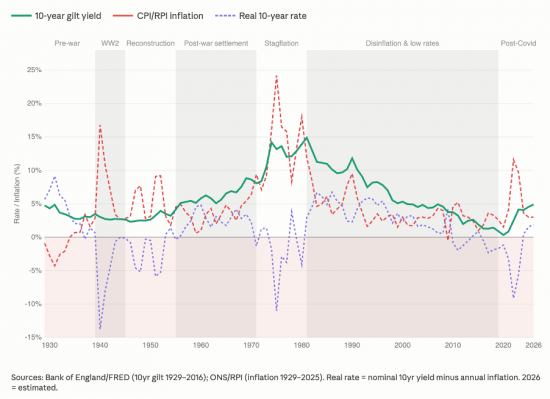
Nearly a century of UK data shows that negative real interest rates have been the consistent policy response to every period of economic stress: the 1930s recession, the Second World War, post-war reconstruction, and the aftermath of the 2008 financial crisis.
We are now in another such period, caused by supply shocks from war, COVID, and the exchange-rate consequences of Brexit, and yet the Bank of England has deliberately pushed real interest rates back into positive territory for the first time in any comparable crisis in modern British history.
This is not neutral monetary management; it is a political choice that transfers wealth from mortgage holders, renters, businesses, and public services to banks and those who already hold financial assets, and it will make the coming recession significantly worse than it need be.
KEY STATISTICS
UK interest rates and inflation since 1929
| Statistic | Figure |
|---|---|
| UK 10-year gilt yield (lowest point, QE era) | 0.33% |
| UK peak inflation, 1975 | 24% |
| UK peak inflation, 2022 | 11.6% |
| Real interest rate at Thatcher-era peak (approx. 1983–84) | ~6% |
THE ARGUMENT STRUCTURE
| Step | Detail |
|---|---|
| Step 1 — A century of evidence establishes the pattern | A chart of UK 10-year gilt yields from 1929 to 2026 identifies seven distinct periods. In every period of economic stress, the 1930s recession, the Second World War, post-war reconstruction, and post-2008 recovery, real interest rates were negative. This is not coincidence; it is consistent, repeated policy. |
| Step 2 — Supply shocks, not excess demand, created the current inflation | The inflation crisis of 2022 was caused by energy disruption from Russia's war, broken post-COVID supply chains, and the exchange rate consequences of Brexit. Higher interest rates cannot produce more oil or repair supply chains; they are the wrong tool applied to the wrong problem. |
| Step 3 — The Bank of England has broken with a century of precedent | For the first time in nearly a hundred years, a period of genuine economic stress has been met with positive real interest rates rather than negative ones. This is deliberate policy, and the government, which retains the power to veto the Bank of England under the Bank of England Act 1998, has chosen not to intervene. |
| Step 4 — High real rates are social policy, not neutral economics | Positive real interest rates transfer wealth systematically from borrowers to lenders, punish mortgage holders and renters, increase government borrowing costs and thereby justify cuts to public services, and discourage business investment. This is not economic management; it is a political choice whose beneficiaries are banks and those already holding financial assets. |
THEIR ARGUMENT → YOUR REBUTTAL
| They Say | Your Response |
|---|---|
| The Bank of England must keep rates high to bring inflation back to target and maintain credibility with markets. | The inflation of 2021 to 2023 was driven by energy prices, supply chains, and the exchange-rate effects of Brexit, none of which respond to interest rate changes. Inflation has already fallen sharply regardless. Maintaining high real rates now does not bring prices down; it simply transfers wealth from borrowers to lenders while increasing the risk of recession. |
| The Bank of England is independent for good reason; governments should not interfere with monetary policy. | The Bank of England Act 1998 explicitly gives the Chancellor the power to override the Bank in the national interest. Independence is a convention, not an absolute rule. When the institution uses its powers to impose positive real interest rates during a period of economic stress, contrary to everything a century of evidence tells us, independence becomes a shield for ideology, not a protection of sound policy. |
| Savers need a return on their money; low interest rates punish prudent people who saved throughout their lives. | The 70 to 80 per cent of the UK population with little or no significant financial savings do not benefit from high rates; they suffer them through higher mortgages, higher rents, and reduced public services. The return on savings is already sufficient to match inflation. What current rates do, above and beyond that, is extract a wealth transfer from borrowers to lenders. Government's role is to serve the majority, not to maximise returns on financial assets. |
| Lower interest rates would reignite inflation and crash the pound. | Real interest rates that are mildly negative or near zero are normal during periods of economic stress; they have been so in every comparable period in modern British history. The pound did not collapse during the post-2008 decade of near-zero rates or during the decades of post-war financial repression. The claim is not supported by evidence. What high rates are doing instead is making a coming recession considerably worse than it needs to be. |
THE ONE-LINER
“Every period of economic stress in the last hundred years has been met with negative real interest rates; the Bank of England knows this, and has chosen to do the opposite, which means this is not a policy error, it is a policy choice, and the people paying for it are borrowers, renters, businesses, and public services.”
FURTHER READING
All sources below are published on Richard Murphy's Funding the Future blog at taxresearch.org.uk. / Funding the Future.
| Post | Date | What it covers |
|---|---|---|
| The Bank of England is harming the country and there isn't a single politician asking why it's allowed to do that | 20 March 2025 | Argues that a real BoE base rate of 1.5 per cent above inflation is unjustified during a period of falling inflation and economic fragility. |
| Why the Bank of England base rate should be no more than the rate of inflation | 17 February 2025 | Draws on a Bank of England staff working paper showing that real interest rates have trended to zero over five centuries, making current positive real rates historically anomalous. |
| The Bank of England is crashing the UK economy | 10 January 2025 | Explains how quantitative tightening is deliberately keeping gilt yields elevated and why the Chancellor has both the power and the duty to act. |
| Borrowing costs are high because that's exactly what the Bank of England wants | 8 January 2025 | Documents 30-year gilt yields reaching levels not seen since 1998 and frames this as the consequence of deliberate Bank policy rather than market forces. |
| Rachel Reeves' figures in the Spring Statement don't stack up – and are very scary | 27 March 2025 | Shows that a real interest rate of 2 per cent above inflation will crush business investment and impoverish mortgage holders over the coming parliamentary term. |
| The Bank of England is continuing to engineer a recession – and Rachel Reeves is letting it do so | 20 September 2024 | Argues that the Bank's combined policy of high base rates and £100 billion of quantitative tightening withdraws funds from the real economy and actively creates recession conditions. |
| Too little, too late: that's the Bank of England on interest rates | 8 May 2025 | Critiques the MPC's 5 to 4 vote for a quarter-point cut as wholly insufficient, with the real rate remaining well above 1.5 per cent, encouraging stagflation and potential recession. |
| Interest rates should be as low as possible | 13 May 2024 | Sets out the structural case that high rates redistribute wealth upwards, reduce productive investment, and serve the interests of financial asset holders over those of the wider economy. |
| Could the Bank of England make life better? | 16 February 2025 | Contends that the base rate should match the inflation rate, currently around 2.5 per cent, since the long-run real rate of interest has converged to zero and bank deposits carry no genuine risk. |
| Interest rates can't fix inflation now | 11 March 2026 | Explains why supply-shock inflation driven by war and energy disruption is structurally immune to interest rate increases, and why the appropriate policy response is government intervention, not monetary tightening. |
| Unpacking the nonsense being said about interest rates and Reeves | 4 July 2025 | Demonstrates that quantitative tightening bond sales are the direct mechanism by which the Bank of England keeps gilt yields elevated, and that this is a deliberate institutional choice, not a market outcome. |
Thanks for reading this post.
You can share this post on social media of your choice by clicking these icons:
There are links to this blog's glossary in the above post that explain technical terms used in it. Follow them for more explanations.
You can subscribe to this blog's daily email here.
And if you would like to support this blog you can, here:

 Buy me a coffee!

[…] The Debate Ammunition for this video is available here. […]
Nicely structured & obvs agree with the arguments. The problem – profiled by me and others in other blogs is that those in authority refuse to engage with these arguments or those making them. This refusal is made easy by the reality that debate & discussion is heavily controlled in the UK, with only those with permitted views (the Tetts of this world) allowed a public platform.
Which begs the question – what to do. On LinkedIn I see assorted imbeciles supporting the BoE line (demonstrating the power of propaganda) arguing with them is pointless, one would get more sense from a pissed village idiot. I get the sense that collectively (blog + commentators) are a John-the-Baptist – stating the bleedin obvious and being ignored.
I keep on, until I lose my head
I’m really enjoying these “Debate Ammunition” pieces; they help to clarify my views. But since most people I talk to still believe in the household analogy, and that the National Debt must be paid off, or at least reduced, my conversations don’t get to this sort of detail. I hope others find these pieces useful; do keep them up.
They are hard work, but I will try.