
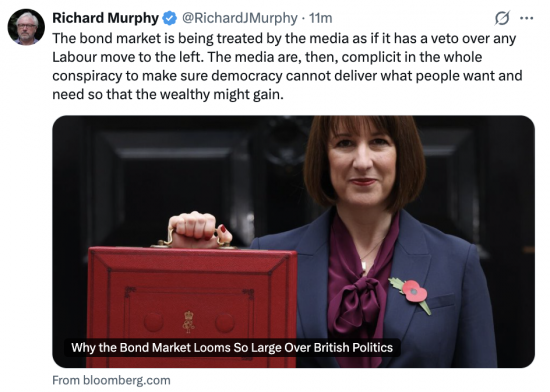
I could write a lot about bond markets, the media, and the conspiracy they have created by mutual consent to deny democratic choice in this country, or I could just repost this tweet I put out this morning, which pretty much says it all:
Thanks for reading this post.
You can share this post on social media of your choice by clicking these icons:
There are links to this blog's glossary in the above post that explain technical terms used in it. Follow them for more explanations.
You can subscribe to this blog's daily email here.
And if you would like to support this blog you can, here:

 Buy me a coffee!

I think this is happening because of the revolving door between the politicians and the civil service and the financial sector. I am in my eighties and when I was young the Civil Service was employment for all of ones working life. The government can change the rules of the game but they seem incapable of doing this.
Genuine question…
When was the last time there was a genuine clash between an elected UK government (10 or 11 Downing Street) and the “bond markets”, that was won by the elected government (and HOW did they win)?
I’m excluding Truss, as that was BoE taking action and no one could call Truss’s time a victory for democracy. I’m also excluding Darling & 2008, as a bail-out of bankers isn’t a victory for democracy either, especially when it results in austerity for 16 years.
“Everyone” seems to believe the dictum, “you can’t buck the markets”, but maybe we’ve just forgotten how to – or its so long since we had a government that wasn’t in fear of, and serving the markets, so never really clashed with them?
I’ll accept examples from other countries, esp USA, Canada, Oz if the UK well is dry.
I guess the only real example is Japan? For decades.
True
Possibly the main ‘recent memory’ possiblity would be the response to Covid. The finance sector was effectively told that significant increases in public spending were going to be undertaken. You can also argue that it showed that those predicting the worst outcomes from such public spending increases were unequivocally wrong, too. We have the evidence to show those prophets of economic disaster are wrong, what we lack are the political leaders to call it out.
Covid or a world war. All of a sudden the money can be found.
In the very near future the consequences of the middle east war will start to require a similar response. It will be ‘interesting’ to see how various governments around the world respond.
Its a major problem. The BBC R4 will ask an ‘expert’ like Jim O’Neil or Paul Johnson and they will trot out the usual stuff about the bond markets and how they must be appeased and the only answer is to cut spending, particularly the triple lock which as we all know is the cause of all our financial problems! I have looked at the earnings of those who follow this line – oddly enough they are all rather well heeled and I suspect would not notice if the state pension was cut. I wish interviewers would ask them “How much do you earn?”
Going back to the media coverage, I suspect most people who do not follow blogs on economics such as this one, assume that they are correct. When I have pointed out how governments are funded to people, I get the distinct impression that most people think “hmm how odd!”
Why when only the UK government has to power to fix the interest rate for future bond sales, or even issue bonds at all, the perpetual myth is sprouted that the bond market “sets” the interest rate.
As you showed yesterday this is not correct.
Governments surrendering the ability to set general interest rates is the classic neoliberal move to remove control of the politicians and ultimately voters to set economic policy.
The sooner the UK government takes back overall control of the Bank of England the better.
The BOE can set interest rates wherever it likes, but it can’t force people to buy Gilts.
10y Gilts yield 5.14% at the moment. How many do you think the DMO will sell if they offer them at 4%?
But I suppose it’s neoliberal to suggest that people aren’t going to donate their money to what other people decide to spend it on our of choice.
None, until base rate is cut by 1%. Then they will be forming a queue around the block, as usual
You really have not thought this out, have you?
Harry
Once again, you give yourself away.
You give away your rampant short-termism. Bonds were supposedly meant to be longer term investments and savings financial instruments. We know that the share trading world is now very short and unrealistically high and with the consequences (more instability, asymmetries of information, share buy-back distortions etc). This is not share trading Harry – are you an ex share trader who has rotated into gilts by any chance? Go on, be honest, give it your best shot.
All I’m seeing here and pick up from you is a desire to short-circuit longer term agreements and benefits of bonds/gilts and bring forward returns that were not even agreed with the issuer. It is complete bullshit.
What would I do? I’d give the bond/giltholders their money back – with accrued returns within the original agreement of course up to the point of return and nothing more. Then hopefully you would shut up because the world would keep going around without you – which it does anyway because the gilts are not used to fund anything (well except open market operations perhaps to soak up excess money in the economy to help fight inflation, perhaps?).
Frankly, bondholders can smell blood in the water – chaos – and they just want to make money out of that. Chaos is a derivative in the lawless world of finance and you Harry are a symptom of it. Gilts are gilts – not shares. Understood?
@Harry
The BoE doesn’t NEED to force anyone to buy gilts, just as they don’t need to force anyone to breathe air. Traders LIKE buying them, they LIKE trading them, they are safe places for saving, guaranteed by the UK government.
What we take exception to is when the short-term WANTS of the high-income bond traders are given priority over the life-threatening urgent and also long term NEEDS of my vulnerable low income neighbours.
We know how it can, and WILL be done differently. Smell the coffee.
@Harry – “it can’t force people to buy Gilts”
Aren’t GEMMS obligated to bid for Gilts in the primary auctions otherwise there would be no bond market in existence (created by governments) …..the secondary bond market is its own casino.
Like Japan, maybe we should control the longterm yield and have the bond market serve the national interest?
Harry wrote : ” can’t force people to buy Gilts.” & “can buy all sorts of safer and better bonds elsewhere.” & “How many do you think the DMO will sell if they offer them at 4%?”
Neither of the first two statements is correct. UK based Pension funds and commercial banks are required to hold gilts by financial sector regulation and need to.
The ‘Gemms’ who operate in the primary market are required to buy some of them, if they refused then they could lose their very lucrative Gemm status. The amount they have to buy isn’t fixed though, the rules say their primary market purchases should broadly match their secondary market holdings.
There no safer bonds than those issued by a currency issuing state, they are traditionally rated “risk-free”, Of course convertibility is not guaranteed, you buy gilts in Sterling and the holder gets Sterling when they mature, value is not guaranteed in another currency which can be a consideration for purchasers and they could, beyond any regulatory requirement, choose to buy other sovereign bonds offering a higher rate.
To answer the question part, Under a tap system, if the DMO pitched the rate too low, then, beyond GEMM rules, they might not sell many in which case the BoE could buy some, or even all of them if it felt it necessary for some reason, or leave them unsold, they could offer whatever was left (new issue) at a later date revising the rate upwards if they wanted to sell them enough if a higher rate was needed, which it may or may not be. The only real disadvantage is that if they kept setting the rate too low then it can cause market gossip about them not being able to sell their bonds.
Conspiracy? Why is everything always a conspiracy with you?
Isn’t the more realistic cause of the bond market selling off that investors don’t want to buy Gilts because of the risk, and they can buy all sorts of safer and better bonds elsewhere.
You mention “democratic choice” but people aren’t forced to lend to the government just because you deem it a worthy thing to do. They have a choice.
And simply put, when the government seems to be unable to control spending and wants to increase it, the national debt is high, inflation is increasing and growth is poor Gilts don’t exactly sell themselves.
‘Harry’
Bonds/gilts are a form of saving which is simply elective by the user as you say. The government does not put a gun to your head and make you save with them. But never in its history as far as I am aware has the government ever failed to meet the terms of a bond/gilt upon maturation – it has always paid, indeed I understand that some of that saving/gilt ownership is really old which signifies that there is nothing wrong with that arrangement – so much for the ‘risks’ you state. No matter how parlous the public finances are, the bonds are redeemed at the original return rate they were issued at because they are simply not used to fund state funding as you and many others seem to think. It is the gilt/bond owners money and they are entitled to what returns are originally stated in the bill of sale – the agreement.
What you suggest is that because a group of gilt owners get together and decide to swap their gilts and want to make a bit of money on the side, they can effectively create a new market with new rules that conveniently forgets the original agreement the bonds were issued at? It is effectively like making ad hoc law, new agreements outside the original consented to. I can’t see anyone in any market consenting to that, let alone a government. It is like have a fixed rate mortgage with a bank, who sells that off to someone else (like they do), who then puts up the agreed interest rate and ignores the original fixed rate in the contract.
The basis of your assertions are contrary to fundamental contract law and wrong. As is much of finance industry.
How would one go about “standing up” to the bond markets? Is it just a case of ignoring them? Or does the faux independence of the BoE need to be removed…which I imagine in itself will cause the markets to panic.
The Bond Market only exists because the Government has created it. The Government has chosen to hand significant power over interest rates, and therefore indirectly over many other parts of our society, to a group of traders. The problems don’t really rest at the door of the bondholders. They are simply doing what the terms and conditions of the gilts enables, indeed encourages them to do. All in the misguided belief that somehow these kinds of market forces lead us all towards a better world. Government created this mess. Only they can put it right. And I believe that it’s possible. I think there are ways that return on investment can be aligned with the kinds of improvements we expect Government to deliver and still control the inflation risks. And I believe Richard thinks so too.
I do
I now pronounce you an Agent of Change!
This is a salient point, State tolerance of such markets when the markets have become so short term and ‘get rich quick’ instead of being investing long term (as Richard has consistently advocated) is simply flittered away like some dopamine hit . Yes, the government is not helping itself and certainly not the the rest of us for sure.
Jake Wrote : How would one go about “standing up” to the bond markets? Is it just a case of ignoring them? Or does the faux independence of the BoE need to be removed…
The government and central bank have to work together, whether one notionally maintains some kind of fiction of central bank independance is optional.
In order top stand up to the bond markets the central bank has to operate in the secondary market, which the BoE does when it thinks it really necessary, e.g when Truss triggered the Pension funds LDI shenanigans or indeed, in its QT programme, to a detrimental efffect with the latter. It just needs to do it more and be more on the ball and converse with the governement on any relevant plans they have, and simply making it clear that they will do whatever is necessary to keep the bond market in line will avert quite a lot of the dodgier speculation in that market because if it removes many of the opportunities to use market speculation to make a quick buck
Encouragingly, I have noticed recently that a number of different persons- not the usual suspects- have been posting, on Facebook, MMT based critiques of the ‘Bond Market’ hysteria. Empowering the electorate with genuine insight into how our economy actually works and the agency available to government is a long and at times an uphill struggle, however hopefully the continued failures of Westminster will allow us to gain traction- it would seem that now you are not alone! Thank you for your continued efforts.
I was talking to family and extended members about this last night who tell me they know nothing about economics. So you explain patiently what is actually going on and they look at you blankly or unconvinced. And then you realise that it is because you yourself who is doing the explaining are not an economist by trade. I see……………
So then you try to show them the extent of your study – the books and papers you have read etc., but still no creedence. And then you realise that some in the family are better off than you, drive more expensive cars, have better property and then you realise that perhaps even though you have done your homework, you are being measured by something else other than the quality of your knowledge.
It’s hard, it’s really hard………………..
I have just checked and the German MSM are largely privately owned by German families and individuals. However they all seem to have significant foreign holdings one being, of course, the Daily Telegraph.
It is difficult because the public at large (I include myself) have very little understanding of macroeconomics. In this way, what happened with the “mini-budget” has not just disciplined politicians, but also the electorate.
The result is that we cower to financial institutions who, as I understand it, need government bonds more than the government needs their money. Unfortunately, the Bank of England (gleefully?) dances to their tune.
Even on the left, well meaning people still think we shouldn’t “spook” the markets (looking at you, Meadway). If we were to take this advice, then meaningful change will be gate-kept by the city.
How do we convince people to brave? That the power of these markets is just vapor? I don’t think I can yet tell a coherent story about what happened with the mini-budget that’s easier to digest than the established tale that we incurred the wrath of a vengeful god.
Meadway! I wish I could recall my exchange with him on Bluesky. His arrogance was breathtaking, and he told me to call him Dr Meadway. He will destroy the Green economic policy.
Anyone who uses titles in that way is an idiot. Yes, I am a prof, but I don’t use it as a crutch
A Russian thinker called Mikhail Bhatkin wrote that ‘ He who is deceived is turned into a thing’.
There are lots of such things of this nature in this world and Meadway is one of them, and it sounds to me that many a bond owner is the same. So, who is using these ‘things’ and what for. This blog knows all too well the answers to those questions.
Until I watched Richard’s YouTube video that explained in ‘simple terms’ what bonds were, and also Paul Mason’s substack that even defined bonds/gilts/yields, then I could get a better understanding of what was going on despite having my own education, qualifications and experiences in other fields.
https://open.substack.com/pub/htsf/p/down-with-the-bond-market-down-with?utm_source=share&utm_medium=android&r=2zfb04
I have personally been in the situation in my own family having to deal with differences in attitudes/understanding/knowledge gathering/patience that across generations and cultures. Trying to be the one to bridge the divide can be very difficult, in trying to get people to observe, reason and effectively communicate; rather than to build up grudges/grievances and then react impulsively due to fear/anxiety.
So if the population in general had basic understanding of balancing the books, of home economics, the value of money rather than relying on credit, understanding the stock market etc – then this would alleviate the ‘them and us’ sentiment, though there has to also be movement and appreciation of those that ‘have’ in the City/’wealth management companies’/’bankers’ to those doing the work at lower levels – because all are interdependent on each other.
However, such behaviour and mindset change will take time to take effect, needing not ‘short-term’ vision but long-term unity within the UK. Unfortunately, in the digital age and influence of social media, brains have been rewired for instant gratification and rewards instead of a slower and more gradual approach; accepting that there is no such thing as perfection, that it is fine to make mistakes as long there is honesty, responsibility, accountability and remedy taken for it.
I typed “Do the Chinese understand its government can create money from nothing?” into google. (Prompted by a letter in the Independent from ‘Forum”.
Chinese understanding of monetary creation varies, but many recognize that the state controls the money supply and uses it for development. While not a universal household concept, the government’s ability to direct banks to create loans and “mark up” accounts to fund infrastructure and economic expansion is a recognized aspect of their state-led, socialist market economy.
and
Many Chinese recognize that the government directs resources to major projects (roads, railways) by marking up accounts in yuan, rather than relying solely on tax revenue.
Economic Strategy: The government often prioritizes economic activity and infrastructure creation over immediate financial returns, understanding they can create the currency to fund such projects.
Distinction from Western Views: Unlike some, the Chinese system allows for high state debt (often viewed as internal savings) and uses it for development rather than fearing “money printing” as immediately catastrophic.
Well that’s interesting. Could Labour -and more-learn from the Chinese?
If only there was a way of offering investors something better that aligned their objectives with those of the State and shared risk and reward in a way that everyone feels comfortable with, but doesn’t get exploited. I don’t suppose “Name Withheld” has been in touch?
I now argue as follows, not initially contesting the belief that taxes fund spending. There is a mismatch in the timing of spending and the receipt of tax revenues. This means the government needs a credit facility at the Bank of England. That credit is simply provided by entering numbers in a computerised ledger….an exercise on double entry accounting. This proves that government spending does not require tax revenues to be received first. Tax revenues received later simply reduce the size of the overdraft that the government has with the Bank of England.
Neat
Connected again after a long sail to Brittany. The sun shines, the wind blows, the are mussels fresh and the wine chilled.
I don’t see a bond market ‘conspiracy’… there really is no collusion. However, there is a complete lack of understanding and imagination that denies any alternative vision…. but this a broader TINA neo liberal problem.
This blog does, I hope, persuade people to think.
Clive – I enjoyed your input at the event in Cambridge and I’m more than happy for your feedback on my contributions to my posts at any time in order to increase my understanding of matters/iron out any misunderstandings/get to the truth.
The BoE is tasked with controlling inflation. The BoE believes there is an inverse connection between unemployment and inflation, that higher unemployment reduces inflation.
If the BoE expects higher inflation it will want to increase unemployment.
The BoE also believes that higher interest rates will increase unemployment. It therefore needs full control over interest rates to control inflation.
When the government spends more than it raises in taxes, the private sector is wealthier by that amount.
Before 1985 it had an option of buying bonds at whatever interest the government was offering.
The market was a price taker. If the market did not want to buy bonds, the debt was left with the BoE.
This created a problem for the BoE because then excess reserves could be used to lend between banks at an interest rate that the BoE felt would encourage inflation.
In 1985 it was decided therefore to auction bonds. Now the government became a price taker but at least the problem of excess reserves was removed.
But what if the markets were prepared to buy bonds at a yield that was lower that the BoE thought was appropriate?
To block this possibility, central banks around the world introduced in 2008-12 the practice of paying interest on the full amount in the reserve accounts of the commercial banks.
So now the BoE sets the lower bound of the yield at which bonds can be sold.
These problems exist because it was decided to use unemployment to control inflation.
We ended up in this situation because solutions like ‘In place of strife’, tripartite talks, the Bullock commission were rejected in the 1970s.
Do we need to revisit these failed attempts, if we are to solve the inflation problem without applying the Philip’s curve?
Robert B is incorrect when he says Pension funds in the Uk and Commercial banks have to hold gilts – they do not. They currently choose to do so for many reasons, but if yields reduce and inflation expectations increase, then they will hold much less.
That’s a fact, not opinion.
Neither UK pension funds nor commercial banks are legally required to hold gilts. But both are strongly encouraged, and in some cases effectively pushed by regulation and market practice, to do so.
For commercial banks, the key issue is liquidity regulation.
Under post-2008 banking rules, especially the Liquidity Coverage Ratio (LCR), banks must hold large quantities of “high-quality liquid assets” (HQLA) that can be sold quickly in a crisis. UK government debt, including gilts and Treasury bills, qualifies as top-tier HQLA.
That means banks do not have to hold gilts specifically, because reserves at the Bank of England also count. In practice, though, banks commonly hold both reserves and gilts because they are among the safest and most liquid sterling assets available.
So, you are talking nonsense.
Ha! – as I thought – the government is the safest place to put your money because it is sovereign currency making capacity totally solvent at any time.
Would that be a fair statement?
Yes
“are required to hold gilts by financial sector regulation and need to” was slapdash wording better is ‘they need to hold gilts to meet regulatory requirements in practice.’
Theoretically a commercial bank could meet liquidity requirements purely with cash/ BOE deposits but it’s not really practical and every other bank would assume they must be in some kind of financial trouble if they did it. They can hold some foreign sovereign bonds to meet requirements but if they tried to use just foreign bonds that would be deemed a “currency mismatch”.
Pension fund regulations are long and complicated but a primary regulatory concern is the investment strategy, they must create an investment portfolio that balances growth potential against risk and protects members’ retirement savings. In practice that means Sovereign bonds being a significant component and if their pension liabilities are in Sterling then theoretically, at least, a significant proportion of gilts, to reduce convertibilty risk, – currency mismatch again.
Actually pension funds rather like longer term gilts and to keep holdings until maturity (LDI events excepted).
Theoretically everyone in the Uk could go to their bank on Monday and withdraw every deposit from every account they have and stick the money in their mattresses but its not going to happen and in practice couldn’t happen, if only because there aren’t enough branches left to do it on that timescale. The Bond doomsayers almost invariably rely on that kind of theoretical but impractical happening in their doom scenarios but the bottom line is if every holder sold their gilts on Monday, the BoE has the capability to buy every single one of them.
Thank you
Its only long duration bonds the 1 year similar to bank rate
https://new-wayland.com/blog/in-reality-uk-borrowing-costs-have-gone-down/
Thank you
being outside of the eurozone exposes sterling to the vicissitudes of market forces in a way that no european land is subject to…..(possible exception was greece back in the day)…Financial markets are vultures always on the lookout for the weakest in the herd.
Being INside the eurozone can be quite challenging too…
Greece https://en.wikipedia.org/wiki/Greek_government-debt_crisis
Cyprus https://en.wikipedia.org/wiki/2012%E2%80%932013_Cypriot_financial_crisis (I was in Cyprus in 2013 during the haircut period).