
I spent too much of this weekend reading this book.
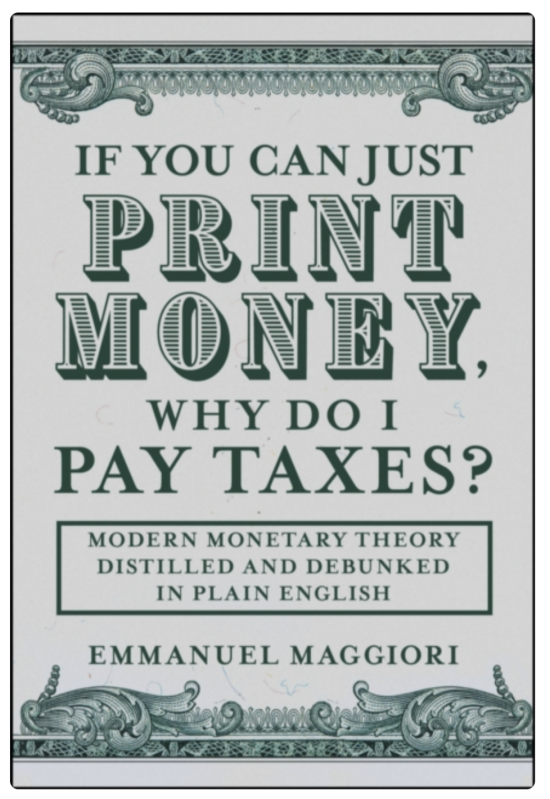
I did so in order that I might write this review, and trust me, you are now in my debt. That's because this is easily the worst book on economics that I have ever read, and I come across some pretty terrible ones in my time.
Let me put this another way, using the words I used to summarise it for my wife, Jacqueline, who had to suffer my verbal abuse whilst reading one false claim after another. It is “a crock of shit”.
As you will note, the book claims to distil and debunk modern monetary theory in plain English. The straightforward fact is that it does nothing of the sort. Instead, it argues with a straw man version of MMT of the author's own creation. In the process, it peddles a great many falsehoods.
In addition, it claims to prove its arguments without coming remotely close to doing so, whilst frequently contradicting itself.
But, before getting to any of that, let me stand back and explain what this book really does not do. This book does not, and I cannot list everything:
- Explain what money is.
- Explain how money is created, or by whom. It would seem that, in the author's view, money just “is”; a mysterious exogenous phenomenon within the economy.
- Explain how money might be destroyed or taken out of circulation in plain English.
- Ever touch upon the role of commercial banks in the money management process or even mention their involvement in anything to do with money, including its creation and destruction.
All of that is quite bizarre.
The book does, however, claim, usually without explanation, that:
- Governments cannot create money before later acknowledging that they might have done so.
- Governments should not create money.
- A government has to replenish its bank account from external sources before it is able to make payments.
- Inflation is always, and forever, the consequence of a government creating too much money. No other alternative is ever considered.
- Governments never own their own debt, which might come as something of a surprise to the UK Treasury's Debt Management Office, which regularly owns tens and even hundreds of millions of pounds' worth.
It never explains:
- The interaction between money creation and taxation.
During his narrative, the author reveals a total lack of understanding of:
- Double-entry bookkeeping and its role in money creation.
- Central bank reserve accounts and their operation.
- Monetary policy, both conventional and unconventional.
- Sectoral balances and the accounting identities that underpin them.
- Fiscal policy, the mention of which is absent from the book.
- The dependency of financial markets on government debt.
- The nature of money as debt, which is inexcusable when this reality is printed on every UK banknote.
He does, however, either by implication or more directly, reveal a belief in:
- The gold standard.
- The quantity theory of money.
- Milton Friedman's original claim that inflation is always a monetary phenomenon, even though Friedman himself abandoned the idea.
- Government incompetence, and by implication, public choice theory.
- The inadvisability of permitting government control of the money supply, which, it is claimed, is a view shared by all economists except those promoting MMT.
He also makes some straightforwardly false claims, including:
- That central banks are always and completely independent of the governments that control them.
- That those central banks do not, and should not, ever take into account the wishes of those same governments when making their decisions.
- That single-entry accounting exists, this being the only basis on which the claimed need of governments to fund their spending can be made.
None of this is a good start when writing a book on MMT.
So what does the book say? The book seeks to demonstrate that what it calls the MMT world is a fantasy which does not withstand comparison with what it calls economic reality.
Doing so, Maggiori suggests there are only three principles underlying all we need to know about MMT. These MMT principles, he suggests, are:
- The government can always pay for whatever it desires because it can always create new money, in which case MMT says we need never worry about money or the consequences of its use.
- The government creates new money every day. As a result, the government can never run out of money, and it can always afford whatever it wishes to do.
- If we loosen budgetary limits, debt ceilings and so on, we could let the government spend more and create money as required, and there will be no adverse consequences as a result. There are free lunches that the government can exploit.
This is, of course, total nonsense. MMT says nothing like this. It sets out very precise conditions under which a government can create money, and they are not universal. Some governments, and all subnational governments, cannot do so. The universality of Maggiori's claim is just wrong.
It is also fundamentally wrong to suggest that a government can create money without consequence. MMT makes it very clear that this is not the case. MMT makes clear that the capacity to spend is strictly limited by the availability of labour, resources and the constraints imposed by climate change. Breach those constraints and inflation follows.
It is, however, true to suggest that a government can never run out of money and can always settle its debts. That is the case. It cannot be otherwise in a fiat money system, and it is hard for anyone to deny that this is what we have, however much wishful thinking an author undertakes.
However, let me ignore all these false arguments about MMT, because they do not affect the substance of the argument within the book. Although Maggiori claims that what he describes as the MMT world does not exist, if you read the whole book (and I cannot recommend doing so), what you discover is the shock of his realisation that, in practice:
- Governments can, in fact, create money,
- They do not necessarily create inflation by doing so, and
- Central banks do coordinate with governments in the delivery of policy,
all of which he thinks is a shocking discovery, but which just suggests the degree of his naïvete.
Saying so, let me stress that the appearance of naïve belief in an ideal form of economic management in the real world is essential to his argument within the book. This is apparent from the following quote from page 41 within it, which is the opening section of chapter 2, which he describes as being about the “real world” that he thinks exists. It says:
It is now time to travel back to the real world, where there are rules that limit the government's power to create money. I'm sorry to be such a killjoy.
In the real world, restrictions are imposed to make the government run like a household. The central bank is usually set up as an independent organisation whose daily operations cannot be controlled by the ruling government. For example, the Treasury, which is the department in charge of government finances, cannot force the central bank to create new money to cover its spending. This tends to turn the government into just another client of the central bank and a user rather than issuer of the national currency.
He adds:
From now on, for simplicity, whenever I speak of “the government”, I will assume the central bank is not part of it but a separate public-purpose organisation.
In addition, the central bank is granted political independence. This means it is given certain goals, such as controlling inflation, and it can choose the best tools to do so.
Where does one begin when assessing the nonsense implicit in this series of claims?
The first, and most obvious, thing to say is that in this so-called “real world” there are economists and politicians who have decided that they will force the government to act as if it is a household even though it is not. As a consequence, this “reality” is not real, but is instead based upon a fantasy, whereas MMT is not. In that case, and as is usual with many arguments put forward by those on the right wing, a falsehood is represented as the truth, and the truth is represented as a falsehood. Everything is inverted, and this whole book is based upon that logic.
Secondly, if only Maggiori understood how governments worked, he would, for example, have come across the Exchequer and Audit Departments Act 1866 in the United Kingdom, last updated in the year 2000, which means that the Treasury can, day in and day out, instruct the Bank of England to make payments on its behalf without the Bank of England ever being required to enquire whether resources are available to meet the obligation being settled.
What is more, because, as a matter of convention, the government's cash position is balanced at the end of the day, this task is not fulfilled by the Bank of England, but is instead managed inside the Treasury. This does not, then, turn the government into just another client of the central bank, it turns it into its master, a fact confirmed by the Bank of England Act 1998, under the terms of which the Governor of the Bank of England is appointed by the government, and all its board members are subject to government approval, which is unsurprising as the government is its sole shareholder.
And then, far from being independent as Maggiori claims, the Bank of England's accounts are consolidated into the UK government Whole of Government Accounts, providing the clearest indication that it is under central government direction and control in the opinion of independent auditors.
In addition, the Bank of England is not given a choice of instruments that it may use to control inflation, but is in fact only provided with the opportunity to control the interest rate within parameters set by the Treasury, and if it wishes to use other instruments, such as quantitative easing and quantitative tightening, it can only do so with the explicit consent and prior approval of the Treasury, as indicated by publicly published letters.
Taking all this evidence together, what we in fact discover is that the supposed reality that it is said disproves MMT is, in fact, the fantasy, and, as Maggiori keeps recognising as he progresses through the book, the real world behaves as MMT suggests, not least when it comes to the management of economic crises, but also with regard to day-to-day matters as well.
Conclusion
Let me, therefore, conclude this overly long review of this truly worthless book. What the author has presented is a form of fairytale in which good is bad and bad is good, and facts are false, and falsehoods are true.
Simultaneously, reality is ignored, and the economic assumptions long associated with neoliberalism are promoted, whilst, very oddly, the cast of characters that you would expect to find in a book like this, including money, banks and debt, are almost notable by their absence.
To describe this book as being partial in its selection of evidence, in its appraisal of data, and in its basis for argument is, therefore, to be generous to it. Frankly, it does not provide evidence, it does not appraise data, and there are no arguments contained of worth within its pages.
I was left with one overwhelming question as a result, which is why a supposedly reputable publisher like Wiley decided to publish such an utterly meaningless pile of nonsense with no academic credibility whatsoever. Only they can answer that, because I most certainly cannot.
Please, don't waste your time with this book, let alone your money. Almost any other use of your time and money that you can imagine will be better spent.
Thanks for reading this post.
You can share this post on social media of your choice by clicking these icons:
There are links to this blog's glossary in the above post that explain technical terms used in it. Follow them for more explanations.
You can subscribe to this blog's daily email here.
And if you would like to support this blog you can, here:

 Buy me a coffee!

You might find a copy of
https://en.wikipedia.org/wiki/Roger%27s_Profanisaurus
helpful.
I can post you mine of you want although it can be
But what do we know of the author, where is he coming from, why do you think he wasted his time writing it?
Why was it written? Who is Emanuel Maggiori? What qualifies him to write such a book.
Either writer is an idiot, or perhaps more plausibly, the book is intended as propaganda, an aid to those looking for some useful nonesense with which to attack MMT.
On a more positive note, at least, following a reading of the nonesense, you Richard, will not be suffering from low blood pressure 🙂
🙂
“Why was it written? Who is Emanuel Maggiori? What qualifies him to write such a book.”
Sounds to me like Donald Trump may have written this book but I know that hypothesis to be incorrect as Donald trump has very limited reading skills and no writing skills. Then I thought maybe he dictated it but then I came to conclusion that Trumps verbal ramblings and train of thought are NOT coherent enough to dictate a book.
I feel for Ms. Funding-the-Future having to listen to the rantings but that is the price she and all of us to pay for the efforts of the Chief Myth-Buster Extraordinaire. Keep on ranting as we will all listen!
She has offered more than the odd profanity herself when reading crap research. I am in good company
Is the name ‘Maggiroi’ Italian for ‘worshipper of Thatcher’? I think so.
I’m really sorry that you had to read this book.
His question though in his last post ‘Will the bank be ‘allowed’ to print the money’ seemed to resonate because we all know that the answer is ‘No’ – thanks to help from people like him who seem to accept this state of affairs and promote it and maintain the Fascist status quo we suffer under.
Just for information, E. Maggiori (emaggiori.com) is a computer scientist who writes “challenging software” and books to explain complex issues in simple terms. I am reminded of H. L. Mencken’s aphorism: “For every complex problem there is an answer that is clear, simple, and wrong.”
🙂
Backgrounds like his frustrate me, because you see the hype given to books like his, when even the IT-related ones are relatively shallow regurgitations, and he’s making out like he’s a world-class expert. Yes, he has a PhD, but in Automation, Image and Signal processing. That no more makes him an expert in how LLMs work than it does make him an expert in MMT.
Part of the challenge is getting the majority to differentiate between fake, self-proclaimed experts and genuine expertise – if you don’t know the subject at all, then how can you tell fact from fiction? Ones like Maggiori presumably have a suitably engaging writing style and a lot of the readers are only casually interested so they never actually put the assertions and claims to the test.
The serious books on the topic are often not as engaging, in part because they have more nuance. An evangelist for an idea (including one writing a tear-down of its competition) is like a salesman. They give a self-coherent narrative that’s one-sided to really hype that viewpoint. They don’t bother with distractions like exploring the published studies or counter-arguments. Reality and substance would only weigh down their pitch.
The result? Endless popular reading books like this that demonstrate a poor grasp of the subject from someone whose main expertise is self-promotion.
Much to agree with
I guess the book is intended solely for those who wish to confirm their pre-existing prejudices against MMT.
Yes
The book is reviewed by a handful of customers on Amazon, the best of which is titled:
“A lot of strawmen died for this book”
Source: https://www.amazon.co.uk/You-Just-Print-Money-Taxes/dp/1394375255/#averageCustomerReviewsAnchor
I will do a review there
Oh dear. That is a disappointment. Sorry you wasted your time.
The author has a PhD in computer science (AI, I think) but calls himself an armchair economist. No doubt his earlier books – debunking technology and AI – did well enough that the publisher was willing to humour him.
There is a launch event at the LSE tomorrow evening, but your review suggests it would not be worth attending. I hope he gets some questions from some economists who actually understand MMT as it already operates in the real world, not the invented straw man it seems he wants to knock down.
I would argue that reviewing the book is definitely not a waste of time. Others may read the book and assume the author is correct. Someone who knows their stuff shows otherwise.
Agreed
“Oh dear. That is a disappointment. Sorry you wasted your time.”
Richard read this book so we don’t have to!
Debunking myths and falsehoods is NOT a waste of time. GO FOR IT!
Please write a 2000 word review and post it on Amazon and GoodReads!
I have posted on Amazon
On this particular point, I could use some clarification:
Inflation is always, and forever, the consequence of a government creating too much money. No other alternative is ever considered.
In a recent discussion I was dealing with the “printing money causes inflation” trope. My counter was that setting inflation targets guarantees inflation, irrespective of money supply. Was I right; in the ballpark; or completely wrong?
I was on firmer ground, when I explained that governments often use deficit spending [or taxing less than they created] to maintain money supply in order deal with the inflation and population growth.
I think I’m right, but I don’t know if I’m right. I don’t want to be spouting nonsense, there’s plenty of that already.
Thanks in advance.
You are partly right, but I would refine the argument.
Inflation is not “always and forever” caused by governments creating too much money. That is a slogan, not a serious explanation.
Inflation can arise from many causes:
• energy price shocks,
• supply shortages,
• monopoly pricing power,
• exchange rate falls due to events beyond our control,
• wage bargaining,
• speculation,
• or excessive demand.
Money creation can contribute to inflation if spending exceeds the real capacity of the economy, but it is not the sole cause.
On inflation targets, central banks do indeed aim for a low positive rate of inflation, usually around 2%, because modern economies require adjustment over time. Relative prices change constantly. A small amount of inflation greases those adjustments and reduces the risk of stagnation or deflation.
So you were in the right ballpark, but not because inflation targets themselves “cause” inflation mechanically. Rather, policymakers accept that zero inflation is neither realistic nor necessarily desirable.
You are also right that governments often need deficit spending simply to sustain economic activity in a growing economy. Population growth, saving behaviour and productivity changes all affect the amount of money needed for trade and production.
So no, you were not spouting nonsense. You were pushing back against an oversimplified claim with a more realistic understanding of how economies actually work.
Thank you Richard, for the detailed reply; it is much appreciated.
It was a casual conversation, not heated, but when we were described as “MMT cranks”, I wasn’t about to let that slide.
Glad to know I wasn’t completely wrong on that particular point, and equally glad I’ll be better prepared next time.
Thanks again, go well.
On Amazon at 0900 this morning the book listing had 6 reviews, 3 5star and 3 1star (although bizarrely it puts the breakdown as 47% 5 star and 53% 1 star).
Talk about polarization!
1 1star review quotes you!
I will be adding another 1 star one
Go for broke! Give it “ZERO” stars!
Roger Ebert gave “ZERO” star movie reviews consistently over his career.
How can anyone who believes in the gold standard presume that they are competent in macroeconomics?
IOU!
While we agree Maggiori produced a poor criticism of MMT, this does not mean that MMT is correct.
The MMT argument that the real constraint to government spending is inflation, not solvency is only partially true and there many other constraints to government spending that appear in the short term
1. Currency Depreciation. If the government massively increased spending with no revenue to fund it (and the economy is near full employment) the currency will likely depreciate. This would lead to higher import prices and further inflation. This import inflation would hit the economy before the rise in aggregate demand from the government spending.
2. Rising gilt yields. Look at Truss’ mini budget, massive tax cuts (similar affect as government spending) led to a rise in gilt rates, mortgages and interest rates on other assets (particularly pensions). This has caused lower growth for the UK over the past few years, as well as 8m households impacted by higher mortgages.
MMT may argue for central bank financing of this debt, but that would have allowed for a massive rise in aggregate demand while aggregate supply is constrained by oil prices, leading to higher inflation and no growth (as UK economy near full employment). In addition, that inflation would have been further baked in by currency depreciation, asset price and wage price spirals, leading to lower investor confidence, even lower growth, and a cost of living crisis.
By contrast, in the current system, the Bank of England helped stabilise by saving pension funds and stabilising the gult yield but at a higher rate. This meant the government curtailed tax cuts so inflation expectations were reduced. While there were awful consequences to the cost of living from this episode, there would have been worse consequences in the MMT scenario.
You are, in effect, restating the MMT position whilst claiming to disagree with it.
MMT does not say there are no constraints on government spending. It says the constraint is not the availability of money, but the availability of real resources and the inflationary consequences that arise when those limits are breached.
Currency depreciation, import price rises and supply constraints are all part of that inflation story.
Nor does MMT claim governments should spend without regard to economic conditions. You explicitly add the caveat “if the economy is near full employment”, which is precisely the sort of condition MMT says matters.
On Truss, the issue was not simply “too much spending” or tax cuts. The problem was the combination of:
• unfunded giveaways to the wealthy,
• no credible productive strategy,
• existing inflationary pressures,
• supply shocks from energy markets,
• and political incompetence.
Markets concluded there was no coherent economic plan.
It is also important to note that the Bank of England ultimately demonstrated the core MMT point. When pension funds were in danger, the Bank intervened immediately and created the liquidity required. No one asked where the money would come from.
What MMT disputes is the idea that bond markets fundamentally finance government or can force insolvency on a currency issuer. They can influence politics, exchange rates and expectations, but they do not remove monetary sovereignty.
So the debate is not really about whether constraints exist. They obviously do.
The debate is about what those constraints actually are. MMT says they are primarily real resource and inflation constraints, not financial ones. Nothing in your example contradicts that.
During the eurozone crisis, didn’t ‘markets’ price Italian debt such that its yield went over 7%? And then European politicians finally got their act together and told the ECB to start QE (debunking the lie that central banks are ‘independent’.
Overnight the rates fell and continued to do so.
If ever there was a debunking of the clear nonsense that politicians can’t intervene in ‘markets’ that episode is it.
The ‘think tank’ Verdant, attached to the Green Party, has the estimable ‘call me Dr’ Meadway, who rubbishes ‘chartalism’, insists you have no economic qualifications and that his PhD proved Steve Keen wrong “although his later position was closer to mine”. All contained in a Bluesky conversation following an interview with Meadway conducted by the Green organiser Ed Poole. The whole tone was ‘don’t challenge me, I know far more than you’. Have you encountered this wondrous beast? Am I traducing him?
I have met him.
You rightly assume he loathes me.
His claim is MMT is rubbish as there is no Marxiost theory of class in it, so it has to be wrong
The Marxist theory of money to whiuch he refers is based on the gold standrad
As many I know agree, he is a very poor economist and a profound threat to the Greens if they listen to him
He has even reviewed his own book on the LSE blog<p>
https://blogs.lse.ac.uk/lsereviewofbooks/2026/05/11/why-cant-we-just-print-money-debunking-the-myths-of-modern-monetary-theory-print-money-pay-taxes-emmanuel-maggiori/
He appears to have wanted to write ‘MMT For Dummies’ but has authored ‘Dummies For MMT’.