
I am pleased to report that we have added a new publication to the PDF download section of this website today.
After months of hard work, we have finally issued the first version of a new collection of posts from this site on Modern Monetary Theory (MMT).
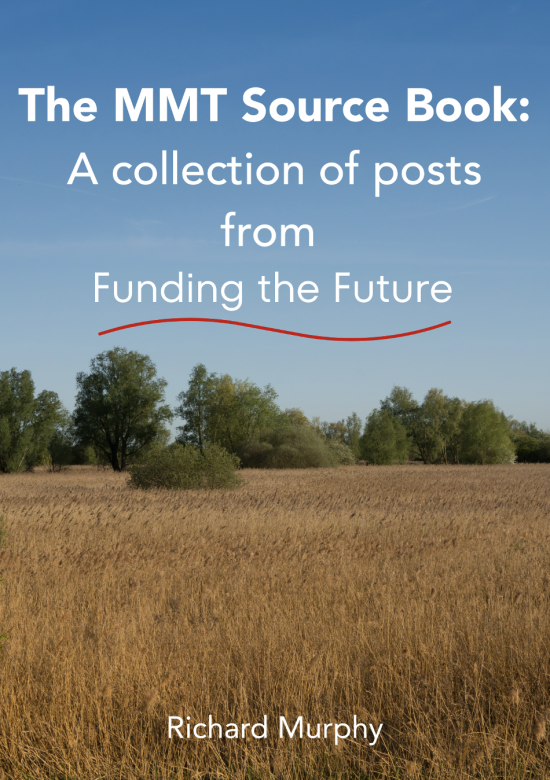
This is a hefty volume, coming in at more than 400 pages of A4, and featuring 94 separate articles ordered into six chapters.
It is a PDF because it is intended that you be able to download this collection and search it when you want answers to MMT-related issues - many, if not most, of which should be dealt with in it.
As I note right at the start of the publication, in a section that explains how I think it should best be used:
I am not saying that reading this PDF as a book is impossible. If you wanted to, you could do just that. It is just that my intention when producing this collection was to, instead, produce a single document bringing together some of my more important posts on MMT to achieve three goals:
-
- To assist you, the reader, in trying to access that information.
- To assist me by referring those making inquiries about MMT to this volume.
- To promote understanding of just what MMT is.
I stress that this collection, large as it is, is not the final word on MMT. I still have a strong desire to write a plain-English guide to this subject, which, in my opinion, is still unavailable anywhere. That said, even if such a volume were produced, I think this collection would remain relevant as a sourcebook and, in that role, I hope that it is of use.
All our PDF guides are available free of charge. I am more interested in education than I am in profit. That said, putting this publication together involved quite a lot of cost. If you feel able to contribute towards those costs when downloading it, I would be grateful. Unless you are feeling particularly generous, I think it would be hard to argue that you are not getting value for money, and that is my intention if you are inclined to contribute in any way you can. However, if doing so is beyond your means, do not worry: this publication is available free for anyone to enjoy.
Finally, although this was not intended as a print publication, we may be able to produce some in that format. It would be spiral-bound, A4, and black-and-white only, except for the cover. The price might be around £30 plus postage and packing. Please let me know if you are interested.
Thanks for reading this post.
You can share this post on social media of your choice by clicking these icons:
There are links to this blog's glossary in the above post that explain technical terms used in it. Follow them for more explanations.
You can subscribe to this blog's daily email here.
And if you would like to support this blog you can, here:

 Buy me a coffee!

MMT assumes the treasury is allowed to create money to fund its spending. The usual rules intended to limit this practice, such as central bank independence, are assumed to be non-existent or not enforced.
As a result, MMT concludes that the central government does not have financial constraints. In other words, it cannot “run out of money” like a household, it doesn’t need to “find the money” to do public works, and so on. These are some of MMT’s most publicised conclusions.
But there’s a problem. What MMT says is a truism. What it really says is, “If the government is allowed to create money, then it cannot run out of money.”
Every economist knows this.
As I noted on X this morning:
I have read your book on MMT. It is drivel. Possibly the worst ever book claiming to be a serious study on economics ever published, by an author writing about modern monetary theory who never explained what money is, how it is created, what the role of commercial bank money creation is, how double entry actually works, or what the role of central bank reserve accounts might be, let alone what open market operations are, and has no awareness of sectoral balances or economic consequences as simple as the multiplier. It is truly dire, and it says a lot about the Institute for Economic Affairs that they are promoting a book whose sole argument is that MMT does not work, because neoliberal economists are doing all they can to make sure it does not.
Can you review on Amazon?
I will
Well, well, little Emmanuel has written a BIG BOOK about MMT. Well done! But you’re all about AI aren’t you? Oh well………….
How does it feel Emmanuel to be unwittingly ( I hope) part of that Italian tradition of Fascism – after all Fascism was created in Italy wasn’t it? Because that is what it seems to me. Is this your ‘inner Roman’ coming out is it? And part of Fascism – let’s be honest – was about creating hardship for the citizen by reducing their wealth, holding back money, helping the people to become weaker so that their government was stronger and could hon-nob with the rich and live a life of luxury themselves?
Your question is, MMT can only exist ‘If the government is ‘allowed’ to print money’. So, what do you have to say about sovereignty then? I don’t know what applies in Italy these days, but in the UK, the state is sovereign on this issue, it owns the BoE and can do this. The pound is literally owned and guaranteed as legal tender by the Government. It used this power after World War 2, using the money, creating the power of the state to wage military war to wage a war on domestic want instead and improve the condition of its people. Why? Because at that time they realised that austerity and economic hardship had bred Nazism in Germany and ultimately the death camps, whose stench was still in their noses when they created social security and the NHS. The death camps were eventually replaced by the fear of communism – another form of authoritarianism . But history is history Emmanuel. Tell us – do you know yours?
Thank you
Models make assumptions. And according to economists like Milton Friedman these assumptions do not matter. It does matter if they are true or not as long as the results of the model are close enough to observable data. This is the mainstream view. Every economist knows this. Mainstream models have failed. They are the ones unwilling to question their assumptions because they say that assumptions don’t matter as long as they are listed.
MMT makes remarkable few aasumptions.
It just deals with observable facts – inclduing that those of right wing persuasion try to deny the truth about money creation, taxation, so-called government borrowing and how the government funding cycle operates
Just a heads up, I have a two-part response to your interviews and blogs with Will Thomson coming out on May 8 and May 12, Australian time. I am respectful.
I haven’t looked at your PDF yet.
Have a great day!
Excellent work, an enjoyable read.
A note:
When the .pdf is converted to an e-reader format via Amazon’s “Send to Kindle” facility, the hyperlinks appear but are not active. I will ensure that when I recommend the Source Book that lack is “advertised”, to avoid complaint.
Unless anyone here knows of a vital step I am missing?
I have no idea no ideas how to get around that, except by creating a Kindle version. We have not mastered that as yet.
I have checked this and gut this advice:
The practical recommendation is therefore:
If you already have a PDF:
* send it directly via Send to Kindle
* do not convert it
Also, look at the kindle on your oc, mac or even iPad but note on a kindle device – they are the least reliable
Well done and thank you. Just downloaded it
Thanks
It took a lot of work