
It is a truth, universally acknowledged, that a Prime Minister in office beyond their use-by date fails to recognise that fact, and has to be expelled from office by the members of their own party, however unwilling they might be to fulfil this obligation.
This will, of course, become apparent in the case of Keir Starmer within the next two weeks.
The Peter Mandelson fiasco will hasten his exit.
The fact that he is very obviously a straw man, put in place by others to achieve their objective of destroying the Labour Party from within, will, though, be inconsequential when most of those who must now get rid of him share that objective.
The reason why he will have to go is that he will have so obviously failed.
Look at these two opinion poll findings, published in the last day or so.
The first predicts the result of the forthcoming elections for the Holyrood Parliament in Scotland, where Labour's presence will be reduced to a rump, when only two years ago, before Labour reached office in Westminster, it was thought by many that Labour had a real chance in Scotland.

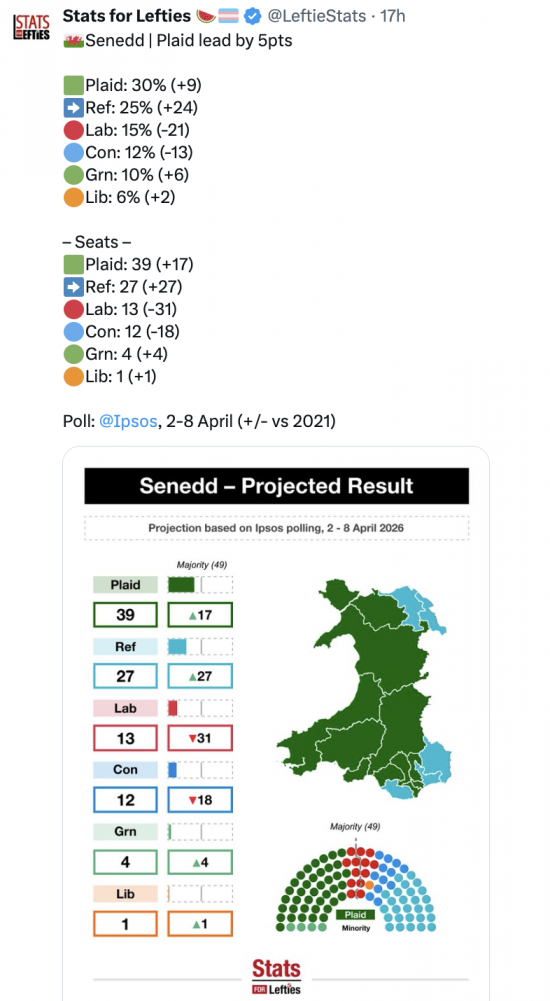
The expectation in Wales is almost as bad:
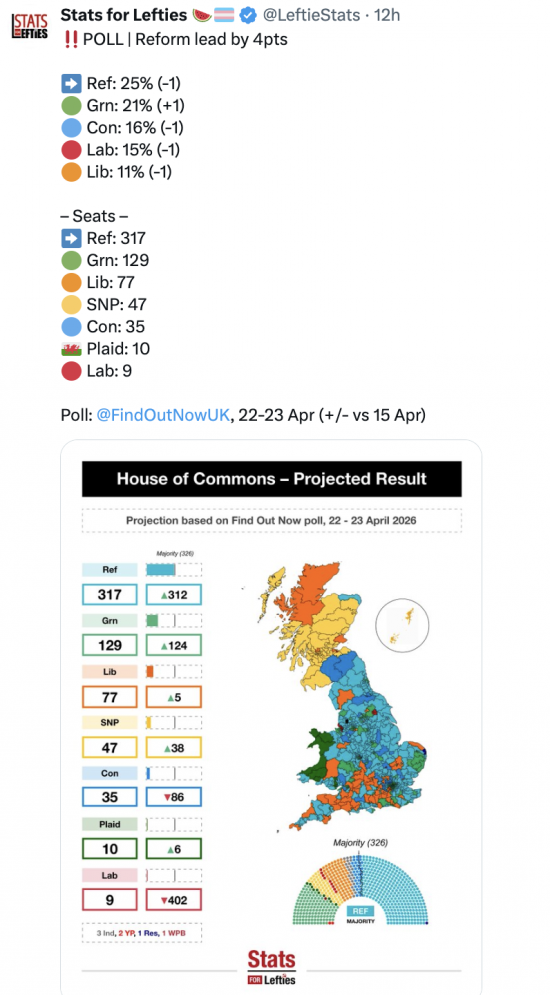
The second represents Westminster voting intentions. Labour's support now suggests that it is heading for oblivion in the way that the Conservative Party is already doing, and that it may have fewer seats in the next parliament than Plaid Cymru:
Those Labour MPs in Westminster, now facing their own futures in alternative careers once their fate is determined, whenever the next general election might be, have only one desperate option left available to them, which is to replace Starmer, however poor the alternative choice might be, as, given the available options, must surely be the case.
I am not going to speculate on who that new leader might be. No one thought Corbyn would win in 2015, and an outsider might achieve the same outcome now.
What I will note is something else, which is that since 2015, the UK has had five Prime Ministers (May, Johnson, Truss, Sunak and Starmer), and not one of them has been successful using any criteria that you might choose, and all but one (Sunak) have been removed from office by their own members rather than by the electorate.
Three questions then follow.
The first is whether the UK is now ungovernable. The answer would appear to be that it is. All our recent prime ministers have found this to be the case. Of course, it is also possible that this is because they were not competent to govern, but that then leads to the second question.
This second question asks whether the UK is ungovernable because it has an electoral system that is incapable of selecting appropriate MPs from amongst whom can be chosen a person suitable to be Prime Minister. The answer to this question would appear to be that this is very obviously true, but that then leads to the third question.
This third question asks whether this might be the case not just because the electoral system is no longer fit for purpose in the UK, but because the UK itself is no longer fit for purpose, and we are trying to find a person to govern a country that is no longer governable because it should no longer exist, since the people of Wales, Scotland and Northern Ireland no longer wish to partake in it. This will become very obvious after May 7, when those three countries are likely to be governed by parties whose ultimate goal is independence from the UK.
Starmer, incompetent as he is, might then be indicative of a greater decay, however hard that is to imagine given the scale of corruption, incapacity, ineptitude and straightforward deceit which have characterised all that he has done. That greater decay is of the UK itself and suggests that, however strong the need for electoral reform, improved governance and greater accountability in Westminster might be, that reform has to take place within a government that is responsible for England alone, with each of the other constituent members of the United Kingdom being allowed to progress in their own independent way.
Let me return to my opening statement in that case and suggest that it is a truth, universally acknowledged, that a country that has ceased to represent the collective identity and purpose of those living within it no longer has a purpose and should be transformed into new jurisdictions that can fulfil that basic requirement.
In other words, the malaise within the United Kingdom is caused by the fact that the United Kingdom is, itself, in existence beyond its sell-by date.
It is time to move on.
Thanks for reading this post.
You can share this post on social media of your choice by clicking these icons:
There are links to this blog's glossary in the above post that explain technical terms used in it. Follow them for more explanations.
You can subscribe to this blog's daily email here.
And if you would like to support this blog you can, here:

 Buy me a coffee!

If as you suggest it’s time for total devolution for Scotland and Wales, and I would suggest reunification in Ireland is long overdue, please can we have better regional devolution too?
The South West gets totally forgotten because Labour know there are no votes to be won down here and until recently the Tories have seen it as safe seat territory. So we get no infrastructure spending, no money for the extra costs of tourism in terms of healthcare and policing etc. and policies that do not work in large sprawling rural areas. I’m for unitary authorities,but the proposals insist on population levels that are impractical for effective governance in Devon. We will end up being dictated to by Exeter and less services than we currently have.
I think English governance needs a complete rethink and to become a lot less Westminster centric. I believe most European countries have much better models we can look at and the UK is rare in terms of the level of centralisation. It really doesn’t help with voter engagement and empowerment.
Wow. That’s a stark analysis that hits home. I love it. I won’t refer to my Celtic cousins but the “state” of Northern Ireland was deeply flawed from the start, just over 100 years ago. It was a flawed solution to the last imperial rule over an oppressed country. Independence for that flawed “state” is hardly an option – but a New Ireland encompassing the whole island in a new country where a new constitution protects and respects all must be our ambition.
Agreed
the polls show a rough balance at present. But also that younger people are more in favour. I see the withdrawal of Northern Ireland as inevitable.
My thought is that inequality is too high, and that’s a major reason for whoever is in government being unpopular. The majority of the population feel their lives are too difficult.
It’s also clear the country squandered the riches of oil discovery, failing to create a sovereign wealth fund. Brexit further harmed our economic position, making all of us poorer.
Some technological changes boosted jobs, like the dot-com boom creating whole new jobs while doing little to reduce existing ones (at least until later – local newspapers lost eventually, etc). AI scares many because it has been presented as a job destroyer instead.
Struggling financially and scared for their future prospects, they are negative about their lot, and the government as a result. They want a government to show a path that gives them a better future. They don’t have that, and haven’t for some time.
This may need to include creating new jobs and/or supported voluntary/charitable work, substantial redistribution, considering 4 day working weeks at some point, or reducing the retirement age. Affirming that even if AI does streamline things so there are fewer jobs then the government will make this something that frees people from some of the work burden rather than abandoning them to poverty.
Robin McAlpine article this morning “How the average person killed politics” looks relevant.
https://www.commonweal.scot/articles/magazine-xfejt
Agreed.
The UK is ungovernable because it has increasingly used the politics of jealousy which some embrace and many reject, whilst sticking to austerity policies/BREXIT. When you divide and conquer like that, what is left for any form of consensual rule to work with?
Nothing is left for politics, lots of advantages are left for the capital than funds it, and of course we are then well on the way to authoritarianism.
It just goes to show that those playing with the divide and conquer have no real idea of the forces they are playing with as the become beyond their control. Divide and conquer is a high risk strategy used by those in a weak position when they know that the game is up. Rather than go away therefore, Neo-liberalism cannot concede defeat and clings on much to the detriment of us all.
I’ve seen a lot of commentary over the last few years from people in England on this subject. It’s predominantly come to three main strands of opinion: either “we’d be sad to see you go, but you should do what you feel is right”, “you’re going nowhere and you already answered the question”, or utterly blasé.
The three main factions of the Single Transferable Party are all of the second view – that we’ll have had our democracy, and should shut up and eat our cereal.
The rot in the UK started in the 1960s – asset strippers in sharp suits – buying and destroying UK companies. The Heath gov’ the Slater-Walker scandal, Thatcher more sharp suits and the big bang (1987) & suddenly (actually there was no “suddenly”) gov’ became about placating business (& privatisation) not governing for citizens. Housing? yeah well that’s about keeping the property developers (& those with land banks) happy. The slo-mo split Wales & Scotland (which has been going on for some time) is a reflection of these multi-decade long developments. All helped by a hopeless selection process for potential politicos (mostly based on “does his face fit” (subtext: is he like us and fit with our beliefs & prejudices)). Thus does one reach the point where the UK can’t even repair feckin’ potholes in a timely fashion (I say Carruthers let’s privatise them what!), because there is no money cos Rachel’s piggy bank is down to its last farthing etc.
Rant over.
Rant permitted
Hmmm, where’s the balance of power going to come from in the Senedd? Plaid + Labour + Green would still be quite thin, and Reform + Conservatives could still cause plenty of opposition if the Labour ones who get it in are more like LINO?
PC could well be a minority
The Greens might actively support – they should become an independent Welsh party now
If they are wise PC will have nothing to do with Labour and challenege the rest to gang up on them, laying the ground for future splits
NO opposiotion group looks plausible. No one will work with Reform, I think.
I don’t think anyone now doubts it’s coming. Those really are some extrordinarily low polling numbers for Labour. I knew 2024 was Labour’s last dance in Scotland; if they screwed up this time, they were gone forever, just like the Tories after the 1970s. But I didn’t think it would happen this fast. Not one of Lb/Con/LD in the top three for Holyrood? Wow . . .
Indeed, wow
I think the UK still has life left in it. Though it does look a bit King Lear at the moment. What is more certain is that Labour politicians only need to keep swearing at their voters and their dream of 0 seats will come true.
Whenever I consider the constituent countries that make the UK returning to their original small nation states I do think of Denmark, Luxembourg, the Baltic states etc and how much better off and more democratic they all are
Agreed
It’s becoming impossible for an elected govt to placate both the super-rich and everyone else; and either can remove a govt they don’t like.
There were workable compromises in the pre-GFC bubble, and then the decade of ultra-low interest rates. But neither are coming back.
I doubt the next govt will last five years, whoever they are.
The UK has been asset stripped… of wealth, infrastructure, the NHS, education, resources, resourcefulness, social capacity, community capacity, pride, national identity… the list can go on and on. And when asset stripping occurs we all know that there’s not much left bar skin and bones but lots of profit to add to the offshore accounts.
Whether or not this destabilising process has come from internal or external influences is a matter of debate and lots of finger pointing but it has worked.
When Labour left last time they left the note saying there was no money left, when the Tories left it should have read ‘nothing left to sell’ as they sold off everything worth selling bar their grandmothers (as far as we know). Add both together and you understand why we are in such a mess.
Any suggestions for what the next note might say next time at the end of this government?
You can’t be worse than us
Yes but every time you *think* we’ve hit the bottom…
There is a real risk that, at the next general election, votes could be split relatively evenly across five or more parties. In that scenario, a party could secure a large parliamentary majority while being supported by only around 20% of those who voted—and an even smaller share of the overall electorate. That would raise serious questions about democratic legitimacy, regardless of which party formed the government.
As you have pointed out the UK is already facing significant economic and geopolitical pressures.
But these are not solely the responsibility of the current leadership and I would agree there is a concern that the present course may (will) not sufficiently reduce those risks.
In that context, the priority for the current government must be structural reform. Specifically:
introducing a form of proportional representation,
considering compulsory voting, with a “none of the above” option, and
requiring a two-thirds parliamentary majority for any future changes to the electoral system.
Starmer morally and politically has to strengthen the foundations of UK democracy and give future governments a better chance of addressing the country’s challenges more effectively.
While proportional systems may lead to more negotiation between political groups, that surely is preferable to the current system which encourages tyranny by the minority.
Thank you
Been musing this myself after St George’s day yesterday and wondering why England is so devoid of identity and its traditions, yet the Scots Irish and Welsh are steadfast in there’s. There is a Arbour Day and a michalemas fair my village does I never heard of till I moved, it makes me realise what we did have and what we have lost and that perhaps not only a new patron saint but a new identity a new flag, is required and one that is not weaponised by people like reform, one that people can feel hope and unity and cultural identity no matter the race or creed and It would be nice to be once again proud to say what we are instead of oh god I’m English, sorry.