
I am aware that we post a lot of polls on this blog these days, although I readily admit most are on our videos and are designed for a YouTube audience.
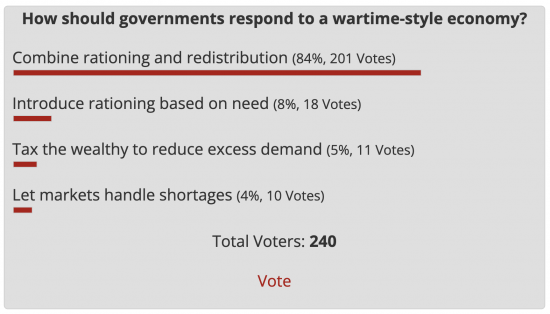
Usually, the results of polls on YouTube are closely aligned with those on this blog. Yesterday was an exception. This was the poll on the blog:
The YouTube poll revealed a quite different balance, with a much greater number of people voting:
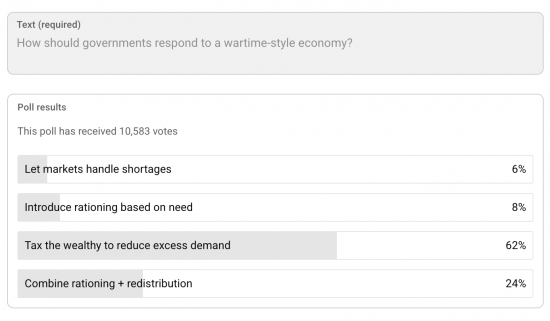
Apparently, 10,600 people have voted in this poll so far. Their preference is very strongly for taxing wealth. The preferences of those voting here are much more balanced, favouring a range of actions, including the potential for increased well taxes.
Perhaps I should not be surprised by this, but I am. The simplistic appeal of wealth taxes really does work with audiences who are angry about economic injustice. The fact that they are so difficult to deliver, due to the massive administrative burden and cost of establishing what a person's wealth might be, is an issue that those who support this form of taxation seem unaware of or choose to ignore. I very strongly suspect that this was a factor in the YouTube result. Although I referred to increasing taxes on income and gains derived from wealth in the video, it was hard to be that nuanced in the question in the poll, given the limited number of words that can be used.
In that case, it is easy to see why the Green Party continues to advocate for a wealth tax, even though there are many better options available in practice for raising revenue and for tackling inequality. I am beginning to recognise, as a consequence, that arguing against the inclusion of such a tax in a manifesto is pointless. The argument has to be about what happens if the opportunity for delivery arises, when better choices on taxes to be imposed will have to be made.
Thoughts would be welcome on this issue.
Thanks for reading this post.
You can share this post on social media of your choice by clicking these icons:
There are links to this blog's glossary in the above post that explain technical terms used in it. Follow them for more explanations.
You can subscribe to this blog's daily email here.
And if you would like to support this blog you can, here:

 Buy me a coffee!

Reform are advocating retention of the triple lock for pensioners; the Green Party advocates a wealth tax. That looks disturbingly like two sides of the same coin. Many of us who want to support a Green movement would like to see politics traded in a new currency.
I always understood that the reason for the triple lock was because our state pension provision is so low when compared with other, similar countries. Maintaining the triple lock should not mean reducing other social security benefits.
I sometimes wonder whether people generally see the words ‘wealth tax’ to mean increasing the amount of tax paid by the wealthy, rather than a % levied on a figure calculated to be their ‘wealth’.
The overall picture is a bit more nuanced if you look at overall pension arrangements in the UK compared with elsewhere, but there is considerable hardship for many pensioners and something needs to be done about that in a way that is speedier than the triple lock. By “the same coin”, I’m talking about over-simplifying complex issues to chase votes. That’s what needs to change.
You might be onto something. Most people don’t understand the ins and outs of “a wealth tax”. Most would define it as a one-off or annual payment according to the value of assets owned… and Richard has often said how hard it is to make it work at a practical level. Indeed, the whole point of the Taxing Wealth Report in 2024 was to offer an alternative.
Surely, the answer is to embrace whole heartedly a “Wealth Tax” – but broaden the definition to include measures from that report. This might be a better strategy. So, not “I oppose a Wealth Tax; it is too difficult – here is my idea instead” but “I support a wealth tax and here are my suggestions as to how it could work at a practical level” (at which point you pull out the Taxing Wealth Report).
So, a change of tone not of substance.
Noted, and you may be right.
The triple lock on UK pensions simply maintains a relatively unthinking voting population more interested in their own wealth / interests than that of the wider society. France is even worse. I would point to Rutger Bregman’s Reith Lecture series for an excellent series of lectures and Q&A that addresses many of the topics that Richard covers (Richard covered them circa Dec 2025 in his blog). https://www.bbc.co.uk/programmes/articles/v78MKsCWHxw0l0PwMn4R0R/bbc-reith-lectures-2025-moral-revolution
The aforementioned lectures also address wealth. A wealth tax as proposed by the Greens fails to tackle wealth inequality in an intelligent way – as Richard has proposed on a number of occasions – however, what it does highlight is the power of populist, simplistic narrative directed towards a relatively unthinking voting population. Possibly the you tube poll reflects this?
A final point on the power of simplistic narrative. Possibly appropriate as we enter the Easter holidays, the aforementioned lecturer is the son of a preacher. His observations is that all sermons / stories are formed by 3 acts: Misery, Redemption and Thankfulness. Other comments were along the lines of that we are living through the ‘survival of the shameless’, where the wealthy dodge taxes and politicians perform rather than govern. Seem familiar?
Agree RM, a Judo mentality, don’t fight, draw on the energy to be stronger.
Wealth tax is a 2 bit slogan, and think most would want sensible operational detail behind the slogan, there’s often a space behind such empty slogans, claim it for FtF. Or somebody else will.
🙂
I think people do want fairer tax and, therefore, for the wealthy to be taxed more.
I don’t think that be necessarily means they want an explicit wealth tax. Equalising tax on earned and unearned income could be framed as (and indeed is) tax on the wealthy. Reducing pension tax relief could be similarly framed. Lots of other redistributive taxes could be similarly framed as taxes on the wealthy.
We know the precise wording of polls can significantly affect the result. Perhaps people would be happy with redistributive taxes rather than a specific wealth tax or, at least, that such taxes can be framed as a tax on the wealthy with general support.
I agree
Tim, the benefit of pension contributions are framed as tax relief but it’s more properly understood as a deferred income that grow and is taxed when you withdraw it. The exception is the tax free cash (which is capped) but if didn’t exist the incentive to save for retirement would be seriously diminished if a majority on the same tax rate going in paid the same on exit.
If we limited the tax relief to basic tax we would also have to limit the tax on exit, otherwise there would be zero incentive for a higher rate tax payer in retirement to contribute.
its true that a majority of higher rate tax payers will fall to basic rate tax in retirement but spreading income is no less fair than the example of two self employed people who both earn £300k over five years but one earns 60k a year and one earns £80k in three of the years and £30k in the other two. The first one will pay less tax because we only measure earnings in each tax year.
Most pension savings are by the wealthy
They do not necessarily pay the same tax rate in retirement as when earning
The system is very far from neutral. It delivers a massive tax subsidy to wealth costing £80 billion a year.
Nothing about your argument stacks.
Dai bach said “if didn’t exist the incentive to save for retirement would be seriously diminished if a majority on the same tax rate going in paid the same on exit.”
Why do the wealthy NEED an incentive t save for retirement. The lowest pad need an incentive because they cannot afford to save, but the wealthy have no such problem.
Agreed
I agree. As we focus on policy platforms, delivery, actual measures to be implemented, we need more pragmatism, especially in language.
My personal wealth tax “spectrum” runs from;
– a “wealth tax” at the negative far end
through:
“Wealth taxeS” (covers a multitude of virtues even if it includes the odd sin)
to:
“Taxing the wealthy” (the FTF equivalent of canonisation) at the virtuous end.
If a green manifesto included effective FTF style TWR 2024 taxation of the wealthy, AND still regrettably, for electoral alppeal, referred to a “wealth tax”, I’d vote for it anyway. If they then ENACTED what they promised (a novel idea in UK politics), I’d vote for them next time too if still alive!
Thanks
I’m inclined to agree regarding creating a manifesto that is simple and appealing; but there remains the danger of another ‘Rory Stewart’ moment for Zack Polanski or whoever from the Greens, in which some journalist or Question Time opponent with supposed ‘authority’ (Faisal Islam on BBC?!) introduces doubts about the practical implementation of a wealth tax (even using some of your own comments on it!??!).
A simple presentation of the injustice of Rishi Sunak paying £0.5m tax on over £2m income (with capital gains, exemptions etc etc) – about 23% I think – versus a regular worker (a public service person such as an NHS doctor might strike the right note) who pays PAYE and NI (even leaving aside possible student loan repayment) whose deductions will also be about 23%… but on only £55k salary, by my estimate. Followed up by a calculation of what Sunak should pay on his £2m, using your ideas for levelling up taxes on unearned income, gains etc… and not referring at all to whatever capital wealth he may have, where it’s located in secrecy jurisdictions or hard to locate and value.
That said, when I’ve used this argument with others face to face, there can be a tendency for their eyes to glaze over with the technicalities! Or maybe they’re simply locked into a mindset that ‘this is income from their wealth so of course it’s different’? In which case just saying ‘Tax Wealth’ may be persuasive.
It seems to me that advocating for a wealth tax is a quick way to attract attention and hopefully votes along with it. The MSM have to be held responsible in many ways for this because one of their most favourite as well as ignorant questions to politicians is, “ how are you going to pay for it?”. The opportunity to explain in any detail is never provided and it is made even more difficult by the absence of knowledge combined with established beliefs in things like the economy being a household held by the interviewer. Simply advocating for a wealth tax instead of saying that there are a whole variety of ways that wealth can be more equitably distributed by already existing different taxes is dangerous ground. It will not be quickly implementable and could likely destroy trust and reinforce existing resistance to taxation. I think a wealth tax could be imagined as the economic equivalent of imagining that Ozempic or Wegovy are the solution to the health crisis.
Might a stepped approach to this matter be an approriate posibility?
Step 1 Establish that resources are the source of welbeing and sustainability and that money is secondary to resources.
Step 2 Making our current tax set ups genuinely transparent, equitable and progressive
Step 3 Consider a wealth tax in such a new set of contexts
Pretty much everyone things that it’s ‘other people’ are the wealth – and they are the once who should be hit by a wealth tax.
I’d prefer the words ‘tax on wealth ‘ replaced ‘wealth tax’ (I know, most people won’t notice a difference). A wealth tax is a blunt instrument – a direct annual levy on an individual’s total net assets. I’ve learnt here why technically it’s a non-starter to implement. A tax on wealth is a broader term that covers capital gains, tax on trusts or inheritance tax, which tax the increase or transfer of assets rather than the stock itself…..and the tax architecture to do that is already in place. Council tax and stamp duty land tax (SDLT) are a proxy for a property wealth tax.
As I have long said, I agree with you.
All I would say is that we are also dealing with another rather more difficult situation in that too many people think that there is not enough money in the world or that all the money already exists – that it is a finite resource and it is about salami slicing it up so that no one really gets what they need (unless you use the CBRA of course). I do hope that you do not give up combating that ‘wisdom’ of the ‘closed loop’ money supply rhubarb we suffer under.
Thoughts? Just keep your taxing wealth report in there, keep bringing it along to the fray. It’s not pointless – are you going to let morons define you!? Of late, we’ve seen the personal toll of the work you have taken on yourself and that has made one or two of us realise a thing or two. But please, don’t tell me any issues you have explored are ‘pointless’. I don’t want to see that word used again. And how many times have you been through the denial mill on any of the issues you have raised? Keep the TWR there please. It was so much work!
And thank you for helping me realise that my scepticism of the Greens is bona fide. If any one wants to be in charge of my life, they’d better up to it otherwise they can bog off. Never mind voting. How about the population turning up at polling stations at the next election and just leaving their voting slips outside the stations and walking away? What a verdict on politics that would be. And yes, I know what your reaction to that will be, for sure – but best wishes.
I am most certainly not giving up on the TWR. If the Greens are going to deliver they will have to use it. There is nothing else out there for them to use.
I think a “wealth tax” is really just shorthand for advocating for a fairer and more redistributive tax system, as has been mentioned by many in the comments. I also think there are much better ways to achieve this than through a pure wealth tax as Richard has persuasively argued.
But no one seems to be considering a second option of simply making everyone extremely wealthy. Simply ask the treasury to issue payments of 2 billion pounds each to all current uk citizens with assets of less than one billion. Redistribution problem solved! We’re all billionaires!
(Did I miss April 1 by a day or two…?)
And that would destroy our currency
While the Greens and Zack Polanski have been using a new taxk on wealth as one of their headline grabbing policies, there are signs that they have also signed up to some (sadly not all) of the tax reform measures contained in TWR and your alternative 2025 budget. In his recent speech at the New Economic Forum Zack saifd ‘While households across the UK struggle, a wealthy minority have thrived. The wealth of those who own those precious assets – the ones sold out from under us under Thatcher, and then sold [or rented] back to us for profit (has) skyrocketed. That is money being made, not by putting anything into the economy, like running a businesses, creating jobs or making a product – but simply from sitting on assets or charging somebody else for the use of them.”
While the Green Party’s letter to Rachel Reeves before the Budget called on her to implement a 1% tax on wealth over £10 million and 2% over £1 billion, it also urged her to align rates of Capital Gains Tax with income tax so income from work is not taxed more than income from wealth, and introducing National Insurance on investment income, in line with employment income, which is a step in the right direction.
Agreed
My thoughts. Yes we need to tax wealth more and income less. The TWR is a terrific document and full implementation probably more effective than a Wealth tax. I’ve pushed back against you before re valuation so I’m risking another ticking off.. We’re talking about individuals with wealth >£10m. Not that many. We don’t need to audit all of them, a decent sample. Use same methods as for Probate. The general public will accept it if they know what’s happening with the cash (yes I know it all goes in the same pot). Use it specifically for social care. If it you have to go into a home then first 12 months payable by the individual then after that the funds come out of the Wealth tax.
Sorry – bUt in MMT trerms you have that all wrong. Tax does not fund spending, ever.
Apologies Richard. I realise govt creates the money and tax destroys it. It’s the optics I’m concerned about. We need to get the public to buy onto it.