
These are the slides for my opening presentation for today's event in Cambridge.
My core argument is this, based on an analysis of Adam Smith's Theory of Moral Sentiments, published in 1759, and building from there:
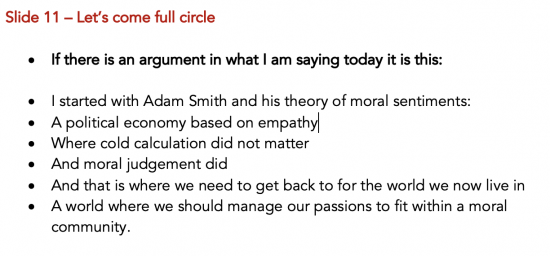
And no, they will not be on a screen, for those wondering how they will be legible. Those attending are also getting the PDF. These are my prompts, not conventional PowerPoint slides.
We are filming today. There should be a video of this in due course.
If you are coming, I look forward to seeing you later.
Thanks for reading this post.
You can share this post on social media of your choice by clicking these icons:
There are links to this blog's glossary in the above post that explain technical terms used in it. Follow them for more explanations.
You can subscribe to this blog's daily email here.
And if you would like to support this blog you can, here:

 Buy me a coffee!

Thank you for these slides. I booked early, couldn’t come because of health problesm, canvelled and my place was resold. It’s good to have some knowledge of whaat’s happening, even though I’m missing out on the social aspects.
Thanks, Lind
It went well
We think the video recording was ok. It will be out next week.
The team need a day off!
I was very surprised when I read ‘Moral Sentiments’ just how radical it felt.
I believed for a while that Smith’s work is redeemable. That there is some merit to it. My understanding is that Alasdair Macintyre believed that the connections between Smith’s work had become so disconnected and picked apart for our own particular self gain that any part of Smith’s work was irredeemable. My view is that Adam Smith seems to advocate moral goods exactly like Macintyre desires. Then there are my critiques who say that I have doubted Macintyre’s understanding. They say that Macintyre is formulating Smith exactly as I do. Where then is this conflict coming from? Economists claim that philosophers like Macintyre don’t understand economics or misrepresent Smith. Economists believe that they know Smith better than philosophers. I know for a fact that both philosophers and economists threw Smith away in the 19th century and professionalised their disciplines. Ever since, the 2 disciplines cant communicate with one another. And that is perhaps Macintyre’s point. The 2 departments both believe the other to be wrong and Smith’s commercial society requires a mutual exchange. We have become incredibly atomised that we don’t trust the exchange process.
I think you are circling the real issue.
There are, in effect, two Adam Smiths. One is the author of The Theory of Moral Sentiments, who argues that sympathy, justice and social norms are essential to a functioning society. The other is the caricature some economists have built from The Wealth of Nations, portraying Smith as a prophet of self-interest and markets left alone. The conflict you describe comes from treating the second as the whole story.
Alasdair MacIntyre’s point, as I read him (and that was maybe 20 or more years ago, I should confess), is not that Smith is irredeemable, but that modern capitalism has detached markets from the moral community that Smith assumed would restrain them. Economists professionalised into mathematics and optimisation; and maybe philosophers into ethics without institutions. Each lost sight of the other.
That is why, on Funding the Future, I keep arguing that economics is about choices within society, not equations in isolation. Markets need moral purpose, regulation and democratic accountability. Smith knew that landlords, monopolists and rentiers were dangers, point I made yesterday.
So the disagreement is not really about Smith. It is about what we have done with him. We turned a moral political economy into a technocratic defence of power, and then wondered why the disciplines stopped talking to each other. The task now is to reconnect ethics, accounting and economics in a politics of care. Does that make sense?
I’ve just read through the ‘slide list’ – thought-provoking in itself – so I look forward to the video – meanwhile, all good wishes for what I am sure will be an excellent event.
Thanks.
I am shattered.
It seemed to go very well.
Great day today thanks a million Richard
Thanks
I read the outline, and I intend to get it printed so I can make notes on it.
I’m impressed. If you left anything out, I couldn’t find it. I wisjmh i could get there.
It looks to me as if a huge reason housing is too high is because the rich have too much money. They keep “investing” (gambling) and pushing the prices up.
Thanks
We had a good day.
Adam Smith would certainly not be a member of the Adam Smith Institute.
Agreed
I had to laugh when you said that The Wealth of Nations is a footnote to the Theory of Moral Sentiments.
It has to be the longest footnote ever written.
I have tried to read it all, but it requires stamina… (and I’m used to reading 18th C literature)
Good to hear that your day went well.
🙂
Excellent work. Thank you.
I fully agree, and I think that this has either been missed – or like the Bible even – Smith has been selectively quoted by people with vested self interest or rather peculiar or particular points of view.
For me, in The Theory of Moral Sentiments, Smith was acknowledging the paradoxes we have in capitalism and that we should manage them judiciously. Doing so would sustain the system; not doing so could be an existential threat as Marx and many others went on to capitalise on. And that threat is real and can be seen around us now.
Capitalism was not really meant as a system to enrich the few; it was a system of fair exchange and rather than overthrow it, we were supposed to manage is sustainably – the governing mechanism being democracy.