
As the FT notes this morning:
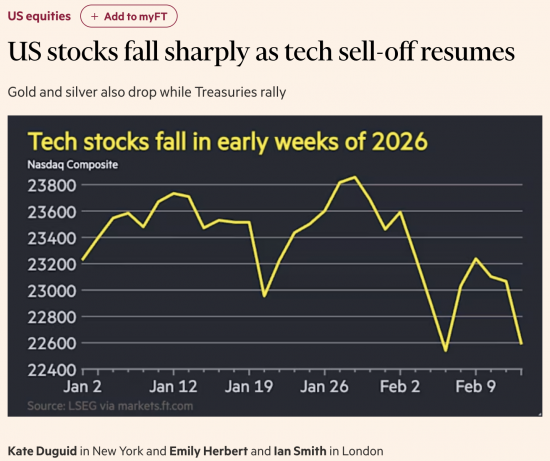
Tech stocks had a bad day yesterday.
So did markets in general.
Amazingly, markets apparently realised that AI might be able to eliminate most financial services advisors because all that will be required to determine optimal investment portfolio holdings will be a person's tax return, portfolio details and a database of tax legislation and out will come a report in seconds, shattering the myth that there is very much expertise involved in supposed investment optimisation routines.
That explains why the shares in wealth advisers did badly.
Why did tech? Could it be that markets have realised that people don't just invest for supposedly optimal outcomes? They all have their own preferences, and the distance between optimisation and choice might be real, requiring that humans be involved in the process of wealth management after all, and AI does not really have the answer.
Either way, the bubble deflated a little bit. And it's still teetering on the edge of that moment when it bursts.
Thanks for reading this post.
You can share this post on social media of your choice by clicking these icons:
There are links to this blog's glossary in the above post that explain technical terms used in it. Follow them for more explanations.
You can subscribe to this blog's daily email here.
And if you would like to support this blog you can, here:

 Buy me a coffee!

Bitcoins are now priced below the level at which profitable mining is possible so no new suckers are buying into the con, which is when all Ponzi schemes collapse.
It’s just a question of which particular straw will break the donkey’s back.
I had a meeting earlier in the week with a chap who had been “playing about with AI financial planning reports”. Whilst I didn’t actually see the ‘output’, he told me that they were broadly similar – looking at the rote 60/40 portfolio approach, for instance When I asked him why he popped in for a chat, he astutely said that AI output does not cater for “emotion & sentiment”, or words to that effect. People seem to need another person (or more) to offer support and reassurance about certain courses of action – “permission”, if you like. This is all very interesting and, in my 35+ years as an IFA, I get that – it isn’t the money or the product sale that really matters, its the “why” and “how” and “what if’s” that are important. These are intangible and change frequently as we remain “fight or flight” creatures at heart.
I know from my experience as a practitioner that it was the “permission” aspect, plus the encouragement that I also sometimes supplied to businesses, that really mattered.
I have been running some analysis on the China – Taiwan/Western Pacific Theatre. It is possible that this will start to “warm up”, with 2027 being the year when Chinese pressure mounts. Given the role of TSMC in the AI-hype, given the reality that the number of ultra advanced IC fabs outside of Taiwan one can count on the fingers of one hand, any squeezing of IC supplies (= reduction in IC sales = slow down in data centre build out = etc), could lead to problems. Invasion (China – Taiwan) utlra low probability, gradual blockade much more likely. Which leaves two open questions: value (what constitutes good value investments) and safety.
Ha! The ‘efficient markets’ hypothesis my arse.
The only thing it is efficient at is getting carried away over fuck all.
🙂
I’m old enough to remember Black Monday in 1987 – was on a business school course in Chicago at the time, realising that most of what they said was cobblers! Then Dotcomm crash in 2000, and the big one in 2008. Much of that time seeing the financial world close up.
Minsky had it right and it’s driven by speculation. The insiders make money on the way up, and on the way down as they make the market and are first to know. The rest of us – the ‘marks’ – pay the bill.
And this has boom and bust written all over it. With all the wrong sorts of people to handle it in power.
I also remember that Monday in October 1987…
‘So why Mr Learned US Professor is IBM worth 2/3 of what it was worth on Friday when you tell us markets accurately price?!!’
On the plus side, it was the small minority of non-Americans who were challenging the academics. German, Irish, Belgian, black SA, Mexican, Aus and 2 Brits. Realised how ignorant even supposedly well educated Americans in senior positions in their organisations, were about the rest of the world. They were too busy bleating about their investments