
The UK government has issued a new report on global biodiversity loss, ecosystem collapse and national security.
This is the summary of their findings:
| No. | Key Judgement | Analytical Confidence Rating (AnCR) |
|---|---|---|
| 1 | Global ecosystem degradation and collapse threaten UK national security and prosperity. The world is already experiencing impacts, including crop failures, intensified natural disasters and infectious disease outbreaks. Threats will increase with degradation and intensify with collapse. Without major intervention to reverse the current trend, this is highly likely to continue to 2050 and beyond. | High |
| 2 | Cascading risks of ecosystem degradation are likely to include geopolitical instability, economic insecurity, conflict, migration and increased inter-state competition for resources. | Moderate |
| 3 | Critical ecosystems that support major global food production areas and impact global climate, water and weather cycles are the most important for UK national security. Severe degradation or collapse of these would highly likely result in water insecurity, severely reduced crop yields, a global reduction in arable land, fisheries collapse, changes to global weather patterns, release of trapped carbon exacerbating climate change, novel zoonotic diseases and loss of pharmaceutical resources. The Amazon rainforest, Congo rainforest, boreal forests, the Himalayas and South East Asia's coral reefs and mangroves are particularly significant for the UK. | High |
| 4 | Ecosystem degradation is occurring across all regions. Every critical ecosystem is on a pathway to collapse (irreversible loss of function beyond repair). | High |
| 5 | There is a realistic possibility that some ecosystems (such as coral reefs in South East Asia and boreal forests) start to collapse from 2030, and others (rainforests and mangroves) start to collapse from 2050. | Low |
| 6 | All countries are exposed to the risks of ecosystem collapse within and beyond their borders. Some will be exposed sooner than others and are likely to act to secure their interests, particularly water and food security. | Moderate |
| 7 | Without significant increases in UK food system and supply chain resilience, it is unlikely the UK would be able to maintain food security if ecosystem collapse drives geopolitical competition for food. The UK relies on imports for a proportion of both food and fertiliser and cannot currently produce enough food to feed its population based on current diets. Countries best placed to adapt are those that invest in ecosystem protection and restoration, and resilient and efficient food systems. | Moderate |
Read that however you will, and what it says is that we are at enormous risk.
I am surprised by some of the weightings, including the moderate rating given to the second risk category. But let me be candid: these risks are not independent of each other, and categorising them as distinct is almost a category mistake, as it implies they are.
I would like to say more, but what is there to say? This report confirms what we know, which is that unless we take these threats seriously, we are in very deep trouble. I have known this since around 1974, when I bought and read this book as a sixth former:
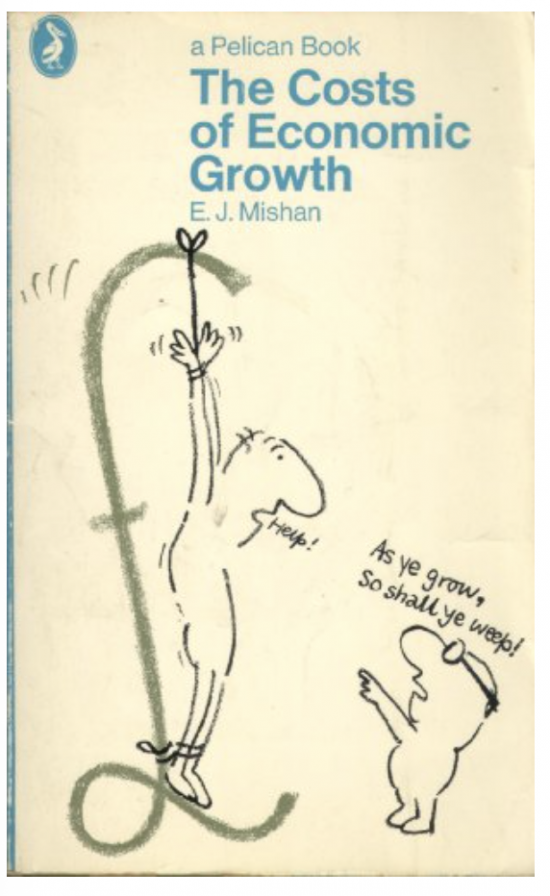
I was persuaded then, and remain persuaded now, that the costs of economic growth are seen in the climate breakdown that challenges our very existence, not just our economy. That was why I was in the Green New Deal Group (which is now moribund) and wrote most of its materials throughout its existence. Arguing about modern monetary theory and other such issues matters, but as ever, it is real resources that matter, and as this report makes clear, these are at risk. We have to take that seriously.
Thanks for reading this post.
You can share this post on social media of your choice by clicking these icons:
There are links to this blog's glossary in the above post that explain technical terms used in it. Follow them for more explanations.
You can subscribe to this blog's daily email here.
And if you would like to support this blog you can, here:

 Buy me a coffee!

I thought perhaps this was a think tank or pressure group report – but as you point out, it is from government.
Yet that same government, when ever it comes to those “hard choices” they so often lecture US about, run resolutely in the opposite direction, with their relentless quest for growth, their abandonment of the green new deal, their uravelling of regulation desiged to protect our fragile ecosystems, their failure to invest in a sustainable economy, and most wicked of all, their failure to take steps to protect their own citizens from these measurable predictable risks, preferring to protect themselves, against the rapidly approachig day when they are rejected by their bruised, battered electorate.
I have not read that one, i will look it up. Limits to growth was the one i read that made me realize, we were in trouble for the future. https://en.wikipedia.org/wiki/The_Limits_to_Growth
I was reading that UK agricultural productivity over the period 2022-2025 is an all time high, and it’s likely true of the rest of the world. Someone must be measuring this wrong as there’s no way that is compatible with what we see in the world today. Maybe it all goes into pet food and battery chicken production but it’s not going into food.
I’ve even had people in my socials food asking for food not to be sent to gaza, but to send money instead. That’s not compatible with broken supply chains.
I have not read that one, i will look it up. Limits to growth was the book that showed us what the future would look like and opened my eyes. https://en.wikipedia.org/wiki/The_Limits_to_Growth
Definitely worth looking at.
Yes, this report is very welcome but grim reading. Will it make any difference? Shelves with similar information have been gathering dust for years and decades. That ecological breakdown is now so apparent why isn’t everybody up in arms to do something about it? In November 2025 the National Emergency Briefing in which 150 MPs attended, spelt out clearly all these problems and what needed to be done on the various sectors – energy, food etc. However government seems content to carry on with business as usual and economic growth and never mind the horrors that are coming down the track that couldnt be clearer from this report.
Much to agree with
Bill, I hadn’t realised that all the expert briefing are available to watch on the National Emergency Briefing website, so thanks for that.
I could not but help to reflect on this post in the following way by observing the behaviour of our media.
Here we are in 2026 – I’m watching rain that should be snow washing soil off hills and mountains to fill up our rivers and make them liable to flooding; washing away our roads and footpaths and other infrastructure (because we insist on them all being done so cheaply these days under the guise of ‘value for money’ and austerity as politicians compete for low local taxes); we are still facing a fresh water crisis/pressure of some sort.
At my railway station, I saw the new trains which are both diesel and battery powered because the Tories lied about electrification of the Midland Mainline being commissioned, and wondered how many resources the batteries consumed to make them as the diesel exhaust wafted around the station (they will only use their battery power I understand as they near London). So that’s electrification further delayed then?
Abroad – Australia has just had fruit bats falling dead out of trees with heat stroke again; flooding haunts parts of Asia, Europe and other continents; an anti-carbon activist is arrested in India! Parts of the Levant are already now too hot to live in. The break up of the polar ice cap is treated as an ‘opportunity’! I mean – where is all that fucking ice going! Er…gone!
And there – seeming to be most popular – are the ructions in the Beckham family being conveyed to one and all because they’ve had a fall out! I ask you. What a bunch of Dodo’s too many of us are.
Sometimes its just like Lou Reed said: ‘Stick a fork in their ass; they’re done’.
Much to agree with
FYI, this report has been sat on by the government for some months and has been released quietly now after FoI requests by campaigners associated with the National Emergency Briefing, and at a time when the news focus is firmly elsewhere. The government appears to be highly resistant to informing the public of the risks they face down the line if we don’t change our ways and make preparations for the inevitable disruptions to come. Presumably they assume they won’t have to deal with the problems before the next election so would rather keep quiet about them.
Thanks, and useful.
“Without significant increases in UK food system” … but we are planning to build on more ‘greenfield’ sites.
I heard of an eastern European country. After WW2, there was a desperate need for housing. All was state-owned and allocated according to family size. At some stage visiting Brits were horrified that an occupier, whose relatives had left, had been given 6 months to move out. ‘That’s terrible!’ ‘No’, replied the man. ‘I don’t need all this space’. He spoke of details of situations like his and of families in a small unit who needed somewhere larger.
In contrast, UK homelessness is widespread. Private builders are encouraged to use greenfield sites a long way from schools, doctors’ surgeries and shops. The ‘market’ ‘requires’ large properties with garages to add to existing similar properties. When family circumstances change, as above, moving is costly – with ‘stamp duty’ as a further disincentive.
Meanwhile, viable living space above shops is widespread and close to facilities but commonly little-used. It could be made available but planning consent would require the provision of parking spaces. For all its difficulties, post-war Council Housing gave families decent homes at reasonable cost.
I agree we need serious investment in water systems, irrigation, sewage, hydroponics and every form of climate‑resilient infrastructure — but none of it will work unless we tackle deprivation first. The communities already living with poor housing, weak services, food insecurity and fragile local economies are the ones who will be hit hardest by ecosystem collapse. If we don’t strengthen those foundations, every shock — drought, crop failure, supply chain disruption — will land on people who are already stretched to breaking point. Climate resilience isn’t just about technology or infrastructure; it’s about reducing vulnerability. And deprivation is the biggest vulnerability we have.