
There was contrasting news from the Guardian's Live business and economics coverage last night and this morning.
First, there was this:
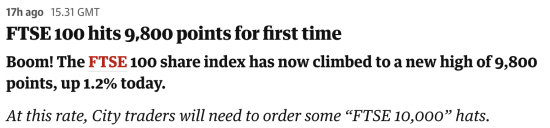
And then this:
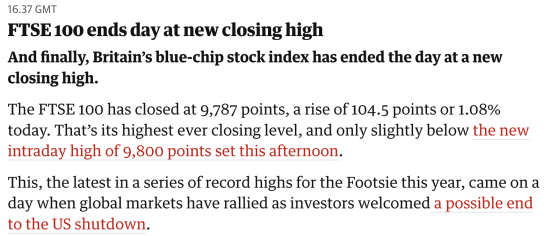
Then note that this means that the FTSE 100 has risen by 20% this year - something that is impossible to sustain.
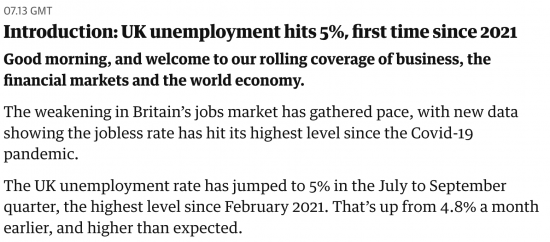
And now note this:
And then this:
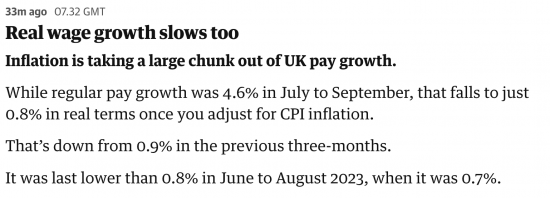
I recently discussed Thomas Piketty's suggestion that when R > G — meaning that the rate of growth in the returns to capital (including gains) exceeds that of the economy as a whole (G) — inequality is bound to rise. Throw in falling wage rates, and right now, this is happening at an almost record pace.
This, I can assure you, is not sustainable. Anyone who pretends it might be is deluding themselves. The crash has not happened yet, but it will.
Thanks for reading this post.
You can share this post on social media of your choice by clicking these icons:
There are links to this blog's glossary in the above post that explain technical terms used in it. Follow them for more explanations.
You can subscribe to this blog's daily email here.
And if you would like to support this blog you can, here:

 Buy me a coffee!

The crash will affect the plebs significantly. Why would the elite care?
The FTSE 250 is not up nearly as much – it is up 6.87%, so somewhat more than wages but not ridiculously so, and over a 5 year period it’s up just 17%, which would be well below inflation or wage growth for that period.
Looking further to the FTSE SmallCap index, that also doesn’t have the ongoing increase that the 100 does either.
What’s clear, then, is that if there is a bubble, it’s around the FTSE 100 (with a similarly one-direction path on the Nasdaq). Most companies are not obviously being significantly overvalued, but the biggest ones are.
Looking at the FTSE All Shares chart shows that the 100 dominates overall share values, largely following the fortunes of the 100, just moderated by the much lower performance of the 250 and SmallCap company share prices.
This suggests a bubble as consolidation from smaller companies to multi-nationals can’t explain the excess growth in FTSE 100 valuations otherwise the FTSE All Shares would be more neutral.
Noted, agreed and thanks.
But the damage will still be done.
To some extent, the performance of the FTSE 100 particularly deprives pre-IPO companies of investment because if you can get stratospheric returns from liquid investments, why would you lock money in a long-term investment in a newer company?
You can at least hope that when the FTSE 100 turns, that it brings investment back towards non-multinationals and particularly to start-ups and scale-ups.
Sometimes I think human beings still live in the Stone Age. I had to laugh at the lack of joined up thinking at the Guardian when they decided to publish the following economics article. Spot the lack of monetary literacy and therefore logic in the article:-
https://www.theguardian.com/business/2025/nov/09/trump-trade-war-dollar-value
Richard,
A number of FTSE 100 firms have indulged in share buybacks and this has fuelled the big increase too.
For example Lloyds Bank has done so two years running.
Agreed
How do share buy-backs affect the FTSE?
By reducing the number of shares on sale for any known source of future profit, so inflating share price. And yes, that does change behaviour or companies would not do it.
But the reduction in the number of shares compensates for the increase in share price with zero net impact on the index value.
Unless investors see the share buy-back as a positive indication for future and hence are happy to buy more shares, which is exactly what the index is supposed to measure.
In isolation it has a zero impact on the index.
In isolation is doing a great deal of work there.