
Why does economics fear diversity? And is discrimination against people who do not fit its expectations built into the very foundations of neoliberalism?
In this episode of Understanding Economics, I argue that neoliberal economics assumes people must adapt to the demands of markets, employers and the economic system, rather than requiring the economy to meet people's needs.
But people are different. Disability, autism, ADHD, gender, ethnicity, beliefs, caring responsibilities and more all contribute to human diversity. No single way of working or living can suit everyone.
Yet our workplaces, education systems and social security arrangements frequently assume otherwise. Those who cannot conform are too often excluded, blamed for their circumstances or punished for failing to meet expectations that were never designed around their needs.
I argue that this is not simply unfair. It is also economically destructive.
When employers refuse to accommodate difference, talent is wasted.
When people are excluded from employment, the economy loses productive capacity and spending power.
When governments blame individuals instead of addressing the barriers they face, discrimination becomes embedded in economic policy.
A caring economy would do the opposite. It would recognise diversity as a strength, adapt workplaces and public services to people's needs, and ensure everyone has the opportunity to contribute.
The fundamental question is whether people should have to fit the economy or whether the economy should exist to serve people, which is what economics should really be about.
This is the audio version:
This infographic supports this video:
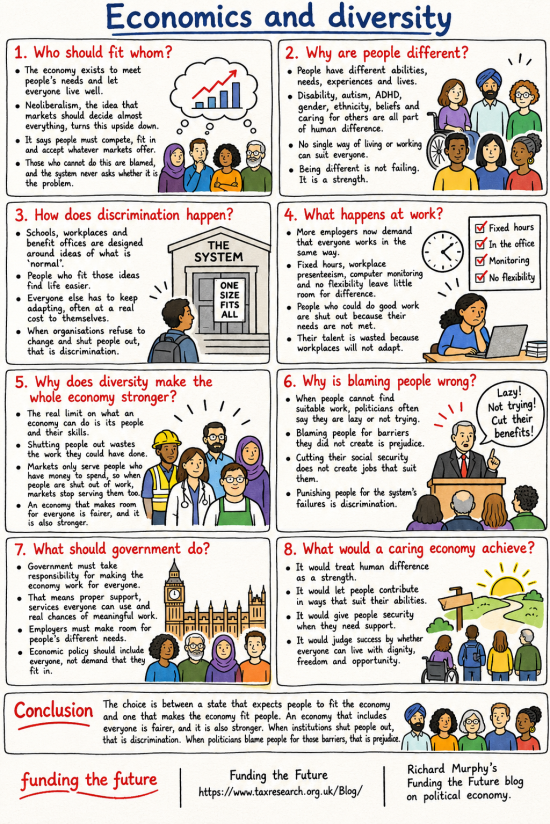
This is the transcript:
Hello, I'm Richard Murphy, and this is Understanding Economics. That's the series of videos I'm making, which explains how I think economics works. And let's be clear: it is how I think the economy works, and I stress that point because there are a lot of economists who will not agree with what I have to say here. That's because I am what is called a heterodox economist. That means I'm outside the mainstream, and as a consequence, I see things differently from most economists. But I think that's a strength and not a weakness because mainstream economics is very clearly not working.
And in this video, I want to talk about a subject which matters a great deal to me, and that is economics and diversity. And by diversity, I mean the fact that quite simply, most people are not the same as each other. You've observed that. You know that's true as a matter of fact, and yet, economics does not accept that this is the case. And I believe we need to rethink economics to not just accept this fact, but to even celebrate it.
So, how does this fit into my thinking? Well, I believe that the economy exists to meet people's needs and let everyone live well. The trouble is, I live in a neoliberal world. And neoliberalism suggests that markets should decide almost everything in our economy, and so it turns my logic upside down. It says that people must compete, fit in and accept whatever markets have to offer. It does not prioritise the well-being of people. It prioritises the well-being of suppliers in marketplaces. And those who cannot comply with the needs of the neoliberal system are blamed by it for their failure to do so. But at no time does neoliberalism ever ask the question whether, it is, in fact, the problem, and my suggestion to you is that it is.
And the simple fact is that people do have different abilities, needs, experiences, and lives. And this is a fact. You know it's true. I do. But neoliberalism doesn't.
There are many reasons for these differences. Disability, autism, and ADHD all contribute. They are a point of much discussion at present. But gender, ethnicity, beliefs and the need to care for others are all part of what makes up human difference. The fact is, very few of us can live our lives precisely in the way that others can. There is no single way of living or working that can suit everyone. And being different is not failing. It is a strength, and that is the point that neoliberalism doesn't understand, and that is what I'm emphasising here.
But despite this, schools, workplaces and benefit offices are designed around the idea of what is normal. People who fit those ideas of normality tend to find life easier. Everyone else has to keep adapting, or, as is said, in the world of autism, “masking”, often at a real cost to themselves so that it might look as though they fit in even though they are different.
And when organisations refuse to recognise these differences, or to change to accommodate them, and as a consequence shut people out, that is discrimination, and I am convinced that the neoliberal economy is built on the basis of that discrimination.
That is seen in our workplaces. For example, more employers now demand that everyone work in the same way. This is a trend of the last 15 to 20 years. Fixed hours, increasing workplace presenteeism, computer monitoring of activity, and no flexibility leave little room for difference. People cannot play to their strengths when deciding how to fulfil their work obligations, and those who could do good work are shut out because their needs are not met as a result. Their talent is wasted because workplaces will not adapt to their needs.
And this has a very real cost. The real limit on what our economy can do is the availability of people and their skills within it. Shutting people out wastes the work they could have done. Markets can only serve people who have money to spend. So when people are shut out of work, that means they don't have money, and markets stop serving them too.
As a consequence, there is a very real cost of this prejudice that is being seen in the workplace. An economy that makes no room for everyone is weaker than one that is available to everyone. And that means an economy that respects diversity is much stronger than one that does not. There is a real economic benefit of adapting to people's needs, in other words, and that is something that neoliberalism refuses to recognise.
And instead it blames people for not complying. When people cannot find suitable work, politicians often say they are lazy or not trying. Blaming people for barriers they did not create is, however, something that is properly called prejudice. Cutting their social security does not create jobs that suit them. Punishing people for the system's failures is discrimination.
And government must take responsibility for addressing these issues. We do have an economy built upon prejudice. We do have one where discrimination is real, and that is unacceptable. The government must make the economy work for everyone. Why? Because unless they do, it will not support everyone's needs, and it will not grow, and that is what they claim they want.
It cannot grow if some people with talent are excluded from the workplace where they can use that talent, or when they have limited opportunity to spend. What this means is the government must provide proper support and services for everyone so that they have a real chance of meaningful work. That means adapting education. That means adapting training, and that means adapting the workplace, and that means understanding.
Employers must make room for people's different needs in that case. And economic policy should embrace everyone and their needs and their diversity and not demand that everyone fit into the stereotype that neoliberalism has dictated to be the norm, even though in a great many cases it is not.
So what would a caring economy achieve instead of this neoliberal one? It would treat human difference as a strength; a strength on the basis of which we could build a better economy, because it would meet more needs. It would therefore be stronger. It would be bigger. It would embrace more people, and they would be able to contribute more. And indeed, that would be one of the goals of a caring economy.
It would allow people to contribute in ways that suit their abilities. And it would give people security when they need support. And let's be honest, a lot of people do during the course of their lives, so there is no shame in this. Having to have training, having to have adaptation is normal. We do it for new parents. We should be doing it for everyone else. And we should judge success by whether everyone can live with dignity, freedom, and opportunity. Those are the goals of an economy.
The choice is between a state that expects people to fit the economy and one that makes the economy fit people. An economy that is fairer is also stronger, and that is key. When institutions shut people out, that is discrimination. And when politicians blame people for those barriers, that is prejudice. And we have no room in economics for either discrimination or prejudice any more than we have room for them in our society. We need an economy that respects diversity, and that is key to our future.
This is what Understanding Economics is all about to me: understanding how we can make the economy work. And if you think this is important, there's a playlist down below which provides access to all the videos that we have made in this series, explaining how the economy works in the way that I see it, so that you can better understand it. That's my goal in making these videos. I want you to understand the world around you so that you can understand it better and play a better part in it, quite possibly as a result.
If you like that, please do like and share this video. Please do subscribe to the channel and look out for more Understanding Economics videos. There will be plenty more to come. We might have made nearly 30 now, but the series could well end up more than double that in length. So thanks for watching this one. Look out for more in the future.
Poll
Thanks for reading this post.
You can share this post on social media of your choice by clicking these icons:
There are links to this blog's glossary in the above post that explain technical terms used in it. Follow them for more explanations.
You can subscribe to this blog's daily email here.
And if you would like to support this blog you can, here:

 Buy me a coffee!


“It is no measure of health to be well adjusted to a profoundly sick society.” Krishnamurti
Agreed
Yes a good blog post. You can see the corrosive effect of conformity in the workplace. Everyone is expected to like working in the office, to some extent enjoy the same social activities and lifestyle. Yet a significant proportion of people at work do not fit the criteria and may feel excluded. Society is diverse and as you have said is more productive and better because of it.
Thank you
Thanks again to all for another thought and question provoking article.
Might a basic purpose and consequence of Neoliberalism be domination/control power?
Might Neoliberal socio-economic power be taken to be/be a most effective way to achieve dominating power, adulation and material advantages?
Might any form of questioning of Neoliberalism, and its advocates and enforcers, be seen as dangerous and an opportunity which could weaken its, and their, parasitic controlling powers?
“Always be alert for forms of education, mass communication and unquestioned convention which do not spread enlightment and questioning, but reduce as many individuals as possible to the same safe, biddable level.” (From H. L. Mencken)
I visited the Rail 200 train and found, mentioned rather in passing this woman
https://en.wikipedia.org/wiki/Abbie_Sweetwine
She and her colleagues introduced the concept of Triage at major incident sites to the UK – the hard way.
I also remember as a teenager hearing Alan Alda talk about the Polio treatment developed by
https://en.wikipedia.org/wiki/Elizabeth_Kenny#Polio_treatment
He made the point that while he had benefitted from it, there had been a lot of opposition to its introduction, because Kenny was a woman and not formally trained. As a result many children who contracted Polio wnded up paralysed unnecessarily.
Oh and of course there is this French campaign
https://www.monks.com/case-studies/Victimes-Citoyens-social-campaign-drive-road-safely
So, what do I conclude, well, being a white middle aged middle class male there is a lot out there to learn from people who are not like me and there are benefits to learning it.
And if the economy as a whole isnt going out and utilising everyones skills then we will ‘underperform’
Thank you and much to agree with
Richard, your piece assumes that we live in a system that needs to, and can be optimised. The argument of diversity and identity politics has confused and fragmented the Left and working people. To get working people to argue about more equity for diversity – esp their own diversity id – distracts from the real fight: the ownership of the economy by the 0.1%. You cannot optimise a rotten system.
Politely, if you are that indifferent to people I do not give a damn about what you say. Your opinion is pure materialist shite and as repugnant as that you think you oppose and you are banned.
I am going to suggest the opposite – Neoliberalism does not discriminate at all! It crushes people of all stripes and rewards psychopathic behaviour wherever it comes from. Non-conforming people have been discriminated against long before Neo-liberalism was thought of.
Now, I am not suggesting that Neo-liberalism is a good thing – rather that we need to look deeper at what makes human beings look to “other” different people.
Typically, it is fear that drives discrimination and insofar as Neoliberalism relies on people’s precarious circumstances to drive them it IS discriminatory – but this is certainly not unique to Neo-liberalism. Indeed, historically any “-ism” is a problem.
Good post – it’s got my back up, here I go…………..
It’s all in Ayn Rand for me – ‘Atlas Shrugged’ – Neo-liberalism is the shutting out of others in order to concern oneself with oneself only, as a path to contentment. It is a profoundly reductive consciousness.
And also so stupid. Diversity is opportunity. That is a fact. Even the City knows this – or did – eggs in one basket and all that . By reducing diversity you end up in a mono-culture, unable to change, but more importantly, unable to renew. And therefore everything Neo-liberalism touches atrophies – dies – because it is effectively a high speed one way street – think about what an inconvenience they are when you are trying to get to someplace. Diversity and long term planning also helps to manage risk.
Instead of diversifying to manage risk, greedy Neo-liberal capitalism diversifies to increase income and that is why we have derivatives (derivatives were sold initially as risk diversification when in fact it is actually just betting). What was the risk management strategy? Insurance. What do we know about insurance? Insurance shares the risk among those insured, so when the shit hits the fan everyone’s costs go up (including the insurer) because a few behave stupidly. So you have an amplification of risk, not a reduction. ‘Insurance’ sounds good but that is all (remember AIG?).
This is why Western democracy is going down the toilet – it only knows how to build wealth through theft, speed and lies. Because only a few people are now allowed to become wealthy, not a diverse many. That is why no one else seems to matter anymore and the people you elect are helping this to happen as I write.
Much to agree with
If neoliberalism is just modern colonialism, and fascism is colonialism turned inward, then it makes sense neoliberalism is based around discrimination.
Neoliberalism is a return to fuedalism. A small number of super rich at the apex of society, untouchable by the law, and in reality, they direct govt policy. Below them are the modern ‘merchant class’, the ‘squeezed middle’ that does their bidding for fear of dropping into the lower tier. Then we have the lower tier. They work every hour god sends, for diminishing returns, and, as govt cynically cuts away their safety net, they have no choice but to do their masters bidding.
The only real difference is that even the minor obligations of the old nobility to protect the poorest off no longer exist. Musk couldn’t care less if every worker he has dropped dead tomorrow.
There’s plenty more serfs where they came from. Or, AI?
Absolutely spot on. Indeed one of your best ever articles.
But why does this happen?
Sadly, after years of watching everything you’ve said pan out, its down to the very thing unions were complaining of in the 60’s and 70’s. As a nation, as businesses, we refuse to move on.
We are still stuck in the 19th C where bosses were tin God’s, and you conformed – or were cast out. Suggestions by the workforce to improve things were, and still are, the mutterings of upstarts. Disabled people were seen as a burden, and their only role in society in terms of work was as circus ‘freaks’.
That attitude still persists today. Business regards the Disabled as a pain the backside, and employs as few as it can get away with. The number of businesses signed up to be ‘disability friendly’ is laughable.
“But you can’t discriminate say the ignorant”. Oh yes you can, say those who work in HR. As any ACAS concilliator will tell you (and they will, its part of their patter), and its correct, winning discrimination cases at tribunal is both rare and hard.
Yet Disabled people in work are constantly bringing up the fact that their employers ignore the law with the charities that support them.
Politicians, as you would expect these days are not even slightly interested in helping, as playing on the same centuries old prejudices pays electoral dividends. Yes, persecuting Disabled people wins votes.
More than slightly sickening that isn’t it?
Much to agree with and thank you