
What if accounting put workers before shareholders? And what if business success was measured by how well companies rewarded their workers rather than how much profit they made?
Conventional accounting treats wages as a cost. The more a business pays its employees, the less profit it reports, assuming everything else stays the same. And that is framed as a business problem.
But why should that be considered a failure?
In this video, I challenge one of the most fundamental assumptions in modern accounting: that business success should be measured by the return available to capital rather than the benefits generated for the people who actually do the work.
Workers invest their time, skills, experience and livelihoods in businesses. Shareholders invest money. Yet our accounting systems give priority to the returns earned by shareholders.
I argue that this is a political choice, not an economic necessity.
Using a simple example, I explain how exactly the same business could be assessed differently if we measured sustainable returns to labour instead of profits attributable to capital.
Higher wages, better pensions, improved working conditions and greater employment security could then become measures of success rather than costs to be minimised.
Businesses would still need to maintain their productive assets, protect the environment and provide reasonable returns to investors.
But accounting could fundamentally change what we consider to be business success.
Perhaps it is time we started accounting as if workers really matter.
This is the audio version:
This is the transcript:
There is something so obvious in accounting that almost nobody thinks to question it. Every accountant everywhere assumes that labour is a cost. Wages and salaries are deducted when calculating business profits. The more a business pays its workers, the less profit it reports, assuming nothing else changes, and it is said that this is a sign of failure.
But why should higher wages be treated as a reduction in business success? What if we've been looking at accounting from the wrong perspective? That's the question I'm asking in this video.
To understand the problem, we need to consider how businesses currently calculate their profits. They start with income earned from selling goods and services. They deduct the cost of materials, like energy, rent, and other purchases, and they also deduct wages, salaries, and the depreciation of their assets, plus the interest that they have to pay on loans. What's left over after the deduction of all those costs from the income that the business has generated is profit, and that profit is generally treated as the measure of the business's financial success.
And let's be clear: before going any further, we need to understand who controls this profit. The reality is that the profit belongs to the company, which is a separate legal entity, quite distinct from its shareholders. Shareholders might own the shares in that company, but they do not own the company itself, nor do they own its profit. Their shares provide limited voting rights on the future of the company and potential rights to income. But it is the directors who control decisions about distributing profit subject to company law.
It is then the company itself which controls this profit. It is the company which has to decide what to do with it. And whilst it's generally thought that the directors are expected to promote the company's success for the benefit of shareholders, UK company law is a lot broader than that and other interpretations are possible.
So that raises a question we rarely ask. Why are shareholders given the priority? The conventional answer is that they provide capital to the company and take risks as a result. They can lose the money they invest if the company fails. But shareholders in listed companies can usually sell their shares whenever they wish. Their attachment to the company is very limited, and there are very few large companies that ever go bust.
The risks of share owning are, in reality, very low, and companies can change their entire shareholder base without changing their operations. We know that can happen. Takeovers and mergers happen day in, day out. The shareholders are not as important as the business itself is the message from all of those takeover operations. The shareholders can be got rid of. The operations of the company cannot. So why are shareholders really the people taking the greatest risks? Why has that myth been promoted when it appears that isn't true?
I, in fact, think and have done for many decades that workers take a much greater risk than shareholders when it comes to working for a company. They commit years of their working lives to an employer in many cases. Their incomes, pension prospects, and financial security depend upon that relationship.
They also invest skills, experience and relationships that cannot easily be transferred elsewhere. Losing a job can disrupt an entire life, not just an investment portfolio. And workers usually only have one job. Shareholders have many shareholdings. As a result, the risk to workers is much more concentrated than it ever is to most shareholders. And businesses cannot function without the people who actually do the work. They can survive without the shareholders they currently have.
Let's go back to that question of how accounting measures business success. Conventional accounting deducts wages before calculating the return to capital, that is, the return to shareholders. The remaining profit after costs have been deducted is treated as the surplus available to reward the shareholders, but workers may have committed much more to the enterprise for reasons I've just explained than its shareholders. And there is no economic law requiring that residual returns in a company be allocated to capital. That is a simple, straightforward statement of fact, and if it wasn't true, no business could ever pay a bonus to its employees. They can, they do, and so what I've just said is true.
There is then a choice to be made about whose interests a business exists to serve. So what if we put labour first instead? That's my question. Suppose we decided that businesses should maximise their sustainable returns to labour, that is, the people who work for them. That would not mean ignoring the needs of financial capital. Businesses would still have to maintain their productive assets. They would still need to use capital to do that. And investors would still need to receive an appropriate return for providing finance at a reasonable interest rate to reflect the risk that they take, in other words. And environmental resources and workers' capabilities would also need maintaining.
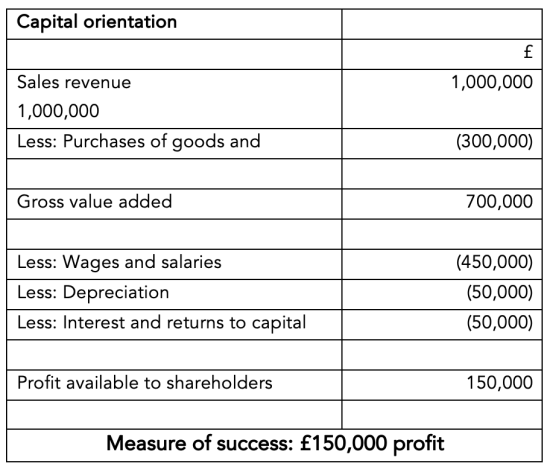
But once those requirements had all been met, suppose the remaining surplus belonged to labour. Let me illustrate this idea with a simple example of a business generating £1 million in sales. It spends £300,000 buying goods and services from other businesses. It pays £450,000 in wages and salaries to its employees. And then it spends £50,000 on depreciation, which is the fund that it puts aside to replace its investment in assets. And it spends another £50,000 paying interest to those who provided it with loan finance and share capital. That leaves £150,000 as the remaining surplus or profit available to the business.
Now, conventional accounting would treat that £150,000 as profit attributable to capital. But suppose we look at exactly the same business from the perspective of labour.
After all the external purchases and the necessary payments to capital, £600,000 would remain available to workers. That's £450,000 that has already been paid to them as wages and salaries. And another £150,000 could be available for additional benefits to employees.
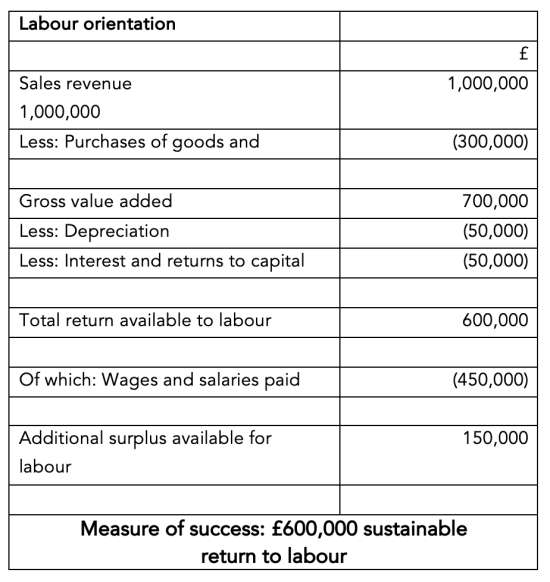
That might mean higher wages, better pensions, better training, or shorter working hours. But it could also mean something else. It could also mean that the business decided to invest for the long-term security of its employees, putting the money back into the business to provide people with the security they need from the employment to which they have, in turn, committed.
But let's be clear: nothing about the underlying economic activity has changed as a result of this accounting difference. What we have done is change what counts as success. The significance of this alternative becomes obvious when we consider higher wages. Suppose the business decided to increase its wage payments by paying a bonus of £100,000. Conventional accounting would report that profits have fallen by £100,000, and that might be interpreted as evidence of a deteriorating business performance. But from the perspective of labour, people who work for the company would be £100,000 in total better off. So why should that be considered a failure rather than a success?
Now, I stress there is an important qualification to this argument, and that is capital maintenance. No business can distribute resources needed to maintain its future productive capacity. I've dealt with this issue in other videos, and I think it's incredibly important and little understood. But buildings, machinery and other physical assets must be maintained or replaced by any business if it is to be a going concern in the long term. And worker skills, health and capabilities also require investment to ensure that people are available to work in a company in the same long term. And at the same time, the environment must be protected if the business is to remain sustainable, and so, work in the era of net zero, which has to come our way.
But after making provisions for all these costs, and I'm saying the business should properly allow for them, we still have to decide who receives the residual, what we call the profit. And that decision is essentially political. And what I'm saying is that accounting is much more political than accountants admit because it endorses the decision that capital should get this return. I'm arguing we have a choice.
We can decide, in accounting, what we measure as business success. If higher wages reduce reported success, businesses have an incentive to restrain them. If higher returns to labour indicate success, the incentive could be reversed. And the actual value of the business for all who work in it, the community it serves, and maybe even for its customers who get a better service from people who are better satisfied in their jobs, might well be enhanced. The transactions and the double-entry bookkeeping would all remain exactly the same. What changes is the purpose for which the business is run and for whom the accounts are prepared.
Now, of course, changing accounting alone would not give workers a legal claim to this surplus. That would also require changes to the ways companies are governed, and it might require a change to company law. But directors would, if this change were made, need to prioritise sustainable returns to labour rather than shareholder returns. And financial capital would still receive a reward, but it wouldn't receive an excessive one, which is what has become the basis of modern financial capitalism.
We would then see a fundamental change in our understanding of business, and that to me is important because I'm interested in business, I'm interested in people, and I'm interested in sustainability, and I believe this change is key because it creates alternatives which are really important in economic terms.
We know, for example, that financial capital can be easily and readily maintained because banks can create money whenever they wish. But we do at the same time know that human time, skills, and capabilities are much more limited. I do therefore believe that companies should be focusing more upon people than worrying about their shareholders, because they are more dependent upon people than they ever are on their providers of capital.
So in that case, why do we organise accounting as if financial capital matters most? I think we need to reconsider what accounting is actually intended to achieve. Its purpose should not simply be to measure the return available to capital. It should help us to understand how economic activity benefits real people. It should recognise the need to maintain all the resources on which future prosperity depends, and it should measure success by the sustainable return generated for labour.
Maybe it's time we started accounting as if work and the people who do it really matter. That is what a politics of care would do. That is what I would do. But of course you may disagree.
There is a poll down below. Let us have your comments. This is a radical proposal, but one that is entirely deliverable without much difficulty in any way in the accounting environment of the UK and around the world.
So what do you think? If you like this idea, please do like this video and please do share it. And if you'd like to support our work, please do that. There's a link, I think, up there to our Ko-fi donation page, and another one is available down below. Thank you very much.
Poll
Thanks for reading this post.
You can share this post on social media of your choice by clicking these icons:
There are links to this blog's glossary in the above post that explain technical terms used in it. Follow them for more explanations.
You can subscribe to this blog's daily email here.
And if you would like to support this blog you can, here:

 Buy me a coffee!

