
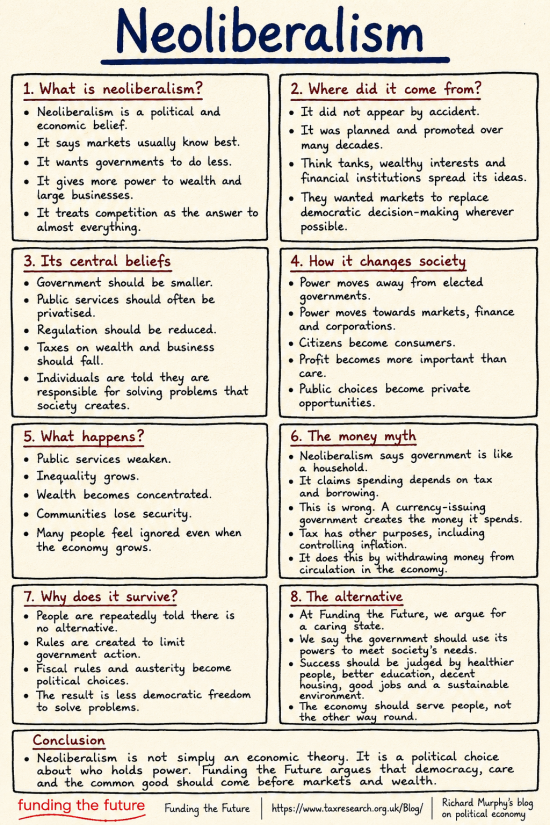
One of my first infographics was on neoliberalism. We produced it in an early stage of our experimentation on this project:
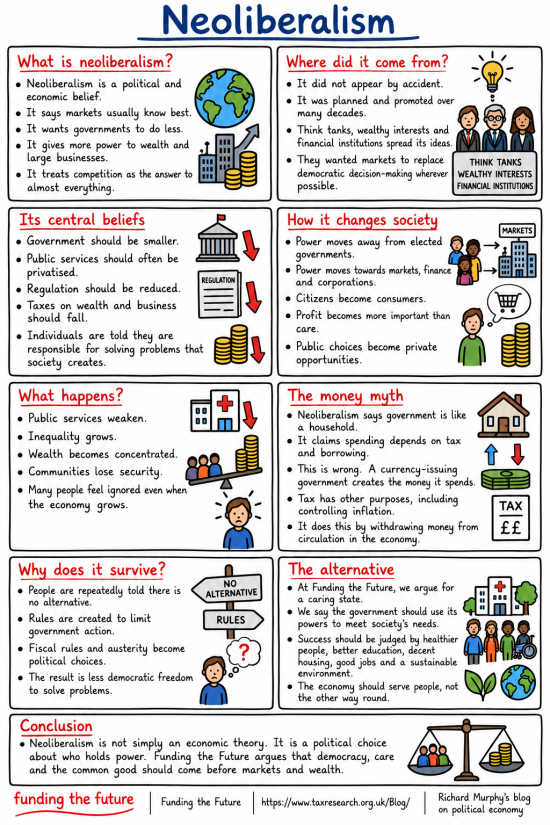
Given the importance of this topic, it has now been updated to our current style.
How to expand this image
Press CTRL or Command and the Plus (+) key on your keyboard to zoom in. Press CTRL or Command and the 0 (zero) key together to restore the screen to normal.
How to download this image
If you right-click the image, you should be given the option to download it to your computer. So long as you do so without the intent to make a profit, you may do so without further permission. Commercial use requires consent. But if you just want to share it, do so with whoever and wherever you want. That is the purpose of these infographics.
The image library
There is a library of these images. It is available here. All downloads are free, but donations help our work.
AI use
I wrote this infographic. I used AI to create the final image.
Thanks for reading this post.
You can share this post on social media of your choice by clicking these icons:
There are links to this blog's glossary in the above post that explain technical terms used in it. Follow them for more explanations.
You can subscribe to this blog's daily email here.
And if you would like to support this blog you can, here:

 Buy me a coffee!

The most difficult task faced by neoliberals in the 70s was to pervert the understanding of macroeconomics as it was at that time. As I recall, and most text-books of that time will confirm, the subject was focused on the best use of scarce resources. The conventional wisdom(Keynesianism) was that of demand management and the central role of (unpredictable) govs. Money and taxation were important considerations, but not central, because if resources were not available, they couldn’t be conjured up. An over simplification, no doubt, but it all made sense.
Today, the subject is all about the dependence of gov on taxation to fund current expenditure, a change brought about over time by neoliberally -friendly wealth and bankers to give them licence to extract even more wealth; resources don’t get a mention, except on this blog. Anyone under 60 will have been taught neoliberal economics and may have little understanding of what came before. Modern Monetary Theory (MMT) was new to me until recently because it has been deliberately surpressed. I knew Monetarism was a ploy when I first came across it and I’ve been disappointed how readily it has been accepted over the years, given where it has lead economies around the world, We’ll never know the counter-factual story of where and how Keynesianism would have led us, but we we can guess.
Neoliberalism is a childishly simple idea in some ways. I like to borrow from Orwell and summarise it as: “four legs bad, two legs good”. More detail helps of course, but that appears to be its essence i.e. reduce the scope of government wherever it doesn’t support the further accumulation of wealth and assume there is almost nothing government can do that “markets” cannot do better.
This should be a ‘Wanted’ poster in countries all around the world!