
Why should money earn interest simply because somebody owns it? We usually treat interest as a natural and inevitable part of the economy, but in this Understanding Economics video, I question whether that assumption is justified.
Commercial banks do not need to collect deposits before making loans. When a bank lends, it creates new money through its accounting records. The process of creating that money itself costs very little, so why are interest rates often so high, even after allowing for the fact that lending does involve administration and the risk that borrowers will not repay?
That question is especially appropriate when much lending is now virtually risk-free. Interest should not be confused with an investment return. Investment involves taking a genuine risk in the hope of making a profit. Interest, by contrast, is a payment for allowing somebody else to use money for a period of time.
I argue that we should separate the different costs currently bundled together as interest. Borrowers could instead see a basic charge for using money, an administrative charge and a separate premium reflecting the genuine credit risk involved.
This matters because interest rates have significant economic consequences. Higher rates redistribute income towards people who own financial wealth while increasing mortgages, rents and borrowing costs. They can also discourage productive investment and spending on priorities such as the green transition.
I am not arguing that interest should be abolished. I am arguing that the basic interest rate on low-risk money should be close to zero in real terms, while genuine costs and risks should be identified and charged transparently.
Understanding what we are actually paying for would make borrowing clearer, improve competition and help us understand who gains and who loses from the interest rates that shape our economy.
This is the audio version:
This infographic supports this video:
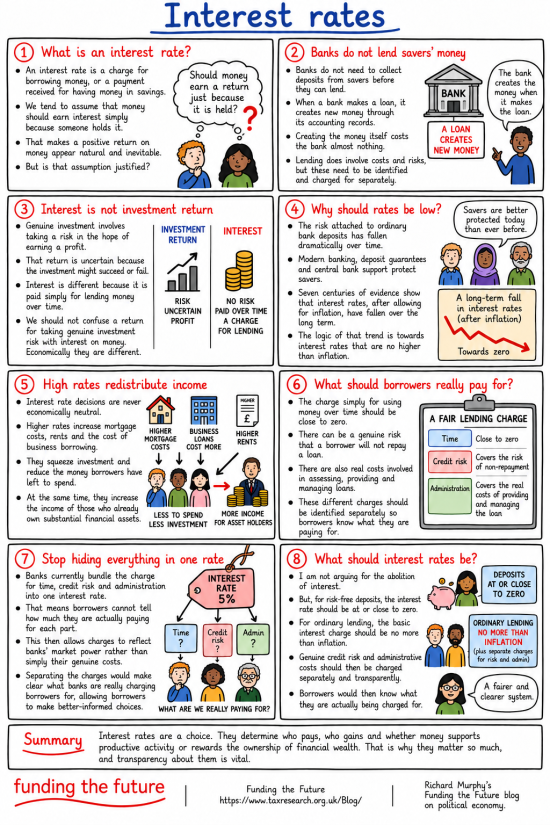
This is the transcript:
Hello, I'm Richard Murphy, and this is Understanding Economics, the series of videos that I'm making which explains economics in the way that I see it. I stress in the way that I see it. Because I do not see economics in the way that most economists do. I am a heterodox economist. In other words, I stand outside the mainstream, but I do so deliberately because mainstream economics very clearly does not work. It's failing us. And so I try to explain economics in a way that makes sense with regard to the world as it really is and in the way that you are likely to see it. That's why I think this series matters, and that's why I hope you will watch it.
So, what is this video about? It is about interest. Now, an interest rate is a charge for borrowing money or a payment received for having money in savings.
We tend to assume that money should earn interest simply because someone holds it. They make a positive return on money, and that appears natural and inevitable. But my question is: is that assumption justified?
As a matter of fact, banks and the government do not need to collect deposits from savers before they can lend. When a bank makes a loan, it creates new money through its accounting records. Creating the money itself costs the bank almost nothing. It just has to type two numbers into a keyboard. It increases the value of a person's loan account, and it increases the value of a person's current account. And that is how money is created. You can see that the cost involved is very small indeed.
Now, I'm not saying there is no cost, because of course there might be a loan agreement to prepare, or some other documentation, and I do accept that there are risks from lending money because the borrower might not repay. But those costs and risks could be separately identified and charged for quite distinctly and separately from the interest on the loan itself.
And let me make clear something else that is important, that has to be said about interest, and that is: it is not an investment return.
Genuine investment involves taking a risk in the hope of earning a profit. The return is uncertain because the investment might succeed or fail. Interest is not like that. Interest arises simply because somebody has left money with somebody else for a period of time and they expect to be paid by that other person for the use of that money. We should not confuse a return for taking genuine investment risk with interest on money that arises purely as a consequence of the passing of time. Economically, they are entirely different.
And why should rates now be so low as I'm suggesting they should be?
Well, the risk attached to bank deposit accounts has fallen dramatically over time. They are now almost negligible. If you have less than £120,000 in a bank account in the UK, and different sums apply in different countries, the government guarantees to repay your deposit. Whatever happens to your bank, there is no risk associated with your loan.
And you have made a loan, let me be clear. You have lent money to your bank, but you will get it back. The government guarantees it.
And as a matter of fact, this is a condition that applies across much of modern banking. Better credit risk data, better deposit guarantees, and better central bank support protects savers throughout our monetary system.
And as a result, we are seeing a very marked trend develop. Seven centuries of evidence have shown that real interest rates, after allowing for inflation, that is, have fallen over the long term, and partly for these reasons. In fact, the logic of that trend is now so strong that real interest rates, as I say, after allowing for inflation, should now be around zero. There is no risk to depositing money, so you do not need to be compensated for the possibility that there is. And that is also true of money, of course, deposited with the government because they can always repay their loans.
So the fact is that we have an odd situation where interest is paid, but it is not necessary. And this is not politically neutral because high interest rates redistribute income within our society. Higher rates increase mortgage costs; they increase rents, and they increase the cost of business borrowing. Those tend to impose most heavily on those with no money. Whilst those who do have money gain as a consequence.
And the economy as a whole suffers if we have high interest rates because the rate of investment within it is reduced, and as a result, we do not get the investment we need. We do not get the growth that some politicians desire. We do not get the spending on the green transition that I want. And all of those are costs to our society. High interest does therefore come with significant penalties attached.
So what should borrowers really pay for? The charge for simply using money over time should, in my opinion, be close to zero after allowing for inflation. So if the inflation rate is at present 3%, that should be, broadly speaking, what the interest rate in our economy should be, and nobody should be paying much more.
But that is not the only charge that you should expect to pay. I do know that there are costs of administration. That cost can be spread over the life of the loan. The charge should be separately identified.
And there are also risks that the borrower will default. Let's not pretend otherwise. People do not pay their credit cards. People do not pay their car loans, and some people default on their mortgages, and the bank has to reclaim them. That is why there is a mortgage. The mortgage is what is called a charge on a property so that if you don't pay your mortgage loan, the bank can reclaim your house. That's how they mitigate their risk.
But there is a risk nonetheless, and a cost involved, and that does require a payment because this is a form of insurance, which is collectively borne by all those who borrow money against the risk that some people will not pay. Of course you have a personal credit score, and that might push up or down the risk premium that you pay, but my point is this should not be called interest. It should be separately identified. You should know what you're paying for.
And banks who do at present, and most of them do this, bundle the whole charge for the time interest on money and credit risk and administration into just one interest rate, which is basically misleading you as to what the cost is. They are using their commercial power as suppliers of credit to increase the costs that they charge you for the risks that you might not impose upon them. That is unjustified in my opinion. We should separate the charges out because then you will be able to decide who is charging you fairly and who isn't. We will get better informed choices throughout the financial system.
But let me be clear, I am not arguing for the abolition of interest. But for risk-free deposits, the interest rate should be at or close to zero, having allowed for inflation. For ordinary lending, the basic interest charge should never be much more than inflation, but genuine credit risk and administrative costs should then be charged separately and transparently, and people should know what they're paying for. Borrowers have to be in a position of understanding the product they're buying, and at present they're told they're paying interest when that is not true.
Interest rates are then a matter of choice. They determine who pays, who gains, and whether money supports productive activity in our economy or rewards the ownership of financial wealth instead. That is why they matter so much. And transparency about them is vital because unless we understand these enormous financial flows, we cannot manage our economy properly, and that is what I want to achieve.
This is what the whole of Understanding Economics is all about. We want to understand our economies better so we make better decisions. To help you, there is a playlist down below, which includes all the videos in this series, and there are now quite a number of them. Start, I suggest, with video one because that's the logical thing to do and work your way through them. You will understand economics better as a consequence, and there are more to come in this series. I would not be surprised if it reaches one hundred in total. Economics is a big subject. We've got a long way to go. I hope you join us on the journey. Understanding economics matters.
Poll
Thanks for reading this post.
You can share this post on social media of your choice by clicking these icons:
There are links to this blog's glossary in the above post that explain technical terms used in it. Follow them for more explanations.
You can subscribe to this blog's daily email here.
And if you would like to support this blog you can, here:

 Buy me a coffee!

While its not without issues clearly either the bank or the borrowers could take out an insurance policy to cover non payment.
If this was available on the open market that might reduce costs
In effect, they already do that. They just ask borrowers to pay the excessive premiums.
Thanks for this “root” article.
Might taxation and the G.D.P. be made more effective if productive/pro-social activites and making money from money were differentiated?
Might there be better explanations altogether?
Many cultures and religions have rejected usury – not just charging excessive interest, but charging any interest at all – as unjust and immoral. Perhaps they had a point.
They did.
Thanks again for another thought-provoking video. It seems that what you are suggesting may not be a million miles from Islamic loans where, as I understand it, Sharia law forbids the payment of interest?
You are right. My thinking is actually in the true Abrahamic tradition.
It seems that people with money to deposit often feel they are owed above inflation interest. Entitled or what?
No one forces people to save money. If they don’t like the return offered then they are free not to save, but to spend the money instead. It is a choice. So zero interest (or even negative interest, a charge for safekeeping, as has happened) is entirely reasonable. Positive interest is not a law of nature or a right.
Zero interest would be better for central bank reserves. Why should a bank be subsidised for reserves that it didn’t create? If a bank doesn’t want zero return on its reserves then it should shed those reserves. 😉 Yes, I know that on aggregate commercial banks can’t do that. But that’s the point.
I would argue that it would be better if interest rates were zero. Yes, people would lose in real terms due to inflation. But that’s a good thing because it erodes inequality. Furthermore zero interest would encourage people to spend not hoard. That would increase the velocity of money and boost the economy (lower unemployment etc).
Noted
Why should a lawnmower earn interest simply because somebody owns it? Why should the owner of a lawnmower receive any compensation for the loss of ability to use it due to somebody else using it?
Richard, your argument rests on a category error. That banks create money by keystroke tells us nothing about its price. The marginal cost of lending is the return forgone on central bank reserves, which is Bank Rate. Costless creation is not costless funding, as your own preferred accounting should have told you.
You then treat the FSCS guarantee as eliminating risk, yet it protects nominal pounds, not purchasing power. Savers holding “risk-free” deposits between 2021 and 2023 lost more than a tenth of their real wealth. Unanticipated inflation is precisely the risk your zero-real-rate rule ignores.
Your appeal to seven centuries of falling real rates backfires. That decline predates deposit insurance, credit scoring and modern central banking by hundreds of years, so it cannot be explained by them.
Most seriously, you never mention that the policy rate exists to control inflation. A permanent zero real rate is not reform. It is the abandonment of monetary policy, justified by defining interest narrowly enough to declare it illegitimate.
Finally, the transparency you demand largely exists already: trackers are Bank Rate plus a disclosed margin, and commercial loans are priced openly over SONIA.
Economics outside the mainstream can be valuable. Economics outside the evidence is merely assertion.
The category error is yours. Banks do not lend reserves to customers, and the existence of Bank Rate does not make reserves the marginal “funding” for each new loan. Banks create the deposit when they lend. Their lending decisions are constrained by capital, liquidity, regulation, credit risk and profitability, not by first obtaining the money they lend.
Nor have I ever suggested that the FSCS protects purchasing power. It protects deposits against bank failure. Inflation risk is an entirely different issue. Conflating the two does not advance your argument.
And, of course, I know that central banks claim interest rates control inflation. I disagree that they are an effective or socially desirable principal mechanism for doing so. High rates cannot create energy, food, housing or other resources in short supply. They work primarily by suppressing demand, increasing costs and weakening labour’s bargaining position.
As for transparency, quoting Bank Rate plus a margin tells us the price. It does not tell us why that margin is justified.
You finish by accusing me of ignoring evidence. But repeatedly substituting one category of risk or cost for another is not evidence. It is precisely the conceptual confusion I am challenging.