
What is microeconomics really about?
Conventional economics usually puts markets at the centre of the answer. It assumes that individuals make rational choices and that markets, operating through prices, allocate resources efficiently. But that account leaves out much of what actually shapes economic life.
None of us makes economic decisions in isolation. Families, communities, businesses and governments all influence the choices available to us. Governments also create the laws and institutions that make markets possible in the first place. Property rights, contracts and money do not simply appear naturally. Markets are social institutions created within society.
Power matters too. Wealth changes the choices people can make, while large companies can exercise considerable market power. And many things that are economically important, including unpaid care and voluntary work, never appear in market transactions at all.
Markets can also fail to account for environmental damage and other costs imposed on society. That is why prices and values are not the same thing.
In this episode of Understanding Economics, I explain why microeconomics needs to look beyond markets. It should ask how society allocates resources, who has power, who bears the costs, who receives the benefits, and how we can organise the economy so that everyone has the opportunity to live well and thrive.
This is the audio version:
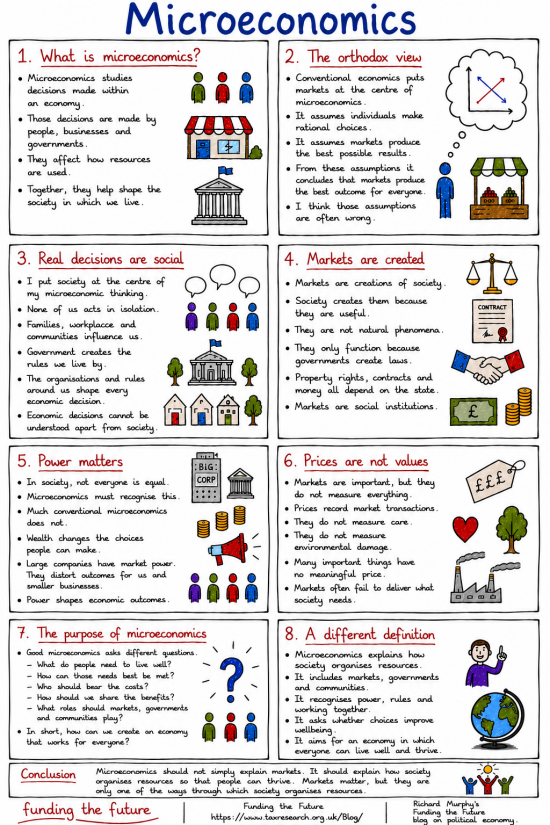
There is no Debate Ammunition for this video, but there is this infographic:
This is the transcript:
Hello, I'm Richard Murphy, and this is Understanding Economics. So far, I've discussed what economics is and what the economy is for, and now I've got to deal with two vital terms that most people will have heard and which we need to address up front when we begin to talk about economics. The first is microeconomics, and the second is macroeconomics. They're both important. That's why they're so early in this series.
Microeconomics studies decisions made within an economy. That is an incredibly important point. Those decisions are made by people, businesses, and also by governments, and they affect how resources are used by all of us. Together they help shape the society in which we all live.
Conventional economics puts markets at the centre of this issue of microeconomics. It assumes that individuals make rational choices all the time on everything, and as a result, it assumes that markets produce the best possible outcomes for society and for everyone. I think those assumptions are wrong because I have never met a rational person of that sort, and if they don't exist, then the system of economics that conventional economics claims exists does not. It's as simple and straightforward as that.
So I put something else at the centre of my microeconomic thinking. I put society in the middle of my thinking. None of us acts in isolation. We work with families. We work quite literally in the workplace, and in our communities, and governments create the rules by which we live. We know that, and we know that governments also create the rules by which markets operate, and communities work.
These organisations and institutions shape every economic decision, and economic decisions cannot be understood apart from society. The two are intimately related. That is why microeconomics is about how society works to allocate resources.
And let me stress then that markets are the creation of society. Society creates markets because they are useful, and I am not going to dispute that at any time in anything I say. But, and I stress this point, markets are not natural phenomena. They are created by the rules that governments create on behalf of society. Property rights, contracts, and money are all necessary to make markets work, and they are all created by the state.
So markets are social institutions. They are not the thing that creates society. Nor are they the foundations of government or anything else. They are a tool. They are not our masters.
And conventional microeconomics misses out on another essential point. And that is that in society, not everyone is equal. In my microeconomics, this is recognised. And I think that is essential because wealth changes the choices that people can make, and it is wealth that creates inequality in our societies.
Large companies have market power, as do individuals with wealth. They distort outcomes for all the rest of us and smaller businesses. Power shapes economic outcomes as a result, and we can see that in our lived experience. So markets are important, but they are not the measure of everything, and in particular, they do not record fair values when it comes to prices.
Prices record market transactions, but they do not measure large quantities of transactions that take place outside the market, and these are very significant.
For example, the care we provide in households, volunteering and all the other activities that we take part in for other people by choice, but without ever being paid: all of these have economic consequences. We have to include them in our microeconomic thinking, and that is vital if it's going to work, but markets have nothing to do with any of this.
So a system of microeconomics that ignores our voluntary behaviour is an incomplete system of microeconomics. I don't want to take the risk of that.
And at the same time, I have to stress something else. Markets also ignore some issues that are detrimental to our well-being. They can price things without taking harm into consideration. Just think about environmental damage. The price of that is not included in the price of the products that you buy, and that's because we don't choose to buy it, and companies aren't required to compensate for the fact that they create it. And so markets can fail to deliver what societies need. And that is important to recognise as well. Prices are not the same as values, and values are what matters.
So what is the purpose of microeconomics then? A good system of microeconomics asks difficult questions, including:
- What do people need to live well?
- How can those needs best be met?
- Who should bear the costs?
- How should we share the benefits?
- What roles should markets, governments, communities, and individuals play in this process? And,
- What rules should everybody play by?
In short, how can we create an economy that works for the benefit of everyone to ensure that everyone has all they need to survive and live well?
We need then a different definition of what microeconomics is. It is not something that is focused upon markets. It is a much bigger subject than that. It includes markets and governments, and communities and people, and it recognises power, rules and working together, and it does so to decide what choices need to be made to improve well-being. Its aim is to suggest how we can have an economy in which everyone can live well and thrive.
Microeconomics should not simply explain markets. Markets matter, but they are only one of the ways through which society organises resources. Others exist, and they are important as well. Microeconomics is vital to our understanding of the world around us. We will be talking about it.
Poll
Thanks for reading this post.
You can share this post on social media of your choice by clicking these icons:
There are links to this blog's glossary in the above post that explain technical terms used in it. Follow them for more explanations.
You can subscribe to this blog's daily email here.
And if you would like to support this blog you can, here:

 Buy me a coffee!

SUVs are an example of the influence of community and advertising. People over + 2 decades were groomed to want an SUV. From the muf PoV SUVs are wonderful cos they are more profitable than e.g. a saloon car or estate. However for the punter they use more fuel, are more expensive to insure and less stable. Thus I would add to microeconomics the role of advertising/grooming of the populace, persuading them to buy stuff that is not in their interests. All advertising is lying and irrational and thus negates the central tenet of microeconomics – the rational person. Just imagine if ALL advertising was banned.
I note in yesterday’s Guardian that Economics is now the 5th most popular A-Level. In view of what I know about how A-Level Economics is taught and the content of the syllabus, this troubles me a bit. Hopefully I’m being to doomist and those up and coming will look out of the window and question why we are where are
The syllabus is pretty dire. I hope my infographics reach those studying it.
I think you often miss some important points re earnings and wealth.
1) Not all people who are asset rich have high incomes and not all people with high incomes are asset rich;
2) Inequality exists as some people have very high incomes;
3) Some people build up assets due to high incomes.
So we need higher taxes on high earnings if we want to reduce inequality.
“And I think that is essential because wealth changes the choices that people can make, and it is wealth that creates inequality in our societies.”
Those are the subjects of separate videos to come. There may be 80 in this series eventually.