
I was asked yesterday what neoliberalism is. This is the answer:
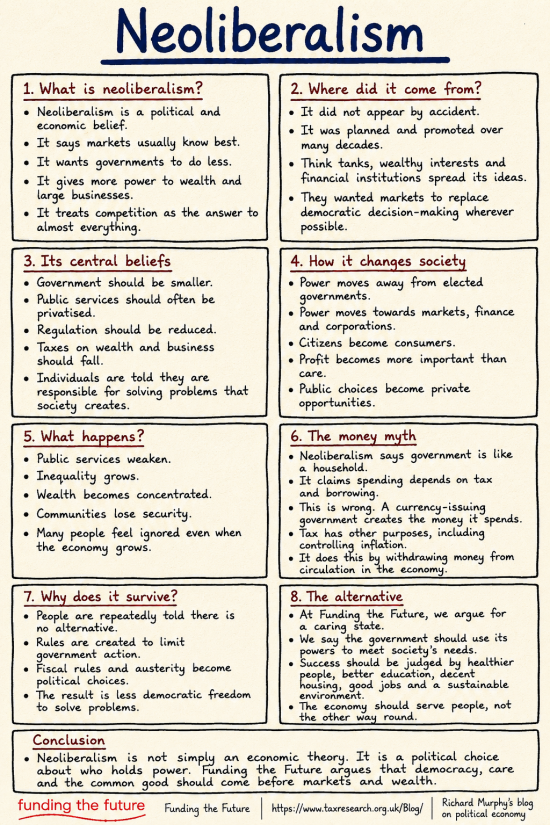
NB: This image has been updated to include big numbers.
How to expand this image
If you press CTRL or Command and Plus (+) on your keyboard, your browser should increase the size of your page every time you do this. Press CTRL or Command and the Minus (-) key together to restore the screen to normal. I can get to at least 2 times the normal size by doing this.
How to download this image.
If you right-click the image, you should be given the option to download it to your computer. So long as you do so without a view to making a profit, you may do so without further permission. Commercial use requires consent. But if you just want to share it, do so with whoever and wherever you want. That is the purpose of these infographics.
The image library
We are planning a library of these images. It will be available soon.
Thanks for reading this post.
You can share this post on social media of your choice by clicking these icons:
There are links to this blog's glossary in the above post that explain technical terms used in it. Follow them for more explanations.
You can subscribe to this blog's daily email here.
And if you would like to support this blog you can, here:

 Buy me a coffee!

One of the very best ideas you have had (infographic). Wonderful for sending to others.
Thanks
More are on their way…
[…] Cross-posted from Richard’s Blog “Funding the Future” […]
That’s my favourite infographic to date; thanks. Fantastic neoliberalism summary. How does it survive? Lobbying, donations, influence (media, government), greed, education, corruption, nepotism … and the list goes on.
Apologies I haven’t commented in a long time. I’m still here happily reading / viewing / listening to as much of your content as I can.
If you’re not happy with my “name” I can change it … however you already have lots of Andrew’s commenting!
I get what you name means, not problem.
And thank you. That one was written 7 times….
Thanks for a most lucid presentation!
Might Neoliberalism be an example of “Bait and Swich”, facilitated by a cartel of most politacal parties and the main stream media and enabled by a mass education set up which avoids reasonably objective socio-economic teaching?
Might the regular public be better informed if it were presented with separated information on production, consumption and financial transactions instead or as well as the G D P?
Fantastic infographics!
It seems to me, reading the neoliberalism infographic that the general public have already grasped, at a gut level, most of the issues about who wields power, about who benefits, about the failures of privatisation (in energy, water and “public” transport), and the preciousness of a publicly owned and controlled, accountable, non-profit NHS. And they are angry about it.
But…
the gap in public understanding is a political one – seeing a connection between the deliberate political choices of government and the lived experience of the people. They either accept the lying excuses of government or believe the lying promises and divisive rhetoric of the main opposition. The “household analogy” has not yet been politically destroyed. Scapegoats are identified and false remedies (austerity) implemented.
FTF has achieved much and has more to do. But until lying, timid, or corrupt, controlled politicians BREAK with the key tenets of neoliberalism, throw off the chains of their controllers, and repent of their self-serving cowardice, nothing will change. So todays “politics of care” substack post “Will Burnham really reject neoliberalism?” has thrown the gauntlet down in exactly the right place, the political transit camp known as 10/11 Downing Street. Years ago, an Anfield crowd humiliated Sports Minister Burnham into repentance over Hillsborough. Now it’s time for REAL repentance over neoliberalism.
It’s up to Burnham whether picks up the gauntlet, and turns rhetoric into reality. He CAN do it. WILL he?
Thanks. Will he? I think we know he won’t but I have to live in hope.
Again, I like this format.
I had to laugh though at the assertion that Neo-liberalism favours competition.
It’s complete rubbish – just like ‘trickle down’ is.
All I’ve ever seen Neo-liberalism do is favour monopoly ownership – they use competition as a transitional disguise, then sell the benefits of economies of scale and acquire competitors. The only monopoly power Neo-libs hate is State monopoly power – purely ideological BTW because they want it all and they want it now.
I have to allow for the theory….
I too raised an eyebrow at the notion (final bullet point in the top left section) of neoliberalism favouring competition. This in the age of monopoly capital! But as you say, we have to allow for the theory. Neoliberalism pays lip service to competition much as the US empire pays lip service to freedom.
More generally, I too find these infographics superb.
Thanks
Fantastic and all on one page
This format is easy and quick to share and read. 🙂
A small suggestion in box 1 add ‘’elected before government as you did in box 4 – its a great point as shows neoliberalism attack on the people’s voice.
And a push back on neoliberalism’s anti democratic demonisation of government eg ‘big government’ .
Thanks
Richard, this series of 1pg outlines is excellent. The ‘handwriiten’ font renders them more accessible, likely to be read. And I see them as great for stimulating discussion in communities.
ONE point there is I really would have liked to have seen mentioned on this note. Something to the effect that (perhaps in the ‘What happens’ box):
‘Discourse on delivery of PUBLIC GOOD is eradicated’
Under Neoliberalism, the public service management now completely fails to motivate staff with the idea of their delivery of public good; or at least that’s my experience of the last 25v years. Yet, it is such an important concept to reclaim in political discourse.
So should I do one on ‘Public good’ ?
Brilliant idea because that’s our goal, would be uplifting and neoliberalism has 40 years track record of failure.
That’s the hard evidence, neoliberalism doesn’t work because it isn’t designed to achieve the goal of public good. It’s primary kpi is to maximise profits and wealth of the rich. On that score neoliberalism must be credited as an unrivalled success. Shame it trashed the planet, jobs, democracy, public services, the high street, and plunged us into perpetual chaos, wars and insecurity!
(I find applauding neoliberalism for achieving unprecedented wealth for the rich is useful to expose its hideous intention.)
I would suggest that the the current version of Neoliberalism still needs large and powerful states to maintain the hegemony of the large corporations. It needs the state to provide the policing of opposition, the military might to crush its enemies and to assist the corporations in their acquisition and control of natural resources in the less-developed world, and the corruption of the judiciary to “manage democracy” and disable political opposition. But as Vance & co. have realised it needs to change culture: to eradicate liberalism (in the non-economic sense) from education at all levels, to discredit independent science, to abolish welfare and other policies that promote re-distribution of wealth and to create an aggressive nationalism by campaigning against, immigrants, other minorities and career-women who do not conform to its vision of a white, “Christian”, male autocracy.
Again, excellent.
It may just be me but I don’t know whether to read left to right or column by column. I liked the one where you numbered the boxes.
I will make sure I do. When I write them they are always numbered
[…] Infographic: Neoliberalism […]
As I understand it the monetarists were able to take advantage of the failure of Keynesian’s inability to deal with the inflation of the 1970’s caused by the OPEC oil shock to gain control of main stream economics. I’m assuming monetarists and neoliberals are part of the same family. My question is how would MMT economists have dealt with the inflation of the 1970’s. This was the neoliberals opportunity and we have not been able to wrest back control despite the failure of monetarism .
You’re right that the inflation of the 1970s provided the opportunity for monetarists and neoliberals to displace the post-war Keynesian consensus. They are not quite the same thing, but they are certainly close relatives. Monetarism became one of the principal economic justifications for neoliberal policy.
As for MMT, it is important to remember that it is primarily descriptive. It explains how the monetary system works. It is not a fixed set of policy prescriptions.
That said, I do not think MMT economists would have relied on high interest rates to deal with the inflation of the 1970s because the problem was not excess demand. It was a massive increase in the price of an essential imported commodity.
The appropriate response would have been to recognise that reality. Some inflation was unavoidable because the UK had become poorer in real terms. The task was then to prevent that one-off price shock becoming embedded. That required targeted fiscal measures to protect those on low incomes, taxes where excess spending power genuinely existed, energy policy to reduce dependence on imported oil, and, above all, some form of incomes policy to manage the distributional conflict that the oil shock created.
Instead, monetarism treated the problem as if it were excessive money creation. It was not. The cure imposed enormous economic and social costs without addressing the underlying cause.
I would also add that the failure of monetarism is now plain to see. Central banks have not controlled the money supply for decades because they cannot. Yet many of the myths created in that period still dominate economic debate. That is why there is still so much work to do.
Hello Richard.
Really liking these infographics. I don’t know how many you plan to do but could your answer to monetarism in the 1970’s be adapted to one?
Your answer begins with ‘You’re right that the inflation of the 1970s provided the opportunity…’
Also in an earlier answer you asked if you should do an infographic on ‘Public Good’. I think, yes.
On my list and bumped up it by you!
Another gem. These are perfect for a quick share over coffee or random conversations wherever and whenever and save me getting in to rambling tongue tied explanations. I expand to full screen on my phone, screenshot and share. Takes seconds. There might be a better way but works for me
Thanks
I’ve been experimenting. There is an easier way. On iPhone/iPad – just press the image and hold and all the options appear as a menu. Simples
I love your infographics – so clear and helpful. I’d love it – if you had time/inclination – if you did one on the costs of net zero vs costs of climate crisis. Ditto on immigration.
They are on my list – you just bumped them up it
The more I look at these the more I think that this is probably one of your best and biggest ideas since I’ve been on board. I’m sharing and getting more responses than from your YouTube videos
I know you will have lots of ideas and loads in the pipeline and, just a suggestion, but maybe ask for requests? two reasons. 1. So nothing slips by and 2. So you get an idea of what we think is important or don’t fully understand. Your blog though. Just an idea
I have had at least five requests today.
I am open to more.