
The real-world signs that people and economies are reacting to the consequences of Trump's war on Iran are growing by the day, and none of them indicates good outcomes at present.
As the Financial Times has reported:
European motorists have cut back at the pump in response to a surge in petrol prices caused by the Iran war, triggering the largest year-on-year decline in Eurozone fuel sales since 2023.
They added:
The trend is echoed in the UK, where motor fuel sales declined 10 per cent year-on-year in April after strong growth in the previous month.
And as The Guardian has reported:
Airlines will have to spend an extra $100bn on jet fuel this year, with fares “inevitably” rising to cover the bill after the war with Iran choked off oil supplies.
They added:
“High oil prices will inevitably mean higher ticket prices,” said Willie Walsh, Iata's director general. “There's just no way to avoid that.”
“It's going to be very challenging and for a lot of airlines the increase in the fuel bill is potentially existential.”
Note that last point: the survival of some airlines is already in doubt. This is no minor blip.
These, I would stress, are just the beginning. They are the inevitable signs that everything is going to get worse.
The employment market is also seeing the consequences. The Financial Times has reported:
UK employers are taking on temps while pulling back on permanent hiring as the Iran war compounds existing cost pressures and clouds the economic outlook.
Recruiters reported a widespread decline in placements of permanent staff in May, according to a monthly poll published on Monday by KPMG and the Recruitment & Employment Confederation, which also showed the strongest upturn in temporary billings for three years.
The likelihood of a serious slowdown in growth and rising unemployment is increasing.
Meanwhile, South Korea's main stock market index plunged by 8% in trading last night.
After a year in which the index rose by more than 80%, after many years of relative stagnation, it looks as if the AI bubble that has driven this index upwards has burst, following falls in the NASDAQ index in the USA on Friday.
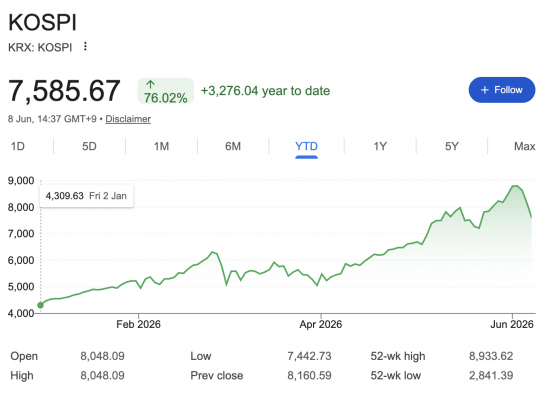
The simultaneous possibility of a major financial crisis, spurred by the end of AI hype, coupled with a real-world crisis driven by oil, energy, food, and other raw material price increases resulting from Trump's reckless war, is now more likely than ever.
I have been predicting this for some time.
Now the reality is appearing.
Right now, there are no signs that this will end well.
Thanks for reading this post.
You can share this post on social media of your choice by clicking these icons:
There are links to this blog's glossary in the above post that explain technical terms used in it. Follow them for more explanations.
You can subscribe to this blog's daily email here.
And if you would like to support this blog you can, here:

 Buy me a coffee!

I have two young people finishing their degrees at the moment and you are right – it is rather hard out there for sure. And people are being more cautious about retiring – going later rather than when they need to which does not help either.
In terms of fuel & cars, speeds on motorways have declined. Most cars now tootle along somewhat below the legal limit. There seems to be an absence of fast moving stuff in the fast lane. I suspect that banditry in the form of (tax?) revenue from speed cameras has likewise declined. Of course, this is all precursor stuff, be interesting to see what happens when things really kick-off.
Interesting
I would like to know what the rise in tax revenue is for the Government from the rise in fuel prices. They must be hauling it in!
Yes, but not massively. There will be n increase, but in the grand scheme of things, not that much, yet.
I doubt there will be a stock market crash yet. With the exception of Tesla, the companies making up the bulk of the Nasdaq 100 index have reasonable valuations. E.g Nvidia price/earnings is 31. Two or three percent falls are common after weeks of large gains and don’t necessarily mean a crash is about to happen. A lot of money will flow into spacex over the next 4 weeks – we could worry about that because it will likely have a very high valuation without ever having mad a profit.
I know no one with sense who agrees with you.
Demand destruction is the real economic killer.
And some think deflation will be the real problem, not inflation:
https://substack.com/@theuaob/p-193732692
As someone who has predicted 5 of the last 2 crashes I am cautious in calling “the top”…… but it really feels like it this time.
It does to me…
But the FTSE disagrees
One thing I have been a little curious about is related to the looming price rises due to higher energy costs. It was just over four years ago now that oil prices spiked to $140/b and natural gas prices surged by, I believed, something like 500% in Europe. These were brief price shocks, though it did take some time for prices to fully drop back to a “normal” range. Combined with post-COVID supply disruptions, this sparked a roughly two year surge in inflation pretty much everywhere, with companies raising prices well beyond what was necessary when you look at the record profits they were posting.
So my question is why they would need to raise prices even higher, for much less severe energy price rises (so far, I know it’s likely to get worse). Should they not be somewhat insulated from the price shock given the measures taken in 2022? Shouldn’t these businesses now be acclimated to higher input costs? I don’t believe they’ve been lowering their prices or higher if more staff over the past two years of “normal” costs.
Of course I know the answer is they will take every opportunity to boost profits, and there are genuine shortages this time. I would like the media to put a little more pressure on businesses to explain why they must raise prices yet again though. It’s just accepted that the people to lose out are consumers. Why can’t businesses take a hit this time? Maybe they post year on year contraction in profits (still posting profit at all). It just always needs to grow, even when doing so will take us further down the road to ruin…
Gary Marcus wrote this piece on Friday following stock market falls in the US, suggesting the AI bubble collapse has started and OpenAI are now actively talking to the US Government about a bailout:
https://garymarcus.substack.com/p/ais-black-friday
This could prove to be a pivotal week.
What is there to bail out? The business model is broken; they can’t sell anything that people can use at a price it’s worth using at. I genuinely don’t understand what is worth bailing out. Like the Dot Com bubble companies, they will leave behind things people can use, LLM’s that people can put to use for specific tasks, but in their current form, the AI companies are unsustainable.