
In this my second post on yesterday's report by Lord Alan Milburn for the government on young people Not in Employment, Education or Training (NEETs)
The first is here.
In this post, I argue that, based on data analysis, the government is misconstyruing the employment problem for young people.
In a third post, to come, I will ask why they might be doing that.
The publication this week of Alan Milburn's interim report on young people and work has generated the usual wave of apparent alarm in our media in reaction to the claim that there are nearly one million young people not in education, employment or training (NEET) at present.
This, it is said, creates a next generation which is at risk. It is claimed that this is a national crisis. And the government, we are being told, must act now.
I have heard all that, but I have to say my immediate, instinctive reaction to the claims was that none of them made much sense, at least in a historical context where what is being claimed to be exceptional actually appears to be normal and unexceptional.
As a result, I have been working through the underlying data on this issue, building up a picture from first principles. And while I do not, in any way, want to minimise the real difficulties facing many young people, I think the NEET framing that Labour appears to have chosen to focus upon misleads more than it illuminates. The numbers, if read properly, do, in my opinion, tell a rather different story that points to the need to address a quite different set of policy priorities. The real question is not, then, just why there is a NEET problem, but why is this the particular issue Labour is choosing to highlight when there might be bigger ones requiring attention?
Let me explain what I did and what I found.
What I did and how
The starting point for what I have done was Milburn's report, which contains a chart (its Figure 1) showing the UK NEET rate for 16 to 24-year-olds from 2001 to 2025, drawn from the Labour Force Survey. I extracted the key data points cited in the text and reconstructed the annual series.
Chart 1: UK NEET rate, 16–24 year olds, 2000–2025
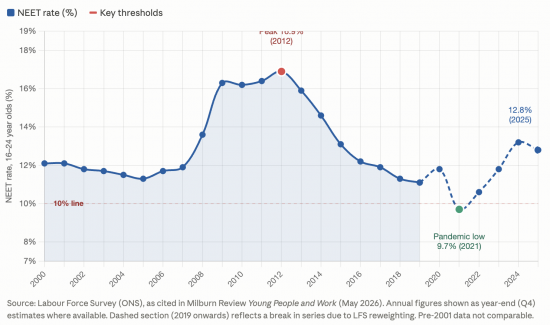
The first thing that struck me was how persistent this NEET rate has been at or about current levels, although it peaked in the aftermath of the financial crisis at 16.9% in 2012. Then the pandemic produced a misleading dip because furlough artificially suppressed unemployment, and not because more young people were in work or learning. But aside from those two distortions, the rate has moved within a remarkably narrow band. For most of the past twenty-five years, it has sat between 11% and 13%. Today it is at around 12.8% if Office for National Statistics data on this issue is right, which, even they admit, is a massive assumption to make, given how unreliable their employment data has been in recent years. We do not, then, have a current crisis in any meaningful sense of that word. Nor is there any significant upward trend in this data that can be meaningfully extrapolated from recent very short-run variations, although that is what reports are suggesting. The current NEET rate is, in fact, close to the long-run norm.
The population behind the rate
My curiosity, however, was not satisfied by discovering this. To understand what the NEET rate actually means in terms of people, you need to know how many 16 to 24-year-olds there are. So the next step was to plot the size of that cohort to help understand trends within it.
Chart 2: UK population aged 16–24, 2000–2025

The cohort peaked in 2012, the same year the NEET rate peaked. The two events are, of course, related. High levels of young people in the population inevitably lead to a high NEET rate. Any policy will always impact this group first if they are disproportionately large in the population as a whole.
Since then, the number in this group has fallen and then partially risen again, but not to its former high levels.
Going back to births
To understand this, I went back to the UK live births series, which runs from 1976.
Chart 3: UK births 1976 to 2025

The pattern here is striking. The baby boom of the late 1980s and early 1990s fed through into a large 16 to 24-year-old cohort in the 2000s and early 2010s, giving rise to the 2012 peak seen in previous charts. A second surge in births during the mid-2000s through to 2012 produced the cohort that is now working its way through the 16 to 24 bracket and will continue to do so until the late 2020s. After 2012, births fell sharply and have continued falling. The provisional 2025 figure, at around 662,000 for the UK, is the lowest since records began in 1976. The total fertility rate in England and Wales has fallen to 1.39 — a record low, and well below the 2.1 replacement level.
Predicting the 16 to 24-year-old population from births
Because the relationship between births and the 16 to 24 age group is mechanically simple, because you just sum the birth cohorts from sixteen to twenty-four years earlier, the birth data gives us a near-certain forecast of how large the youth cohort will be in the coming years. Assuming no deaths (which is a reasonable approximation for this age group, where mortality rates are low) we get this chart, in which I comapre forecast and actual data plus NEET trends, using a right hand axis for NEET data.
Chart 4: Predicted 16–24 population from births (+ 1m migration) vs ONS actual, 2000–2025
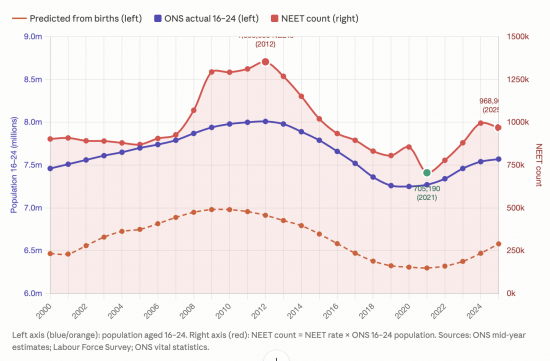
The forecast and actual data track each other well. The actual data closely predicts the NEET rate in actual number terms.
The consistent migration effect should be noted: over the whole period, there are around 1 million more young people than births predicted. They came to the UK as children or young people. There is no broad change in that figure over the whole period.
This then let me forecast, using the birth-based prediction plus the one million uplift trends in population in coming years, plus likely NEET rates. This chart of the 16 to 24 population and the NEET count, both actual to 2025 and forecast to 2035, gives us the clearest view of where we are heading.
Chart 5: 16–24 population and NEET count, actual 2000–2025, forecast 2026–2035
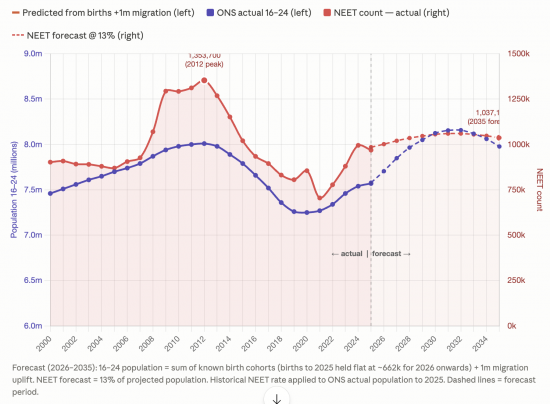
The forecast is built on a simple and transparent assumption: that the NEET rate stays flat at its current level of around 13%, which is also a consistent data point throughout the period looked at. Apply that to the projected population, and you get the forecast NEET count.
What does this data show?
The forecast shows that the number of NEETs will rise for a few more years, but not because the rate or issue is worsening, but because the cohort is growing as the larger birth years of 2008 to 2014 move through the 16 to 24 window. But the rise is modest, and it goes into reverse from around 2030 as those cohorts age out and are replaced by the much smaller birth cohorts of the early 2020s. By the mid-2030s the 16 to 24 population will be falling, and with it, at a constant rate, the absolute number of NEETs.
So is there really a crisis?
Let me be clear about what this analysis does and does not show.
It does not show that the situation facing young people in Britain is comfortable or acceptable. A NEET rate of 12 to 13%, meaning one in eight young people are outside education, employment and training, is not something to be relaxed about.
The Milburn report is right that too many of those young people are experiencing health-related inactivity, that the system fails them, and that the structural problems are real, although, as I have noted this morning, it does not point out that UK youth unemployment is also a deliberate feature of UK monetary policy that the Bank of England is tasked with delivering.
But the framing of an escalating crisis in NEET numbers does not withstand close demographic scrutiny. The rate is not rising significantly. The absolute numbers will rise for a few years simply because the cohort is growing, but that is a mechanical demographic effect, not a policy failure. And by the 2030s, as the low-birth cohorts of the early 2020s come of age, the numbers will fall back regardless of what policy does.
If we are looking for a genuine, structural, worsening problem for young people in Britain, I would suggest that this data shows that we are looking in the wrong place.
The real issue: insecurity within work
The NEET measure captures only those outside education, employment and training. It says nothing about the quality of the employment that young people do manage to find. And here the picture is genuinely alarming.
Young workers in Britain are disproportionately concentrated in the sectors and contracts that offer the least security: zero-hours arrangements, gig economy platforms, short-term agency work, part-time roles that cannot sustain independent living.
At the same time, the collapse in apprenticeship starts, which are down by more than 40% according to the Milburn report, means fewer young people are entering structured, skill-building employment of the kind that historically provided a ladder.
The traditional Saturday job in retail and hospitality that provided work experience has also largely disappeared, and many entry-level roles have been automated or made conditional on experience that a young person cannot by definition already have.
As the Milburn report notes, it is striking that nearly 30% of NEETs have good GCSEs or higher qualifications. The issue is that the labour market is failing to absorb them, and not that they lack credentials. It is not their fault that the structure of the employment market has changed. Good qualifications now offer less protection against insecure, low-wage, zero-hours work than they once did.
What we face, in other words, is not primarily a NEET crisis. We face a youth employment quality crisis. We face a situation where being nominally in employment provides far less security, income, skill development and progression than it once did. That is not captured in the NEET statistics at all. A young person on a zero-hours contract in a warehouse, earning too little to afford their own home and with no prospect of advancement, is counted as employed. They do not appear in the NEET numbers. But their situation is arguably worse by being more invisible, and simultaneously more structurally entrenched, than someone who is NEET and at least visible to the support system.
What the government should really be asking
The Milburn review is not wrong to document the failure of health services, welfare systems and education pathways to support young people into participation. Those failures are real and documented. But by framing the entire exercise around the NEET measure, there is a risk that the policy response focuses on moving young people off the NEET count rather than improving the actual quality of their lives, and both matter.
The questions that deserve more urgency are these:
- Why has the youth share of the labour market declined even as overall employment increased?
- Why have apprenticeship starts collapsed?
- Why are so many entry-level roles now accessed through automated recruitment systems that screen out inexperienced young workers before any human has looked at them?
- Why has the housing market made financial independence impossible for most young workers in high-demand areas?
- And why are the forms of employment most available to young people, such as gig work, zero-hours contracts, and agency work, precisely those that offer the least protection, the least skill development and the least pathway to security?
These are questions about the structure of the labour market itself. They require answers that go well beyond the welfare, health and education reforms that Milburn's diagnosis, however accurate, tends to suggest.
They require thinking about:
- labour market regulation,
- employer incentives,
- the role of trade unions in sectors where young people actually work, and
- the relationship between housing costs and the viability of low-wage employment.
The NEET numbers will largely take care of themselves as the demography shifts, as I show. In that case, to focus on this issue alone is a distraction. The insecurity that young workers face within employment will not be going away anytime soon, and it is on that issue that focus is really required.
Methodology
This analysis was produced using publicly available data from the Office for National Statistics, the Labour Force Survey, and the Milburn interim report on Young People and Work (May 2026).
The charts described in this piece were produced from ONS vital statistics, mid-year population estimates and Labour Force Survey NEET data. All projections use known birth cohort data to 2025 with post-2025 births held at the 2025 provisional figure of approximately 662,000, plus a one million migration uplift applied to reflect the consistent immigration effect observed in the 16–24 ONS population series. The NEET forecast applies a flat 13% rate — approximately the current level — to the projected population. No mortality adjustment is made, as child and young adult mortality rates in the UK are sufficiently low that their exclusion does not materially affect the projection.
Claude AI was used ot assist data presentation used here.
Thanks for reading this post.
You can share this post on social media of your choice by clicking these icons:
There are links to this blog's glossary in the above post that explain technical terms used in it. Follow them for more explanations.
You can subscribe to this blog's daily email here.
And if you would like to support this blog you can, here:

 Buy me a coffee!

Brilliant analysis Richard. And it totally echoes what I see of decent young people working hard in insecure poor quality jobs. I have to ask why no-one else looked at birthrates etc. to see why numbers go up and down? I’m working in education and we are given birth rate data to predict our intakes and numbers are falling sharply and not recovering post Covid with economic reasons suspected.
Once again data is being cited but the wrong questions are being asked. It’s no wonder the Green Party is doing so well in the younger adult age groups, because they are the only party talking about insecure employment and housing and it’s impact on quality of life.
Thank you
It seemed onbious to me
But then, I have been in education
I think my own life experience is a reflection of this situation. So please indulge me.
I left my native South Africa in 1961 with a very ordinary science degree having been granted a two year graduate apprenticeship in a big engineering firm in Manchester. It was all expenses paid plus a living weekly wage. That experience and training has formed the basis of my life ever since including an MBE for services to the community. This was an entry into adult life shared by many young people at that time. Trade and graduate apprenticeships were the norm.
Fast forward to 1981 and at the end of my first year as a school teacher I asked my leaving class what jobs they were going to. One out of twenty five was going into the army and a girl was losing her Saturday job. The rest were facing unemployment. In twenty years of teaching in inner city schools the situation didn’t change much.
That gives some indication of the scale of the problem I hope.
Thanks
Thank you for this analysis, Richard, a clear explanation of what might be called “The Demographic Time Bomb.” For the last 30-odd years, I have spent my days in helping “Baby Boomers” save and prepare for “retirement” – the vast majority do live to see this – by arranging pensions, long-term investments, and so on. Over the last two or three years, there has been an explosion of people wanting to set up retirement benefits, a process that is gathering quite a momentum. Indeed, in our small IFA practice we have arranged “retirement packages” for 30+ people in the last six months alone. I’m at the end of the “Baby Boomer” cohort and over the next few years those left still working (and actually believe in “retirement”) will hang up their hats.
Then they will start dying off. So, I believe that changing demographics will profoundly change society sooner than many seem to think. In my small village in Somerset of about 1,800 people, there are already 8-10 empty properties (a scandal), and we know several people in their 80s and 90s rattling around in too much house whose hour glass is naturally running low. These properties are full off ‘stuff’ that no-one wants, too.
Perhaps, then, this issue will slowly evaporate as nature takes its course – with falling property prices, increased job vacancies, and, hopefully, a far better outlook for the young.
You may be right
The egg timer of life eventually runs through for all of us
Mark, I’m not sure that the implications in a baby-boomer Somerset village will be quite the same as for the very different age, employment, pension, housing and income profiles of a S Bristol coucil housing estate.
My neighbours are unlikely to be willing to wait for the Grim Reaper to see them through to the “slow evaporation” of the “problem”. They may do what they did 30 years ago (my choice of newspaper is deliberate)
https://thebristolcable.org/2022/07/30-years-since-the-hartcliffe-riots/
and will no doubt get similar treatment from the media, the PM and Home Secretary. Ex-DPP Starmer has form on riots. Reform UK Ltd will be rubbing their hands in anticipation and doing everything they can to stoke the flames. But the fuel has been provided by 40 years of right-wing neoliberalism and a fair dose of intellectual left-wing arrogance – a pattern that is being repeated again today across the country, but thankfully, not by FTF.
Your analysis is greatly to be applauded. However, I am sceptical about the data because the ONS treat a person as employed if they work just one hour in a reference week. Furthermore, they ask only 90,000 people then extrapolate that over the entire workforce.
Pity the government didn’t commission you to do the report instead of Alan Millburn.
I stress, ONS data is a limit here – and say so
I have not read the other posts – just stopping by on my lunch break. I’m glad to see Milburn challenged. It seems to me that this manufactured crisis is being used to justify moving money around from other groups (disablement/illness support) to something ‘more acceptable’ – people looking for work etc. This avoids ‘new money’ having to be found and sticking to fiscal ‘fools’.
The underlying issue for me too is long term – it is that we still think it acceptable to have a pool of redundant people controlling the cost of labour. And we are just not investing enough in the country which would generate a lot more jobs for all generations. Great work Richard.
Thank you
Dusting off my MCA Survival at Sea Certificate and working in a few comments I have already made today and a few new ideas.
I mentioned Blairs Policy Task Forces so how about one whose job it is to make sure as far as possible that children and young people get through school and education/training and into ‘tenured’ and reasonably paid employment and secure housing of their own?
Not quite cradle to the grave but cradle to first home.
Anything less shows a decided lack of ambition.
I was talking to an old (mid 90’s) man I know. Back in the 60’s (19 not 18) he wanted to move. Went to the Job Centre or whatever it was called in those days – he had a skilled trade and within a week or so they found him a job over a hundred miles away and off he went.
Similarly I have talked to old Job Centre staff about the work they did helping people not only the unemployed either into work or to change jobs.
We need JC staff who know employers and what they want and who can then put suitable candidates forward
Much to agree with
Thanks Richard. I enjoyed this post. I suspect you enjoyed creating it! I do like numbers. They don’t lie. People use numbers to lie though, or, as you say, distract.
Which leaves me wondering why this report, and why now. And I pray I’m wrong, but this could be used to justify a massive recruitment drive for the military and/or the return of national service. The Bliars of this world (&bored of peace etc) really seem to want a war. I hate these government reports.
I think it is to distract from the neoliberal failure of the Bank of England and fiscal rules and to deliver a pathway to reducing social securoty – the Tony Blair goal
A friend on social media today says just the same thing. It may be coincidental but the forces at work need a new cohort for their armed forces expansion to deal with their intended war with Russia.
It is a frightening time.
Some good points. Yes we need to look at the poor quality of jobs which are available to younger people. Gig work, zero-hours contracts, and agency work are not good either in the short term of as stepping stones. These jobs also make it very difficult for young people to save, rent or think about home ownership. Its a dismal situation.
Some years ago I started writing down a list of ‘all the jobs I’ve ever had’– since I was about 16. The first one on the list is quite bizarre, I admit, but in those days.. it was as an announcer on the Tannoy system about the names of children lost on Aberavon Beach, (that’s in Port Talbot) and to re-unite them with their parents. I then had to give everybody ‘tea and biscuits’ and smile a lot as most (all) situations were resolved happily.! Apart from that I did learn how to talk (actually, listen) to people from a different social background to myself. I must now admit that I only got the job because my father knew someone… I now have three grand daughters in the age range you describe , so what can I advise? The aforementioned ‘list’ of jobs is quite long, as I can imagine it is for many of my generation, ranging from waitressing at posh wedding receptions to supply teaching and now finally ending up as a self-employed sheep farmer (Sorry, Richard, I know you don’t approve of us!). I am a generation above you , so I don’t have quite so much time to sort things out.
I eat lamb
Oddly I was doing such a list today….same reason
Ann, Lovely to hear your story. I am probably the same era as you but still working.
My first job was washing up in a beach cafe in north Wales, a half mile walk each end and two bus rides from home.
I am also going to make a list of all my jobs. Some of them could be done by AI but would be a huge loss of human contact, particularly my years in hotel receptions and restaurants.
As a single parent, blessed to be living in a country where council housing and benefits were available without being made to feel a leech, I fell into my perfect career through a badly worded advertisement for a newspaper reporter. I now campaign for restoration of the NHS and a return of publicly-funded, -run and -accountable public services, from health to education, housing, security, transport, water etc.
The Social Determinants of Health were critical then, and remain so, but our government(s) have been (in the same way they are working for Israel, at the behest of the USA) steering Britain away from that very obvious set of principles to make the country as healthy, content and prosperous as it can be.
https://www.health.org.uk/topics/wider-determinants-of-health?gad_source=1&gad_campaignid=13881943804&gbraid=0AAAAADunFmTukgzeLG6VGel33M3OdLwsY&gclid=EAIaIQobChMIt8OO0o3jlAMVh5VQBh2ZaBH2EAAYASAAEgJ1Q_D_BwE
Thank you, and good luck
I haven’t read Milburn’s report in full yet, but I was impressed by his section on early years care and the need to support families so that all children can have the chance of a good start to a good education. Also his suggestion that widespread failures in housing, healthcare, social care and education all have a part to play in the difficulties faced by many young people.young people.
As far as apprenticeships go, I think part of the problem came from changes in how apprenticeships work, from opening them up so that they were available to anyone of any age and level of workplace skills to allowing the employer to provide all the training. I noticed a huge increase in HR professionals gaining level 7 qualifications through the apprenticeship route. I am happy that older people can gain training and skills, but not at the cost to young people that arose from it. I also take part in a small business forum and there was a noticeable increase in the number of 1-person businesses deciding that they needed help with their workload and so were intending to take on an apprentice as they could not afford an employee! and an increase in the number of employers wanting advice on how to dismiss an apprentice as they were not generating enough income.
My problem is with the goal
It is to make people cogs in the machine
It is, but I think, for many people being cogs in the machine is what they are comfortable with. A we are unlikely to change the machine in the short term the emphasis should be on ensuring that those who are not comfortable with being cogs are able to find their own place.
Agreed
[…] Alan Milburn's concern, reported this week, about young people who are not in employment, education or training. The issue he identifies is […]